史湘雲 · 最愛笑的女孩,最後卻哭得最慘 Shi Xiangyun, the Girl Who Loved to Laugh Most, Yet Wept Most Bitterly in the End Shi Xiangyun, the Girl Who Loved to Laugh Most, Yet Wept Most Bitterly in the End 史湘雲 · 最愛笑的女孩,最後卻哭得最慘
中篇小說(116) Novella (116)
中文全文 Ch-full 中文介紹 Ch-intro 繁體/簡體 TC/SC 英文全文 Eng-full 英文介紹 Eng-intro
如果說林黛玉像一場春雨,晴雯像一團烈火,那麼史湘雲,大概就是大觀園裡的一股清風。她的出現,總會帶來笑語歡聲。
別的姑娘說話,都是輕聲細語,小心翼翼。只有她不同。她說話聲音大, 笑起來更大聲。 她喝酒時絕不矜持, 要喝必是痛飲。高興時甚至學男人模樣,穿起男裝,滿園亂跑。她不像一般的深閨小姐,倒像個誤闖進大觀園的少年郎。
所以很多人第一次讀《紅樓夢》,都以為史湘雲是紅樓夢裡最快樂的女子。可曹雪芹筆下最狠的地方就在這裡。他偏偏讓最愛笑的人,最後變成哭得比誰都慘的人。
在《紅樓夢》中,史湘雲是賈母的親侄孫女。賈母是史湘雲的姑奶奶。 史湘雲的祖父是賈母(史太君)的親兄弟。她和寶玉是青梅竹馬的姑表兄妹。
湘雲幼年父母雙亡,曾長年跟隨賈母在賈府生活,由大丫鬟襲人照料(襲人後來才被派去服侍寶玉),因此她和寶玉兩人從小一起長大,性格投契,是無話不談的最佳玩伴。
史湘雲也是個命苦的女孩, 在襁褓中即父母雙亡,
她雖然出身史家,也算是侯門小姐,可真正的日子,卻並不好過。在《紅樓夢》第三十二回中,薛寶釵向襲人透露了史湘雲在家的真實處境:史家如今家道中落、經濟拮据,家裡連做針線活的奴僕都裁撤了,身為千金小姐的湘雲每天要起早貪黑地做女紅,十分勞累。
如果說林黛玉像一場春雨,晴雯像一團烈火,那麼史湘雲,大概就是大觀園裡的一股清風。她的出現,總會帶來笑語歡聲。
別的姑娘說話,都是輕聲細語,小心翼翼。只有她不同。她說話聲音大, 笑起來更大聲。 她喝酒時絕不矜持, 要喝必是痛飲。高興時甚至學男人模樣,穿起男裝,滿園亂跑。她不像一般的深閨小姐,倒像個誤闖進大觀園的少年郎。
所以很多人第一次讀《紅樓夢》,都以為史湘雲是紅樓夢裡最快樂的女子。可曹雪芹筆下最狠的地方就在這裡。他偏偏讓最愛笑的人,最後變成哭得比誰都慘的人。
在《紅樓夢》中,史湘雲是賈母的親侄孫女。賈母是史湘雲的姑奶奶。 史湘雲的祖父是賈母(史太君)的親兄弟。她和寶玉是青梅竹馬的姑表兄妹。
湘雲幼年父母雙亡,曾長年跟隨賈母在賈府生活,由賈母的丫鬟們照料,因此她和寶玉兩人從小一起長大,性格投契,是無話不談的兒時玩伴。
史湘雲也是個命苦的女孩, 她雖然出身史家,也算是侯門小姐,可真正的日子,卻並不好過。在《紅樓夢》第三十二回中,薛寶釵向襲人透露了史湘雲在家的真實處境:史家如今家道中落、經濟拮据,家裡連做針線活的奴僕都裁撤了,身為千金小姐的湘雲每天要起早貪黑地做女紅,十分勞累。
可奇怪的是,她竟沒有因此變得陰沉。她還是性格爽朗, 愛說愛笑。這也是史湘雲最讓人心疼的地方。
她不像黛玉那樣,把傷心寫在臉上;她總是把眼淚藏起來,再用笑臉面對世界, 把歡笑帶給別人。
因為疼惜這個從小就失去父母的姪孫女, 賈母曾將史湘雲接到賈府,放在身邊扶養。 所以, 她和這個姪孫女之間, 比其他賈府孫輩,多了一層祖孫之情。
史湘雲第一次進賈府時,年紀還小,穿著一身男孩衣服,英氣勃勃,連寶玉都看得發怔。賈母極疼她,除了對她幼年失去父母的憐憫, 還因為她身上有一種難得的熱鬧氣。那時的賈府、大觀園,已隱隱籠罩著幾分衰敗的陰霾。史湘雲的到來, 好像把那股陰霾衝散很多。
進了大觀園以後, 她沒有收斂, 也沒有改變, 別人都對多愁善感的黛玉避讓幾分, 她卻經常和黛玉鬥嘴。
黛玉嘴尖,湘雲嘴快,兩人三天兩頭拌嘴。可奇怪的是,她們之間好像與別人不同, 雖然鬥嘴厲害, 可是轉眼又好得像一個人。她不像寶釵那樣處處讓著黛玉,也不像別人那樣怕黛玉的小性兒。她是真拿黛玉當自己人。
而寶玉,也極喜歡湘雲。
但那種喜歡,和對黛玉不同。黛玉像寶玉心口上的傷,一碰就疼;湘雲卻像一壇醇香好酒,能讓人痛飲, 寶玉喜歡湘雲的就是這一點 , 和她相處, 不必小心翼翼, 唯恐說錯了話得罪誰, 可以暢所欲言, 無拘無束。
史湘雲和寶玉一起喝酒,一起說笑,一起胡鬧。湘雲是極少數敢直接勸寶玉「學些仕途經濟」的人。別人一說這話,寶玉立刻翻臉,可湘雲說了,他卻只是笑著罵一句:「你也成了那些祿蠹了。」
因為寶玉知道,湘雲勸他不是為了功名。她只是希望他將來能活下去。這種感情,其實更深, 寶玉懂。
可真正讓寶玉記住湘雲一生的,或許還不只是這些。而是那年中秋夜。那時眾人聯詩,月光如水,夜色清寒。湘雲忽然吟出一句:
「寒塘渡鶴影。」
這句一出口,連黛玉都怔住了,因為這句詩,太冷,冷得不像湘雲為人。她平日總像一團火,熱烈, 開朗,可忽然之間,卻說出這樣淒清的一句詩,彷彿露出了她心靈裡那隱藏很深的一角。
黛玉接了一句:
「冷月葬花魂。」
這兩句放在一起,竟像極了兩個人的一生寫照。後來很多人都說,《紅樓夢》裡最美的聯句,就是這兩句。但可怕的是,這兩句詩,不僅是美,竟成了兩人最終命運的預言。
黛玉真的死了,而湘雲,也終究沒能逃掉悲慘的命運。
湘雲後來嫁了人,嫁給了才貌雙全的衛若蘭。人人都以為,她總算有了個好結局。畢竟湘雲不像黛玉那樣多病,也不像迎春那樣懦弱,更不像晴雯那樣鋒利。她似乎比所有女孩,都更能活。
然而命運捉弄人, 史湘雲這段姻緣極為短暫,衛若蘭很快便因故早逝,留下湘雲獨自守寡。 後來隨著四大家族(賈、史、王、薛)相繼衰敗,湘雲的叔父家也敗落了,名門閨秀竟淪落到靠做女紅針線維生。甚至有紅學版本探佚,認為她曾不幸流落至風塵,淪為船妓, 此說見於部分紅學探佚資料,筆者僅據實錄之,無法考證真偽。
看來曹雪芹筆下的《紅樓夢》,從不肯放過誰。那個曾經在芍藥花下醉眠、大笑、喝酒的瀟灑女孩,忽然變成寡婦。而且隨著家道敗落,一下子,就把她整個人生都打碎了。
更可怕的是,那時賈府也敗了。大觀園散了。老太太死了,寶玉瘋了,寶釵守著空房,襲人嫁了人,紫鵑出了家。那些曾經日日在一起吟詩作對、看花聽雨的少女,一個個,全被命運沖的七零八散。
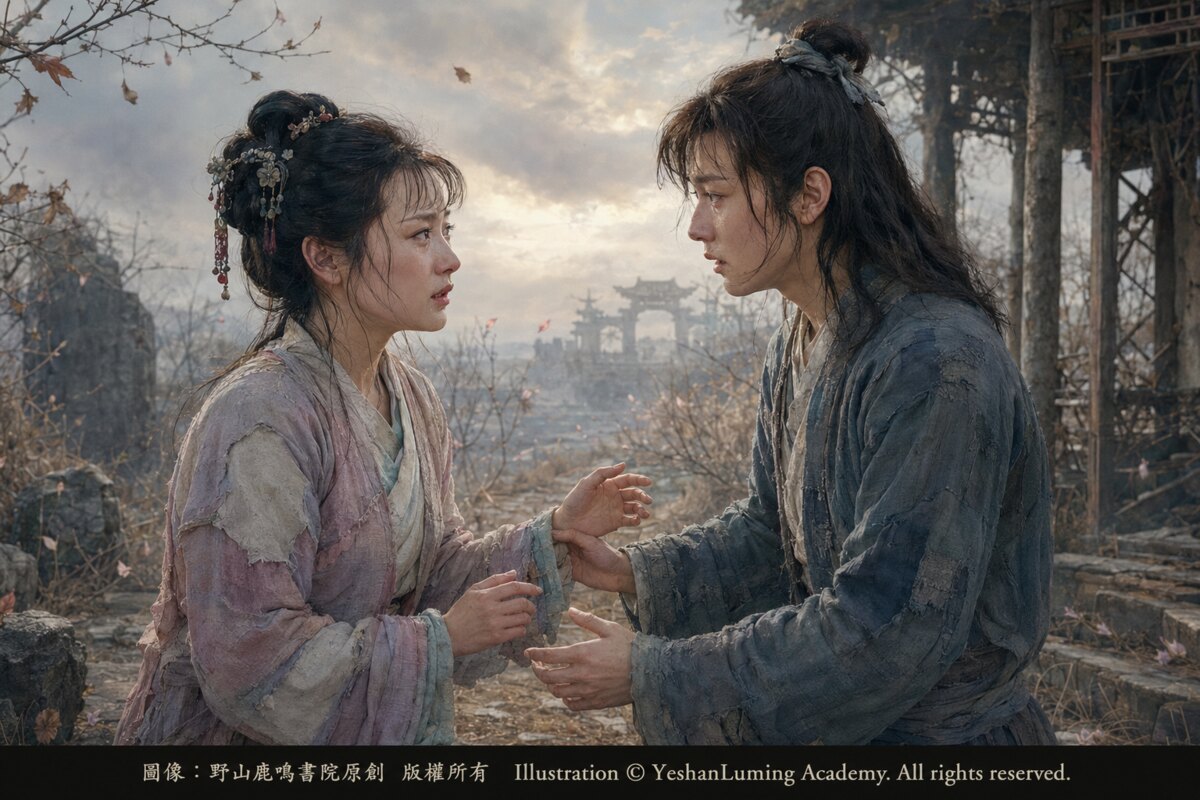
有人說,她後來與落難的寶玉有過重逢。那時兩人都已不是少年,沒有了大觀園,沒有了詩社,沒有了錦衣玉食,只剩兩個被命運折磨得滿身傷痕, 飽經風霜,歷盡滄桑的人。
在家族徹底敗落、流離失所後,淪落為乞丐的寶玉(或出家前的遊蕩),與孤苦伶仃的湘雲意外重逢,兩人都經歷了人世間的滄桑變革,相見時憶起當年的一切,不禁極度傷感、悲痛。
圖像:野山鹿鳴書院原創 版權所有 Illustration © YeshanLuming Academy. All rights reserved. 點擊查看大圖
If Lin Daiyu was like a spring rain, and Qingwen like a blazing fire, then Shi Xiangyun was probably a fresh breeze blowing through the Grand View Garden. Whenever she appeared, laughter and cheerful voices followed.
Other young women spoke softly and carefully, always cautious in manner. Only she was different. Her voice was loud, and when she laughed, she laughed even louder. When she drank, she never pretended to be delicate; if she drank, she drank heartily. When she was happy, she would even imitate men, put on men’s clothes, and run about wildly through the garden. She did not seem like an ordinary young lady raised in seclusion, but rather like a spirited young boy who had wandered into the Grand View Garden by mistake.
That is why many people, when they first read Dream of the Red Chamber, think Shi Xiangyun is the happiest young woman in the novel. But the cruelest part of Cao Xueqin’s writing lies precisely here. He insists on turning the person who loved to laugh most into the one who, in the end, cried more bitterly than anyone else.
In Dream of the Red Chamber, Shi Xiangyun is Grandmother Jia’s grandniece. Grandmother Jia is Xiangyun’s grandaunt. Shi Xiangyun’s grandfather was the blood brother of Grandmother Jia, Lady Shi. She and Baoyu were maternal cousins who had known each other since childhood.
Xiangyun lost both parents when she was very young. For many years, she lived in the Jia household under Grandmother Jia’s care, looked after by Grandmother Jia’s maids. Because of this, she and Baoyu grew up together. Their temperaments suited each other, and they became childhood companions who could speak of anything.
If Lin Daiyu was like a spring rain, and Qingwen like a blazing fire, then Shi Xiangyun was probably a fresh breeze blowing through the Grand View Garden. Whenever she appeared, laughter and cheerful voices followed.
Other young women spoke softly and carefully, always cautious in manner. Only she was different. Her voice was loud, and when she laughed, she laughed even louder. When she drank, she never pretended to be delicate; if she drank, she drank heartily. When she was happy, she would even imitate men, put on men’s clothes, and run about wildly through the garden. She did not seem like an ordinary young lady raised in seclusion, but rather like a spirited young boy who had wandered into the Grand View Garden by mistake.
That is why many people, when they first read Dream of the Red Chamber, think Shi Xiangyun is the happiest young woman in the novel. But the cruelest part of Cao Xueqin’s writing lies precisely here. He insists on turning the person who loved to laugh most into the one who, in the end, cried more bitterly than anyone else.
In Dream of the Red Chamber, Shi Xiangyun is Grandmother Jia’s grandniece. Grandmother Jia is Xiangyun’s grandaunt. Shi Xiangyun’s grandfather was the blood brother of Grandmother Jia, Lady Shi. She and Baoyu were maternal cousins who had known each other since childhood.
Xiangyun lost both parents when she was very young. For many years, she lived in the Jia household under Grandmother Jia’s care, looked after by Grandmother Jia’s maids. Because of this, she and Baoyu grew up together. Their temperaments suited each other, and they became childhood companions who could speak of anything.
Shi Xiangyun was also a girl with a bitter fate. Although she came from the Shi family and could be counted as a young lady of a noble house, her actual life was far from easy. In Chapter Thirty-Two of Dream of the Red Chamber, Xue Baochai reveals to Xiren the true situation Xiangyun faced at home: the Shi family had declined, money was tight, and even the servants who did needlework had been dismissed. Xiangyun, though a young lady of rank, had to rise early and work late every day at women’s sewing, exhausting herself.
Yet strangely, she did not become gloomy because of it. She remained open-hearted, cheerful, fond of talking and laughing. This is what makes Shi Xiangyun so heartbreaking.
Unlike Daiyu, she did not write her sorrow across her face. She always hid her tears away, then faced the world with a smile, bringing laughter to others.
Because Grandmother Jia felt pity for this grandniece who had lost her parents so young, she once brought Shi Xiangyun into the Jia household and kept her by her side. Therefore, between Grandmother Jia and this grandniece, there was an extra layer of grandparental affection, deeper than what she felt for many of the other younger members of the Jia family.
When Shi Xiangyun first came to the Jia household, she was still young and wore a set of boy’s clothes. She looked so spirited and heroic that even Baoyu stared at her in a daze. Grandmother Jia loved her dearly, not only because she pitied Xiangyun for losing her parents in childhood, but also because Xiangyun carried a rare liveliness within her. At that time, the Jia household and the Grand View Garden were already faintly shrouded in the shadow of decline. Xiangyun’s arrival seemed to scatter much of that gloom.
After entering the Grand View Garden, she did not restrain herself, nor did she change. Others gave way to the melancholy and sensitive Daiyu to some degree, but Xiangyun often quarreled with her.
Daiyu had a sharp tongue; Xiangyun had a quick one. The two bickered every few days. Yet strangely, their relationship seemed different from everyone else’s. However fiercely they argued, in the blink of an eye they would be as close as one person again. Xiangyun was not like Baochai, who yielded to Daiyu at every turn, nor like others who feared Daiyu’s touchy temperament. She truly treated Daiyu as one of her own.
And Baoyu, too, loved Xiangyun very much.
But that affection was different from what he felt for Daiyu. Daiyu was like a wound on Baoyu’s heart; the slightest touch caused pain. Xiangyun, by contrast, was like a jar of rich, fragrant wine, something one could drink from heartily. This was exactly what Baoyu liked about Xiangyun. With her, he did not have to tread carefully, afraid that one wrong word might offend someone. He could speak freely and live without restraint.
Shi Xiangyun drank with Baoyu, joked with him, and joined him in mischief. She was one of the very few people who dared directly advise Baoyu to “learn something of official career and worldly economy.” Whenever anyone else said this, Baoyu immediately turned angry. But when Xiangyun said it, he merely laughed and scolded her: “So you have become one of those career worms too.”
Because Baoyu knew that Xiangyun did not urge him for the sake of fame and rank. She only hoped that he would be able to survive in the future. That feeling was, in truth, even deeper. Baoyu understood.
Yet what truly made Baoyu remember Xiangyun for the rest of his life may not have been only these things. It may have been that Mid-Autumn night. The company was composing linked verses. The moonlight was like water, and the night air was cold and clear. Suddenly, Xiangyun recited one line:
“The shadow of a crane crosses the cold pond.”
The moment this line came out, even Daiyu was startled, because it was too cold—so cold it did not seem like Xiangyun at all. In daily life, she always seemed like a ball of fire, warm, intense, and open-hearted. Yet all at once, she uttered such a desolate line, as if revealing a deeply hidden corner of her soul.
Daiyu answered with another line:
“Under the cold moon, a flower’s soul is buried.”
Placed together, these two lines seemed almost like portraits of the two women’s lives. Later, many people would say that the most beautiful linked couplet in Dream of the Red Chamber was precisely these two lines. But what is frightening is that these lines were not merely beautiful. They became a prophecy of the two women’s final fates.
Daiyu truly died. And Xiangyun, too, in the end, could not escape her tragic destiny.
Later, Xiangyun married. She married Wei Ruolan, a man of both talent and beauty. Everyone thought that at last she had found a good ending. After all, Xiangyun was not as sickly as Daiyu, not as weak as Yingchun, and not as sharp-edged as Qingwen. She seemed, among all the girls, the one most able to live.
Yet fate toys with human beings. Shi Xiangyun’s marriage was extremely brief. Wei Ruolan soon died young for reasons unknown, leaving Xiangyun to live as a widow. Later, as the four great families—the Jia, Shi, Wang, and Xue—declined one after another, the household of Xiangyun’s uncles also fell into ruin. A young lady of a noble family was reduced to making a living by needlework. Some versions of Redology reconstruction even suggest that she may have unfortunately fallen into the world of courtesans and become a boat prostitute. This view appears in certain materials of Redology reconstruction; I merely record it here and cannot verify whether it is true.
It seems that Dream of the Red Chamber, under Cao Xueqin’s pen, refuses to spare anyone. That free and spirited girl who once slept drunk beneath peony blossoms, laughing and drinking, suddenly became a widow. And as her family declined, her entire life was shattered all at once.
What was even more terrible was that by then, the Jia household had also fallen. The Grand View Garden had scattered. The old matriarch was dead. Baoyu had gone mad. Baochai guarded an empty room. Xiren had married. Zijuan had become a nun. Those young women who had once spent their days together composing poetry, admiring flowers, and listening to rain were all, one by one, scattered into pieces by fate.
Some say that she later met Baoyu again in his downfall. By then, neither of them was young anymore. There was no Grand View Garden, no poetry club, no brocade clothes or fine food. Only two people remained, both wounded all over by fate, weathered by hardship, and worn by the changes of the world.
After the family had completely collapsed and they were left wandering without a home, Baoyu, reduced to beggary—or wandering before he became a monk—unexpectedly encountered the lonely and helpless Xiangyun. Both had endured the great transformations of the human world. When they met again and remembered everything from the past, they could not help feeling extreme sorrow and pain.
圖像:野山鹿鳴書院原創 版權所有 Illustration © YeshanLuming Academy. All rights reserved. 點擊查看大圖
返回介紹 Back to Intro
返回介紹 Back to Intro