芳官·會唱戲的女孩·晨鐘暮鼓終其一生Fangguan, the Girl Who Could Sing Opera, Whose Life Ended in Morning Bells and Evening DrumsFangguan, the Girl Who Could Sing Opera, Whose Life Ended in Morning Bells and Evening Drums芳官·會唱戲的女孩·晨鐘暮鼓終其一生
Cao Xueqin describes the situation in the original Dream of the Red Chamber as follows: “The Grand Imperial Consort had passed away. All titled ladies were required to enter court and attend in order of rank while observing mourning according to their titles. An imperial edict was sent throughout the realm: all titled households were forbidden to hold banquets or musical entertainments for one year, and commoners were forbidden to marry for three months.”
In plain words, this meant that because the emperor’s Grand Imperial Consort had died, official households were not allowed to stage performances for a year. The young opera girls therefore had nothing to do. The Jia household wanted to perform a good deed, an act of charity, by sending them home. And what happened? Cao Xueqin writes in the original text:
“They called the twelve girls over and questioned them face to face. It turned out that more than half of them did not wish to return home. Some said that although their parents were still alive, those parents had only ever made a business of selling us sisters, and if they went back, they would only be sold again;
some said their parents had already died, or that they had been sold by uncles, elder brothers, or younger brothers;
some said they had no one to turn to; others said they could not bear to leave because of the kindness they had received. In the end, only four or five wished to go. When Lady Wang heard this, she had no choice but to keep the rest.
The four or five who wished to leave were all ordered to be taken back by their godmothers and to wait until their own parents came to collect them. Those who did not wish to go were scattered throughout the garden to serve.
Grandmother Jia kept Wenguan for her own use. She assigned Fangguan, who played the zhengdan role, to Baoyu; Ruiguan, who played the xiaodan role, to Baochai; Ouguan, who played young male roles, to Daiyu; Kuiguan, who played the dahualian role, to Xiangyun; Douguan, who played the xiaohualian role, to Baoqin; and Aiguan, who played old male roles, to Tanchun. Lady You requested the old female-role player Jiaguan for herself. Thus each found her place, like weary birds released from a cage, and every day they played and wandered in the garden.”
This was how Fangguan entered the Yihong Courtyard where Baoyu lived. Baoyu felt special sympathy for these girls who had no personal freedom. Because of their tragic experiences, he felt especially tender toward them. Fangguan in particular, after she came to the Yihong Courtyard, seemed to have the free nature of a child completely released. She was simply like a little wildcat newly let loose into a garden.
She did not understand rules, nor was she willing to obey them. When other girls saw the godmother-servants who managed them, most lowered their brows, followed orders meekly, and endured whatever came. But Fangguan was different. She dared to fight for her own rights and demand to be treated equally.
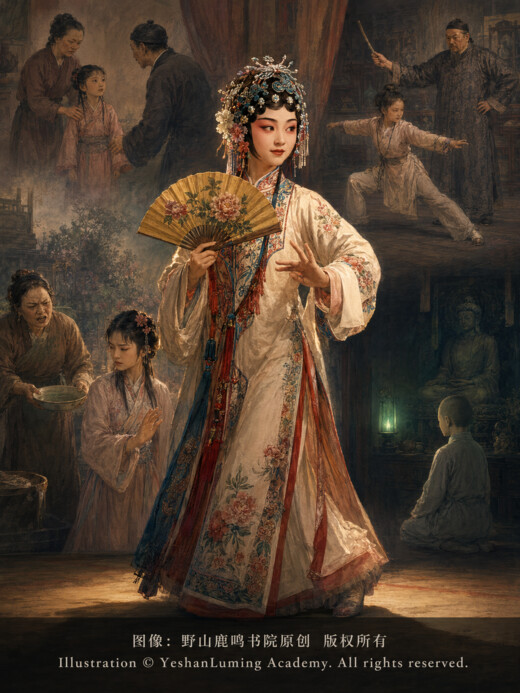
Once, because of the matter of washing her hair, she quarreled with her godmother, Granny He. It turned out that Granny He had used the dirty water left after washing her own daughter’s hair to wash Fangguan’s. Fangguan found it disgusting and refused to use it. Granny He then cursed her.
To understand the whole affair clearly, it is best to copy a passage from Cao Xueqin’s original Dream of the Red Chamber.
“Fangguan had gone with her godmother to wash her hair. Her godmother insisted on letting her own daughter wash first before allowing Fangguan to wash. Seeing this, Fangguan said she was being partial: ‘You give me the leftover water from washing your daughter’s hair! You take my monthly allowance every month, living off what belongs to me, and that is not enough? You still give me leftovers and scraps!’
Her godmother’s embarrassment turned into anger, and she cursed her: ‘You ungrateful thing! No wonder everyone says there is not a single opera girl who is easy to deal with. No matter how good someone is, once she enters this profession, she goes bad. Even a little brat like you has become picky and quarrelsome, talking with a salty mouth and a bland tongue, like a mule that bites the herd!’ Fangguan and her godmother began to quarrel.”
In this matter, Baoyu clearly and firmly stood on Fangguan’s side. The original Dream of the Red Chamber writes it this way:
Baoyu said, “No wonder Fangguan complains. Since ancient times it has been said that when something is unfair, it cries out. She is here without parents or close kin, with no one to look after her. You earn money from her and then mistreat her. How can you blame her?”
At that time, Fangguan must have felt fortunate that she had met a good person, someone willing to stand up for her. Baoyu did indeed treat her very well. Not only her, but all those “little opera girls” stirred in Baoyu an almost natural pity. He did not regard them as servants or playthings, but as part of his “kingdom of girls.”
Fangguan was lively by nature and bold in temperament. She often joked and chatted freely with Baoyu without restraint. She even once became drunk and fell asleep beside Baoyu, and no one thought too much of it.
Because in the Yihong Courtyard, everyone seemed to have forgotten the outside world. That place was too much like a dreamlike paradise. Young boys and girls were together amid birdsong and flowers, with bright laughter all around. Baoyu spent every day immersed in it, truly believing this was the real world, and that everyone could go on living like this forever, never growing up, never parting.
But neither Fangguan nor Baoyu truly knew that the outside world would never tolerate the existence of such a dreamlike paradise. Above all, it would never tolerate “opera girls” standing on equal footing with their masters.
Onstage, they could be emperors and generals, talented scholars and beautiful ladies. But once they stepped off the stage, they did not even possess the most basic qualification to be treated as “people.” When they sang well, they were praised and admired as playthings, not as human beings. When they sang badly, things became even worse: they could be thrown away without mercy, like garbage.
Fangguan was a girl with a very strong personality. She was not like Xiren, who knew how to lower her head, nor like Ping’er, who knew how to maneuver through difficult situations. She possessed a kind of integrity and pride rarely seen in an opera girl of that time.
Once, Ruiguan gave her some rose-scented powder, and Jia Huan, as one of the masters, insisted on seizing it from her. Fangguan refused, and actually quarreled with Jia Huan to his face. Although Jia Huan was not especially favored, he was still a master. In such a situation, most people would have yielded.
But Fangguan would not. That refusal to submit was precisely what Baoyu loved most about her. Yet it was also this very trait that finally harmed her.
Because the Jia household was, after all, not the Yihong Courtyard. The Yihong Courtyard was like a spring dream, but the Jia household was a true feudal prison.
Later, the search of the Grand View Garden began. Lady Wang finally made up her mind to discipline those who were “corrupting Baoyu.” Fangguan, born from the world of opera performers, naturally became one of the first targets. In Lady Wang’s eyes, these girls from the opera world were frivolous, seductive, and unruly. They were the root of the evil that lured Baoyu into moral decline.
And so, a campaign of expulsion began. When Fangguan was driven out of the Yihong Courtyard, she was still very young. At that time, she probably did not yet truly understand what she had lost.
When she left, Baoyu’s heart was filled with pain. But still, there was nothing he could do. This is one of the cruelest things in Dream of the Red Chamber.
In the first eighty chapters of Dream of the Red Chamber left by Cao Xueqin, Fangguan’s final fate is not explained. Perhaps he had simply not yet had time to write it. But in that era, what good ending could there be for a “little opera girl” with no status at all, driven out of the Grand View Garden and stripped of every protection?
Baoyu loved those girls and cherished those girls, but he could not protect them. It was so with Qingwen, and it was so with Fangguan.
According to Gao E’s 120-chapter continuation of Dream of the Red Chamber, Fangguan was later sent to Shuiyue Nunnery.
From a little girl who could sing opera, joke, laugh, and lose her temper, she suddenly became a young nun beside the green lamp and the ancient Buddha. But she was never someone who could truly be a nun. She was too lively, too fond of excitement, and too full of love for the human world.
She should have lived among flowers, amid laughter, beneath the lights of the opera stage. But in the end, she could only face the wooden fish and the Buddha’s image, enduring her days in bitterness.
She would never sing opera again. Nor would there ever again be someone like Baoyu to cherish her and protect her. And that little girl who had once laughed and made trouble in the Yihong Courtyard, who had even dared to scold Jia Huan, was finally, little by little, worn away by this world.
(To be continued)