愛是專屬的·給寶玉上課的女孩齡官Love Is Meant for One Alone · Lingguan, the Girl Who Taught Baoyu a LessonLove Is Meant for One Alone · Lingguan, the Girl Who Taught Baoyu a Lesson愛是專屬的·給寶玉上課的女孩齡官
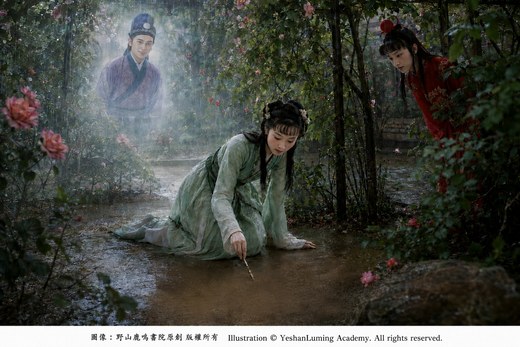
The sun had been blazing overhead that day. As Baoyu happened to pass a trellis covered in roses, he suddenly noticed a slender figure crouching beneath the flowers, using a hairpin to trace a character in the earth, stroke by deliberate stroke.
At first he could not make out what she was writing. Only after repeatedly following the movements of her hand did he realize that Lingguan was writing the same character again and again: “Qiang.”
She finished one and immediately began another. As if possessed, she drew the same character over and over. Then the weather abruptly changed and rain began to fall, but she remained completely unaware. She continued tracing the character while quietly weeping, never noticing that her clothes were gradually becoming soaked.
Watching from a distance, Baoyu was transfixed. Never before had he witnessed such single-hearted devotion. It was not love for wealth or power. It was love for one particular person.
The character “Qiang” was the same “Qiang” in Jia Qiang’s name. Lingguan’s heart, it turned out, belonged to Jia Qiang alone.
At that moment, Baoyu felt a kind of loss he had never known before. For the first time, he truly understood that not every girl’s heart was open to everyone; that simply because someone treated a girl well did not mean she must love him in return; and that there were people in this world who reserved all their affection for one person alone.
Although Baoyu had always understood something of love, his feelings had remained tinged with a childlike vanity. He loved all girls and assumed that all girls loved him. Lingguan taught him for the first time that true love is exclusive—it cannot all be possessed by one person.
Without intending to do so, Lingguan taught Baoyu one of the most important lessons of his life. She did not advise him as Xiren did, nor did she deliberately quarrel with him as Daiyu sometimes did. In fact, she had scarcely spoken more than a few words to him. She merely crouched beneath the rose trellis, tracing the character “Qiang” over and over, and in doing so made Baoyu grow up a little.
To understand Lingguan more fully, let us return to a passage from Cao Xueqin’s original text. Nothing reveals more clearly her aloofness, her sensitivity, and a way of thinking far beyond that of ordinary people.
“One day, weary of wandering from place to place, Baoyu remembered an aria from The Peony Pavilion. He read it over twice but still found himself unsatisfied. Having heard that, among the twelve girls of Pear Fragrance Court, Lingguan, who played young female roles, was the finest singer, he deliberately went out through the side gate to look for her. Baoguan and Yuguan were both in the courtyard. When they saw Baoyu arrive, they smilingly invited him to sit down.
“Baoyu asked, ‘Where is Lingguan by herself?’ The girls told him, ‘She is in her room.’ Baoyu hurried inside and found Lingguan lying alone on her pillow. When she saw him enter, she did not move in the slightest. Baoyu was accustomed to joking and playing with other girls and assumed that Lingguan would be no different. He went forward, sat down beside her, and smilingly begged her to get up and sing the aria ‘The Fine Curling Threads.’
“Unexpectedly, the moment Lingguan saw him sit down, she hastily raised herself and moved away. With a grave expression, she said, ‘My voice is hoarse. The other day, Her Highness summoned us to perform, and even then I did not sing.’ When Lingguan sat upright, Baoyu looked at her more carefully and realized that she was the same girl who had traced the character ‘Qiang’ beneath the rose trellis. Finding himself treated in this way—never before had anyone shown such dislike for him—he flushed awkwardly and could only leave the room.
“Baoguan and the others did not understand what had happened and asked him the reason. Baoyu told them and continued on his way. Baoguan said, ‘If you wait just a little while, Second Master Qiang will come. If he asks her to sing, she will certainly sing.’ Baoyu was puzzled and asked, ‘Where has Brother Qiang gone?’ Baoguan replied, ‘He just went out. Lingguan must have wanted something, and he has gone to find it for her.’
“Baoyu thought this very strange and waited for a short while. Sure enough, Jia Qiang soon returned from outside carrying a birdcage. Inside was a bird, and above it was fastened a tiny stage. Brimming with excitement, he hurried in to find Lingguan. When he saw Baoyu, he had no choice but to stop.
“Baoyu asked him, ‘What sort of bird is that? Can it carry flags in its beak and perform on the stage?’
“Jia Qiang smiled. ‘It is a Jade-Crested Golden Bean“
”How much did it cost?’ Baoyu asked. ‘One tael and eight mace of silver,’ Jia Qiang replied. As he spoke, he invited Baoyu to sit down and then went into Lingguan’s room.
“By this time Baoyu had completely forgotten his desire to hear Lingguan sing. He only wanted to see how she and Jia Qiang behaved together. Jia Qiang went in and said with a smile, ‘Get up and have a look at this little amusement.’ Lingguan sat up and asked what it was. Jia Qiang said, ‘I bought a bird for you to play with, so you would have something to cheer you up instead of feeling miserable all day. Let me show you what it can do.’
“He took out some grain and coaxed the bird into hopping about on the little stage and carrying tiny demon-faced flags in its beak. All the other girls laughed and called it amusing. Lingguan alone gave two cold laughs, turned away in anger, and lay down again.
“Jia Qiang continued smiling ingratiatingly and asked whether she liked it. Lingguan said, ‘Your family took perfectly good human beings, brought us here, and shut us inside this prison to learn this wretched trade. As if that were not enough, now you bring in a bird and force it to do the same thing. You plainly brought it here to mock us—to hold it up as a picture of what we are—and you still ask whether I like it.’
“Hearing this, Jia Qiang became alarmed and hurriedly swore that he had meant no such thing. ‘What possessed me today? I must have had perfumed oil clouding my mind! I spent one or two taels of silver buying it because I thought it would amuse you. It never occurred to me that you might see it that way. Enough, enough—I shall set it free. Perhaps the good deed will help relieve your illness.’ With that, he released the bird and smashed the cage to pieces.
“Lingguan continued, ‘The bird may not be human, but it too has an old mother bird waiting in some nest. How could you bear to catch it and make it perform this wretched nonsense? Today I coughed up two mouthfuls of blood. Madam ordered a doctor to examine me, but instead of asking carefully about my illness, you bring this thing here to make fun of me. I have no one to care for me or pay attention to me, and now I am ill as well.’ With that, she began to cry.
“Jia Qiang hurriedly said, ‘I asked the doctor last night. He said it was nothing serious and that two doses of medicine would cure it. He was going to look at you again the day after tomorrow. How was I to know you had coughed up blood again today? I shall fetch him now.’ As he spoke, he turned to leave. Lingguan called after him, ‘Stop! The sun is poisonous at this hour. If you rush out in anger and bring him here, I shall refuse to see him.’
“Hearing this, Jia Qiang had no choice but to stop. Baoyu watched the scene in a daze. Only now did he understand the true meaning of the character ‘Qiang’ traced beneath the rose trellis. Unable to remain any longer, he quietly withdrew. Jia Qiang’s whole heart was fixed on Lingguan, and he gave no thought to seeing Baoyu out. It was the other girls who escorted him from the courtyard.
“Baoyu pondered and reflected all the way back to Happy Red Court, lost in thought. He found Lin Daiyu and Xiren sitting together in conversation. As soon as he entered, he sighed deeply and said to Xiren, ‘What I said last night was entirely wrong. No wonder Father said that my understanding was like peering at the sky through a tube and measuring the sea with a gourd.
“‘Last night I said that all of your tears would be shed for me and would bury me, but I was wrong. I can never have them all. From now on, each person’s tears must belong to the one for whom they are meant.’
“Xiren had regarded the previous night’s conversation as nothing more than playful nonsense and had already forgotten it. She had not expected Baoyu to mention it again and laughed. ‘You really are a little mad.’ Baoyu remained silent. From that moment on, he understood deeply that the bonds of human affection are separately ordained for each person. Yet he would still secretly grieve and wonder, ‘Who will shed tears over my grave in the years to come?’ These were the thoughts Baoyu carried in his heart, though we should not speculate too freely about them.”
There are too many stories contained within this single passage. It not only reveals how different Lingguan was from the other girls; it also shows how she taught Baoyu a profound lesson about life.
First, Baoyu was the pampered young master of the entire Jia household. Whenever he wished to approach a girl, most would have felt flattered and hurried eagerly toward him. Lingguan alone refused. The moment Baoyu sat beside her, she immediately rose and moved away. Baoyu, who “had never before experienced such rejection and dislike,” flushed with embarrassment and could only retreat from the room.
This was the first time Baoyu discovered that not every girl welcomed his attention. Even if he was the Jia family’s most cherished young master, he had no right to enter any girl’s inner world whenever he pleased.
Second, Baoyu had even smiled ingratiatingly and begged her to sing “The Fine Curling Threads.” Lingguan refused him gravely, saying only, “My voice is hoarse. The other day, Her Highness summoned us to perform, and even then I did not sing.” Her single reply left Baoyu speechless.
This did not necessarily mean that Lingguan deliberately despised Baoyu. It did, however, make one thing perfectly clear: she was not a plaything who must sing whenever someone wished to hear her. Even before Baoyu, she retained the right to say no.
Third, Jia Qiang spent money on a little bird trained to carry flags in its beak and perform on a tiny stage. He had hoped to please Lingguan and cheer her up. Yet the moment Lingguan saw the bird imprisoned in its cage and trained to perform, she thought of herself.
She told Jia Qiang, “Your family took perfectly good human beings, brought us here, and shut us inside this prison to learn this wretched trade. As if that were not enough, now you bring in a bird and force it to do the same thing. You plainly brought it here to mock us—to hold it up as a picture of what we are—and you still ask whether I like it.”
The words were extraordinarily profound.
In the eyes of the Jia family’s masters, the Grand Prospect Garden was a display of wealth, power, and refinement—an earthly paradise. In Lingguan’s eyes, however, it was a “prison.”
She had seen through it. She knew that although she lived in the Grand Prospect Garden, and although someone might flatter or indulge her, she remained, in essence, a purchased opera performer. She had never been free to decide whether she came there, nor was she free to decide whether she would sing. Today she performed for one household; tomorrow she might perform for another. Her tears, her smiles, her body, and her youth did not truly belong to her.
The little bird was imprisoned in a cage and taught to carry flags and perform on a stage for the amusement of spectators. In what way was Lingguan’s own fate any different?
The other girls found the bird’s performance amusing. Lingguan alone recognized its cruelty at a glance. It was not that she failed to understand Jia Qiang’s good intentions. Rather, the bird forced her to see her own fate.
Jia Qiang, who sincerely cared for her and perhaps truly loved her, became flustered. He could only break the cage, release the bird, and willingly obey her wishes. In the eyes of others, Jia Qiang was a master and Lingguan merely a lowly performer who had been bought by his family. Yet within their relationship, Lingguan refused to place herself beneath him.
She could love Jia Qiang, but she would not surrender her dignity for that love.
Lingguan was in poor health. She had already begun coughing up blood, and her spirits were habitually low. Even if Jia Qiang truly loved her, she remained unhappy, because she knew that however genuine their affection might be, it could not alter the fact that she was living inside a cage.
Jia Qiang could buy her a bird, summon a doctor for her, and smile as he tried to cheer her up. But he might never possess the power to give her true freedom.
It was also through Lingguan that Baoyu first truly understood that some girls might smile outwardly and still remain unhappy within, because they were not free.
Baoyu had once said that he hoped the tears of all the girls beneath heaven would be shed for him and would one day bury him. The words sounded deeply affectionate, yet they still contained a self-centered fantasy. He wished to possess the feelings of every girl and hoped that each of them would weep for him.
After witnessing the love between Lingguan and Jia Qiang, however, he finally understood: “Last night I said that all of your tears would be shed for me and would bury me, but I was wrong. I can never have them all. From now on, each person’s tears must belong to the one for whom they are meant.”
Every person’s love has its own destination. Simply because you love everyone does not mean that everyone must love you. Nor does treating someone kindly oblige that person to repay you with love. Love is not distributed equally, and no one person can possess all of it.
Love is meant for one alone.
Later, an Imperial Dowager died, and noble families were forbidden to hold banquets or musical performances for an entire year. The Jia family’s opera troupe was consequently disbanded. The young girls who had once performed every imaginable joy and sorrow upon the stage were scattered like flowers blown apart by the wind.
In the first eighty chapters, Cao Xueqin never explains in detail where Lingguan ultimately went. Perhaps he simply did not have the time to complete the fate of every character.
Some readers speculate that she later followed Jia Qiang. Others, remembering that she was already coughing up blood, believe that she may have died of illness while still very young. Yet these remain nothing more than later conjectures. The original novel gives us no certain answer.
Cao Xueqin’s silence only makes her story more painful. In that age, the life of an opera performer was like duckweed drifting upon the water. However proud she might be, however devoted, however much she resembled Lin Daiyu, she could not change her identity or her fate, because in the end, she was still merely an actress.
Yet the sudden rain beneath the rose trellis, and the character “Qiang” traced thousands of times in the earth, remained forever in Baoyu’s heart.
Many years later, Baoyu would probably still remember that there had once been a girl beneath the roses who told him, one stroke at a time: love is not something in which everyone may claim a share. Love is meant for one alone.
(To be continued)