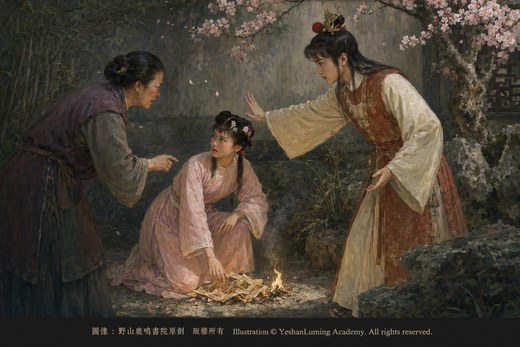
A matron guarding the garden caught her in the act. The woman loudly berated her and threatened to report her to Wang Xifeng and the other masters so that she would be severely punished. Secretly burning paper offerings in the Grand Prospect Garden was a serious violation of its rules. Ouguan was merely a lowly young opera performer. If the matter were truly brought before Wang Xifeng and the others, the consequences were easy to imagine.
By coincidence, Jia Baoyu happened to pass by. To protect Ouguan, he first lied to the matron, claiming that “Miss Lin had ordered her to burn some discarded sheets of paper on which mistakes had been written.” He then invented another story, saying that he had dreamed of the “Spirit of the Apricot Blossom” and needed Ouguan to burn paper offerings to dispel some ritual impurity.
Seeing that Baoyu was protecting Ouguan, and that the matter now also involved Lin Daiyu, the matron did not dare pursue it any further. Ouguan thus escaped a dangerous situation unharmed.
After the matron left, Baoyu asked Ouguan what had happened. Grateful that he had rescued her, Ouguan also recognized him as “someone of the same kind” as herself. With tears in her eyes, she told him that only Fangguan and Ruiguan knew about the matter.
Yet the secret was too intimate for her to explain in person, so she asked Baoyu to return home and question Fangguan privately. Only after Baoyu returned to Happy Red Court and spoke with Fangguan did he learn the story of Ouguan and Diguan.
To understand more accurately what these young performers—children in age, yet adults in thought—truly believed, let us return to Cao Xueqin’s original text.
“Baoyu gave Fangguan a meaningful look. Fangguan was naturally quick-witted, and after several years of studying opera, there was little she failed to understand. She therefore pretended to have a stomachache and said she did not want to eat. Xiren said, ‘If you are not eating, stay here and keep him company. I shall leave the congee for you, and you can have it when you are hungry.’ With that, she left.
“Baoyu then told Fangguan in detail how he had encountered Ouguan, how he had protected her with a lie, and how Ouguan had asked him to question Fangguan. He then asked, ‘For whom was she making those offerings?’ Fangguan’s eyes reddened. She sighed and said:
“‘When you hear the story, you will agree that Ouguan was behaving foolishly.’
“Baoyu hurriedly asked, ‘How so?’ Fangguan replied, ‘The person she was honoring was Diguan, who died.’
“Baoyu said, ‘The two of them were friends, so it was only right that she should honor her.’
“Fangguan replied, ‘Friends? It was nothing so simple. It was all a foolish fantasy. Ouguan played young male roles, and Diguan played young female roles. They used to perform as husband and wife. Every day when they acted, they pretended to be so affectionate that, as time passed, the two became confused and began to behave as though it were real. Eventually, one cherished the other, and the other loved her in return. When Diguan died, Ouguan wept until she was more dead than alive. She has never forgotten her and still burns paper offerings at every festival. Later, Ruiguan replaced Diguan. When we saw Ouguan treating her in the same way, we asked, “Why did you forget the old one as soon as you found someone new?” She replied, “I have not forgotten. When a man’s wife dies, he may marry again. As long as he does not cast the dead woman aside and never speak of her, he still possesses true feeling.” Would you not say that she is foolish?’
“Hearing these foolish words, which so perfectly accorded with his own foolish nature, Baoyu felt both joy and sorrow. He marveled at them and praised them without end. Taking Fangguan by the hand, he instructed her, ‘Since that is the case, I have something I want you to tell her. She must never burn paper offerings again. Whenever a festival comes, she need only prepare a single burner of incense. If her heart is sincere and reverent, it will be enough to reach the spirit. I too keep only one incense burner on my table. Whenever something weighs upon my heart, I burn incense, regardless of the date. A cup of fresh water or tea may be offered, or fresh flowers and fruit—even meat, fish, or vegetarian food will do. What matters is the reverence in one’s heart, not empty outward forms. Tell her that from now on, she must never burn paper offerings again!’ Fangguan promised that she would.”
Ouguan often played husband and wife with Diguan onstage, while away from the stage they were companions in love. After Diguan died, Ouguan wept until she was more dead than alive. Whenever a festival arrived, she still secretly made offerings to her.
Later, however, the opera troupe assigned Ruiguan to replace Diguan and perform opposite Ouguan. As time passed, affection also developed between Ouguan and Ruiguan.
The other young performers therefore asked Ouguan, “Why did you forget the old one as soon as you found someone new?”
Ouguan replied, “I have not forgotten. When a man’s wife dies, he may marry again. As long as he does not cast the dead woman aside and never speak of her, he still possesses true feeling.”
This was what made Ouguan so extraordinary.
She did not pretend that, because Diguan had died, she would never love again. Nor did she forget the dead Diguan simply because she had found a new companion.
In Ouguan’s eyes, a person could love again. Falling in love with someone new did not mean betraying the one who had died. As long as she still remembered the person she had once truly loved—as long as she did not cast her aside completely or pretend that she had never existed—she remained faithful in feeling.
These seemingly childish words profoundly shook Baoyu, filling him with wonder and admiration.
Although Ouguan was very young, her thinking far surpassed that of many young masters and ladies of her time. She was not as sharp as Qingwen, nor as cold and proud as Lingguan, but deep within her was a distinctive kind of stubbornness.
Her simple statement—“As long as he does not cast the dead woman aside and never speak of her, he still possesses true feeling”—unintentionally became a challenge to feudal morality.
The society of that time demanded lifelong fidelity from women. While her husband lived, a woman had to depend upon him; after he died, she was expected to preserve her chastity for the rest of her life. A woman who remained a widow until death was praised and officially honored as a “chaste wife” or a “virtuous widow.”
For a man, however, marrying again after his wife’s death was regarded as entirely natural.
Ouguan borrowed precisely this principle—that a man could take another wife after the first had died—to explain her own feelings. She might not consciously have intended to rebel against feudal morality, yet her idea inadvertently exposed the profoundly unequal moral standards imposed upon men and women in that age.
She neither pretended to obey society’s demand for lifelong fidelity to one person, nor wished to appear heartless and faithless by abandoning the old for the new. She acknowledged that human feelings could change and that a person could fall in love again. Yet she also believed that someone who had once been truly loved should not be completely forgotten merely because she had died.
This was not the childish nonsense of an ignorant girl. It was a clear and penetrating understanding of what true love meant.
Such an idea was extraordinarily rare and far ahead of its time in the society portrayed in Dream of the Red Chamber.
The morality of that age frequently judged women according to only two standards. One was the “chaste woman,” who spent her entire life faithful to a dead man. The other was the “wanton woman,” who, if she ever loved again, would be condemned as faithless and accused of violating womanly virtue.
Ouguan refused to think in this way. She acknowledged her new love but was equally unwilling to betray the old. Her reason and clarity were more mature than those of many adults.
The person most deeply shaken by her untimely and advanced way of thinking was Jia Baoyu.
Baoyu had always been a lover by nature, and nothing distressed him more than seeing people oppressed by ritual morality and social rules. When he heard Fangguan recount Ouguan’s words, he did not laugh at her as absurd. Instead, he was deeply moved, as though he had suddenly encountered a kindred spirit.
For what Ouguan said perfectly accorded with Baoyu’s own “foolish nature.”
In Baoyu’s eyes, if people truly possessed feeling, they should not be completely bound by rules. Love was love, and longing was longing. The dead should not be forgotten merely because they had died; nor should the living, simply because they had once loved someone, be forbidden ever to love again and condemned to suffer in loneliness.
Baoyu therefore did not blame Ouguan for secretly burning paper offerings. Instead, he concealed what she had done and advised her that she need not risk doing so again. If love remained in her heart, then burning a single stick of incense and offering one cup of clear tea would be enough.
“What matters is the reverence in one’s heart, not empty outward forms.”
These words were not merely Baoyu’s advice to Ouguan. They were also Cao Xueqin’s answer to conventional ritual and morality, spoken through Baoyu.
True love does not depend upon whether others can see it, whether the ceremony is magnificent, or whether it conforms to society’s rules. What matters is whether the person is truly remembered in one’s heart.
The story unfolded deep within the garden, beneath an apricot tree: a young opera performer secretly honoring the dead while several children discussed love, death, and life. It belonged neither to its time nor to the rules of that society. In its strange beauty and sorrow, it seemed almost like a tale from Strange Tales from a Chinese Studio.
Yet the more beautiful it became, the more painful it felt, because these girls were so terribly vulnerable.
When Ouguan later became close to Ruiguan, others mocked her as faithless. In truth, those people did not understand what genuine love meant.
Those who love most deeply often understand something that others do not: the living cannot survive on memories alone.
Loving someone who has died does not mean that one must also cease living. Falling in love with someone who is still alive does not mean that all former love was false.
Ouguan still remembered Diguan. When the Qingming Festival arrived, she risked punishment and even expulsion from the garden to hide beneath an apricot tree and secretly burn paper offerings for her. Yet she was also willing to accept Ruiguan and allow herself to continue living within a new love. This was what made her most remarkable.
Later, when Lady Wang purged Happy Red Court, Fangguan, Ouguan, Ruiguan, and the other girls who had come from the opera troupe were treated as if they were “little fox spirits” and driven from the Grand Prospect Garden.
Their foster mothers wanted to take them back and later arrange marriages for them as they saw fit. All three girls refused and said they would rather shave their heads and become nuns. Fangguan and Ruiguan left with Zhitong of Water Moon Convent, while Ouguan entered religious life under Yuanxin of Ksitigarbha Convent.
Why did all three choose the religious life?
Probably because they understood that once they returned to the hands of their foster mothers, neither their marriages nor their futures would belong to them. Like merchandise, they would very likely be arranged, disposed of, or even sold once again.
They did not necessarily become nuns because they had truly renounced the mortal world, nor because they sincerely yearned for oil lamps, Buddhist images, and a life of religious devotion. For these desperate girls with nowhere else to go, it may simply have been the last path still open to them.
From the opera troupe to the Grand Prospect Garden, and from the Grand Prospect Garden into religious life, they appeared to move from one place to another, yet they never obtained true freedom.
These girls had been abandoned by fate from the beginning. Onstage, they performed every joy and sorrow of gifted scholars and beautiful women, yet they never possessed the power to direct their own lives.
Before an audience, they played emperors, generals, scholars, and beauties. They spoke the most beautiful words of love and performed the most moving romances. Once they stepped off the stage, however, they did not even possess the right to decide whether they wished to sing, whether they wished to marry, or what kind of life they wanted to live.
Among them, Ouguan was probably one of the very few who truly understood the meaning of love.
She knew that after the death of someone dearly loved, a person could still choose to live and to love another. As long as the person once truly loved was not forgotten, loving again was not a betrayal.
Onstage, Ouguan played a charming and romantic young man. What she left to Baoyu—and to all who came after her—was an understanding of love more lucid than that possessed by many adults: the living may continue to love, and the dead should never be forgotten.
(To be continued)