火彩從何而來·光在鑽石中的旅行Where Does Diamond Fire Come From? · Light’s Journey Through a Diamond The World of Gemstones · Diamond SeriesWhere Does Diamond Fire Come From? · Light’s Journey Through a Diamond The World of Gemstones · Diamond Series火彩從何而來·光在鑽石中的旅行 寶石世界·鑽石篇
寶石世界·鑽石篇(105)The World of Gemstones · Diamond Series (105)
不過,如果只有材料本身的高折射率, 高色散特質,而沒有良好的切割、打磨,這些被稱為火彩的光學效果,也無法充分展現。這也是為什麼同樣重量、同樣品質的鑽石,有些看起來光芒閃耀,有些卻黯淡無光, 不同之處就在於是否被科學地進行了切割,打磨。
鑽石的切割打磨,實際上是在「控制光」在鑽石內部的運動路線。每一個刻面的角度與比例,都會影響光線進入與離開的路徑。如果切工精準,光線會以最美的形式,反射回觀察者的眼睛;如果切工不當,光線則可能從側面逸出,使鑽石看起來黯淡無光。
這也是目前世界上最流行的鑽石《圓形明亮式切工》,成為鑽石切割主流的原因。這種切割方式, 通常使鑽石有57個, 或者58個切面組成。區別就是,是否把一个可有可無的鑽石尖底, 計算在內。
這些刻面的設計角度, 已經經過長時間的反覆計算, 和實際實驗驗證,能夠在最大程度上平衡, 反射鑽石的亮度、火彩與閃光。
寶石學研究的結論是,鑽石的光學效果,不是單一因素的結果,而是材料本身折射, 色散物理特性,與切工設計共同作用的產物。
當我們轉動一顆鑽石時,看到那些閃爍的色彩光芒,其實並不是光在變化,而是光在不同刻面之間流動,被重新分配。每一次閃動,都是光線經過一次完整路徑後的結果。
這樣看來,鑽石並不是在「發光」,而是在「展示光」。
它本身並不產生光,但卻能把外界的光,轉化為一場動態的視覺表演。也許正因為如此,人們才會在其中看到火焰、看到流動,甚至看到某種難以言說的美。
如果說硬度讓鑽石成為人類最好的加工材料和工具,那麼光,才是讓鑽石成為人見人愛的寶石之源。
(未完待續)When people are first captivated by a diamond, it is usually not because of its hardness, but because of its light. The flashes that dance as the stone is viewed from different angles sometimes resemble flames and sometimes rippling water, making it difficult to look away.
This distinctive optical phenomenon of diamond is commonly referred to by both the jewelry industry and consumers as “fire.” But if we ask where the captivating fire of a diamond actually comes from, the answer can be found in this article.
The fascinating fire of a diamond is not truly mysterious. It is simply the result of light being refracted and dispersed within a particular material.
According to the scientific principles of gemology, there are three principal reasons why a diamond can produce such powerful optical effects:
First, diamond’s high refractive index; second, diamond’s high dispersion; third, the precise cutting and polishing performed by human hands, which enable light passing through the diamond to release its natural beauty to the fullest extent.
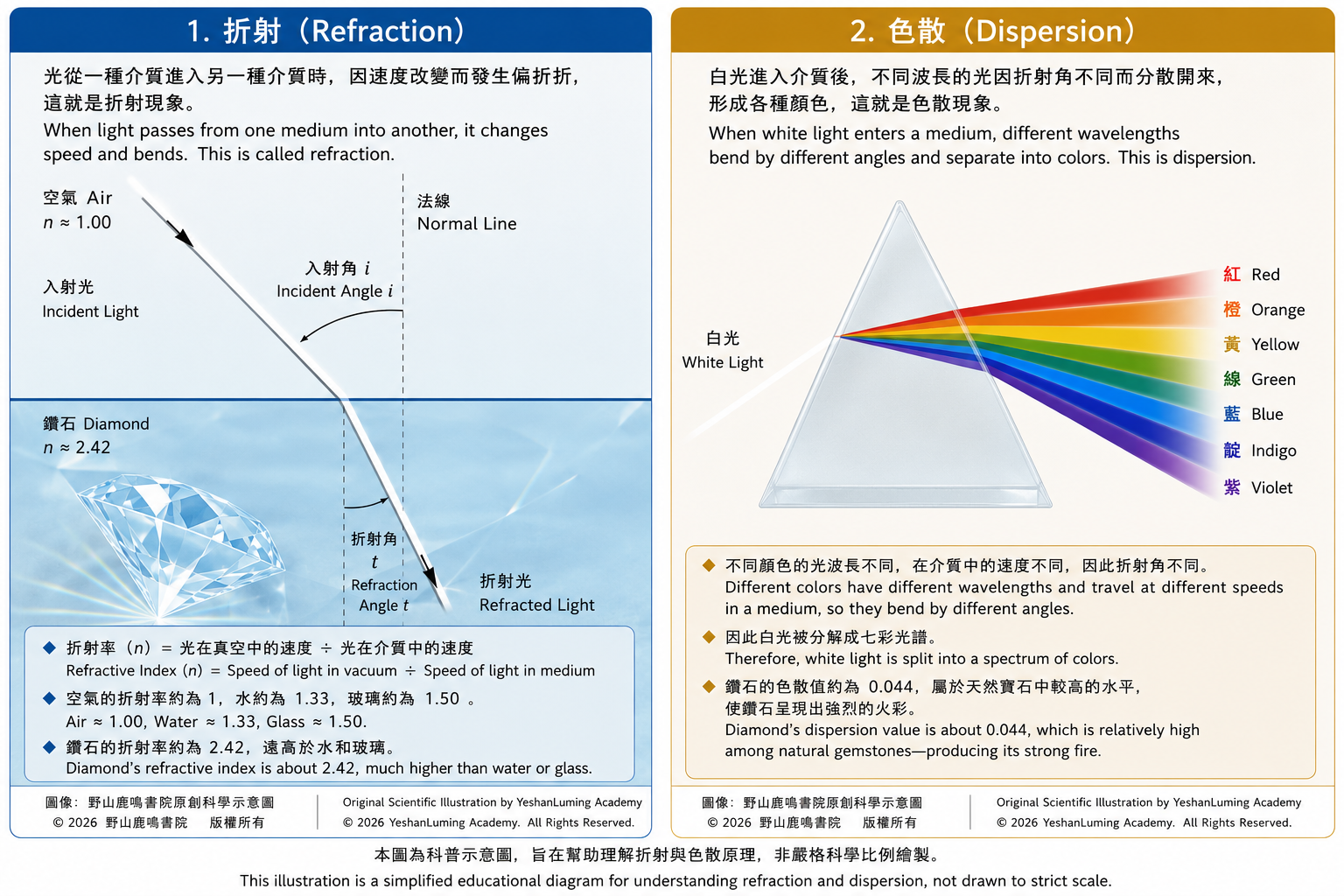
Let us begin with diamond’s high refractive index. When light passes from air into a diamond, it bends because air and diamond possess different optical densities. This bending of light is known as refraction. The degree to which a substance refracts light is expressed by its refractive index. The refractive index, or Index of Refraction, is calculated as the ratio between the speed of light in a vacuum and its speed within a particular medium.When people are first captivated by a diamond, it is usually not because of its hardness, but because of its light. The flashes that dance as the stone is viewed from different angles sometimes resemble flames and sometimes rippling water, making it difficult to look away.
This distinctive optical phenomenon of diamond is commonly referred to by both the jewelry industry and consumers as “fire.” But if we ask where the captivating fire of a diamond actually comes from, the answer can be found in this article.
The fascinating fire of a diamond is not truly mysterious. It is simply the result of light being refracted and dispersed within a particular material.
According to the scientific principles of gemology, there are three principal reasons why a diamond can produce such powerful optical effects:
First, diamond’s high refractive index; second, diamond’s high dispersion; third, the precise cutting and polishing performed by human hands, which enable light passing through the diamond to release its natural beauty to the fullest extent.
Let us begin with diamond’s high refractive index. When light passes from air into a diamond, it bends because air and diamond possess different optical densities. This bending of light is known as refraction. The degree to which a substance refracts light is expressed by its refractive index. The refractive index, or Index of Refraction, is calculated as the ratio between the speed of light in a vacuum and its speed within a particular medium.
The refractive index of air is approximately 1, that of water approximately 1.33, and that of glass approximately 1.5. Water is therefore optically denser than air, yet optically less dense than glass. The lowest possible absolute refractive index belongs to a vacuum and is equal to 1; the absolute refractive indices of all other media are greater than 1 when compared with that of a vacuum.
This may already sound a little technical and complicated, but that does not matter. I have included it here as a record and to provide an opportunity for readers who wish to study the subject more deeply. Those who are not interested need not examine it closely or insist on understanding every detail; a general understanding is enough.
Diamond has a refractive index of approximately 2.42, far higher than that of ordinary glass or water. This means that once light enters a diamond, its direction is altered dramatically rather than continuing straight through.
Yet what truly makes a diamond appear to “glow” is not merely its high refractive index, but the repeated reflection of light within the stone. After entering a diamond, light continually reflects between its internal facets. When the angles are suitable, the light may be reflected entirely back into the diamond instead of escaping. This allows light to remain within the stone longer and gives it more opportunities to emerge again from different directions.
In gemology, this phenomenon is known as total internal reflection, and it is one of the principal sources of a diamond’s brilliance. It is this repeated reflection that makes a diamond appear exceptionally radiant under light rather than merely transparent.
In addition to reflection, diamond possesses another even more captivating property: dispersion. When white light enters a diamond, it is separated into light of different wavelengths—the red, orange, yellow, green, cyan, blue, violet, and other colors that we see. These colors dance among the different facets, creating what people call diamond “fire.”
Here we encounter another scientific term: dispersion. To make it easier to understand, let us explain it briefly. The wavelengths of visible light range from approximately 400 nanometers for violet light to 700 nanometers for red light. Different colors of light travel at the same speed in a vacuum, but at different speeds within a material medium. As a result, when light enters such a medium, different colors are refracted at different angles and spread apart. This is known as dispersion.
A rainbow is perhaps the most familiar example of dispersion. Dispersion separates sunlight in space according to its different wavelengths, and therefore into different colors, producing the beautiful rainbow we so often see.
A rainbow forms when sunlight enters the nearly spherical droplets of water suspended in the air and undergoes both dispersion and reflection. This is why rainbows commonly appear after rain when the sky begins to clear: countless tiny spherical droplets remain in the atmosphere, refracting sunlight and causing it to disperse.
When sunlight enters a water droplet, it is refracted once, reflected from the rear surface of the droplet, and refracted once again as it leaves. In total, it undergoes one reflection and two refractions.
Sunlight enters the droplet at different angles and is also reflected within it at different angles. The strongest returning light appears at angles of approximately 40 to 42 degrees, producing the seven-colored—or, more accurately, many-colored—rainbow that we see.
The same principle applies in gemology: the higher a material’s dispersion value, the greater its ability to separate light into different colors. Diamond has a dispersion value of approximately 0.044, which is relatively high among natural gemstones. After proper cutting and polishing, light entering a diamond behaves somewhat like light entering an atmosphere filled with countless tiny water droplets, producing clear and vivid flashes of different colors.
圖像:野山鹿鳴書院原創科學示意圖Original Scientific Illustration by YeshanLuming Academy
點擊查看大圖 Click to enlarge
However, even if a material possesses a high refractive index and strong dispersion, these optical effects known as fire cannot be fully displayed without excellent cutting and polishing. This is why diamonds of the same weight and similar quality may appear entirely different: some blaze with light, while others look dull and lifeless. The difference lies in whether they have been cut and polished according to sound scientific principles.
Cutting and polishing a diamond is, in essence, the art of controlling the path of light within the stone. The angle and proportion of every facet influence the route by which light enters and leaves the diamond. When the cut is precise, light is reflected back toward the observer’s eyes in its most beautiful form; when the cut is poorly executed, light may escape through the sides, leaving the diamond looking dim and lifeless.
This is also why the Round Brilliant Cut, the most popular diamond cut in the world today, has become the dominant standard in diamond cutting. A diamond fashioned in this style usually consists of 57 or 58 facets. The difference depends on whether the optional point at the bottom of the diamond—the culet—is counted as an additional facet.
The angles of these facets have been refined through prolonged calculation and repeated practical experimentation, allowing them to balance and reflect the diamond’s brightness, fire, and scintillation to the greatest possible degree.
Gemological research has therefore concluded that a diamond’s optical appearance is not the result of any single factor, but of the combined interaction between the material’s physical properties of refraction and dispersion and the design and execution of its cut.
When we rotate a diamond and observe its flashing colors, the light itself is not changing. Rather, it is moving among different facets and being redistributed. Every flash is the result of light completing a particular path through the stone.
Seen in this way, a diamond is not truly “producing light.” It is displaying light.
A diamond creates no light of its own, yet it can transform the light around it into a dynamic visual performance. Perhaps this is why people see flames within it, movement within it, and even a kind of beauty that is difficult to express in words.
If hardness makes diamond one of humanity’s finest materials and tools for cutting and processing, then light is what makes diamond a gemstone loved by all.
(To be continued)