鑽石的硬度之謎·為什麼它是最硬的天然物質The Mystery of Diamond Hardness · Why Is It the Hardest Natural Substance? The World of Gemstones · Diamond SeriesThe Mystery of Diamond Hardness · Why Is It the Hardest Natural Substance? The World of Gemstones · Diamond Series鑽石的硬度之謎·為什麼它是最硬的天然物質 寶石世界·鑽石篇
(未完待續)Among all the descriptions of diamonds, there is one statement that almost everyone has heard: a diamond is the hardest natural substance on Earth. The sentence sounds simple enough, yet it naturally raises an intriguing question. Why is it diamond? Why, among all the minerals found on our planet, has diamond alone reached the ultimate limit of hardness?
If we rely only on our intuition, this "hardness" may seem like an inexplicable characteristic. From the perspective of gemology, however, a diamond's hardness is no accident. It is the direct result of its internal atomic structure.
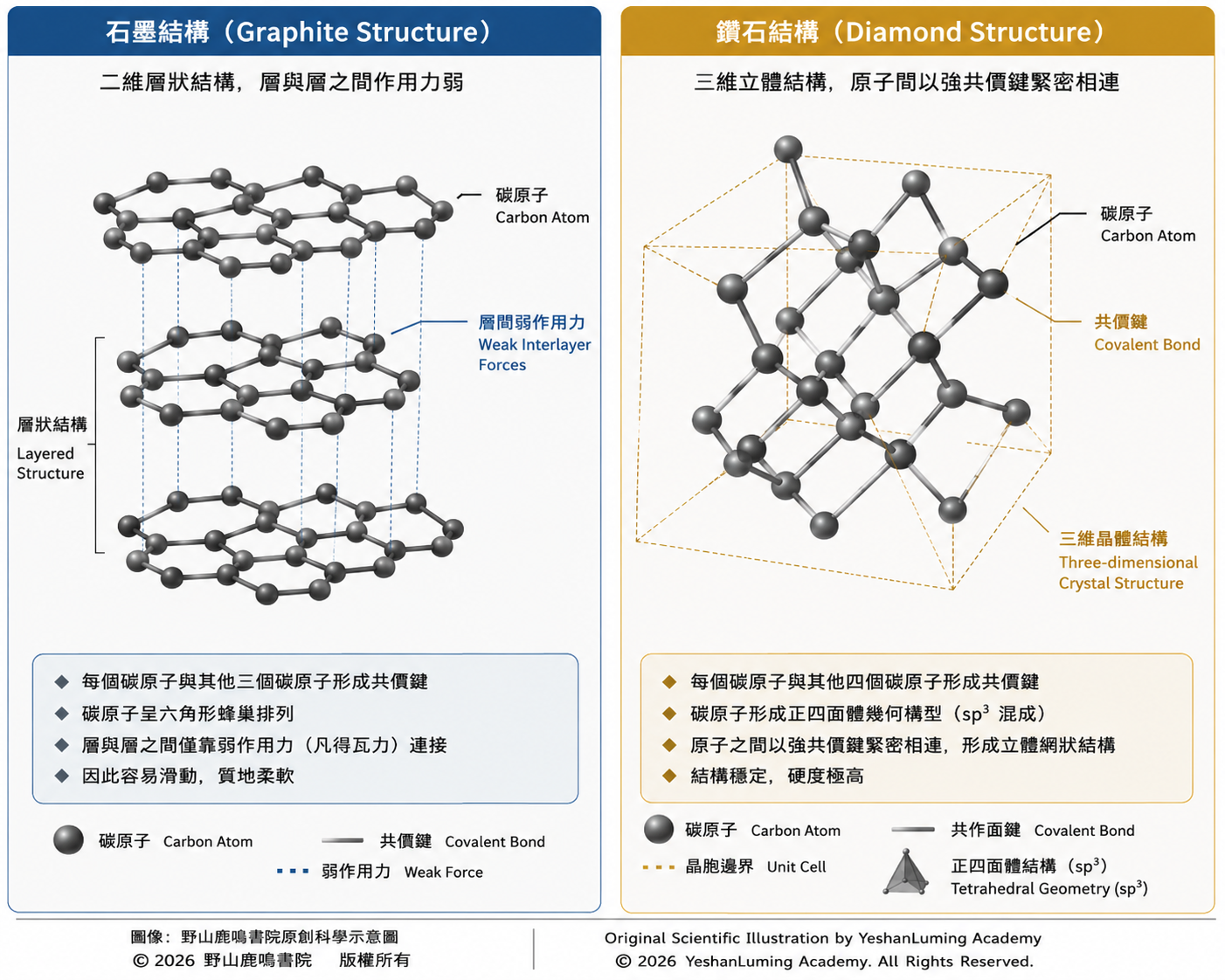
The extraordinary hardness of diamond comes from its unique crystal structure. Within this structure, every carbon atom forms stable covalent bonds with four neighboring carbon atoms, creating a continuous three-dimensional network. This arrangement gives the entire crystal the strength of an intricately woven spatial framework, with no obvious weak points and no direction in which it can easily be broken apart.
In gemology, the hardness of a mineral actually reflects the strength of its atomic bonds and the way those atoms are arranged. Diamond reaches 10 on the Mohs Hardness Scale because this three-dimensional bonding structure is exceptionally rare in nature and is almost impossible for other substances to cut or damage. It is worth noting that the Mohs scale is a relative measure of a mineral's resistance to scratching, rather than a measure of its absolute strength.Among all the descriptions of diamonds, there is one statement that almost everyone has heard: a diamond is the hardest natural substance on Earth. The sentence sounds simple enough, yet it naturally raises an intriguing question. Why is it diamond? Why, among all the minerals found on our planet, has diamond alone reached the ultimate limit of hardness?
If we rely only on our intuition, this "hardness" may seem like an inexplicable characteristic. From the perspective of gemology, however, a diamond's hardness is no accident. It is the direct result of its internal atomic structure.
The extraordinary hardness of diamond comes from its unique crystal structure. Within this structure, every carbon atom forms stable covalent bonds with four neighboring carbon atoms, creating a continuous three-dimensional network. This arrangement gives the entire crystal the strength of an intricately woven spatial framework, with no obvious weak points and no direction in which it can easily be broken apart.
In gemology, the hardness of a mineral actually reflects the strength of its atomic bonds and the way those atoms are arranged. Diamond reaches 10 on the Mohs Hardness Scale because this three-dimensional bonding structure is exceptionally rare in nature and is almost impossible for other substances to cut or damage. It is worth noting that the Mohs scale is a relative measure of a mineral's resistance to scratching, rather than a measure of its absolute strength.
However, there is a common misunderstanding here. People often interpret "hard" as meaning "unbreakable." In reality, although diamond is extremely hard, that does not mean it cannot fracture. Hardness refers to resistance to scratching, not resistance to impact.
In gemology, these are two completely different concepts. A diamond can easily scratch almost any other mineral, yet under a sufficiently strong impact and along certain crystallographic directions, it may still split along its cleavage planes. This is precisely why diamond cutters must understand the crystal's orientation with extraordinary accuracy. A single mistake in judgment can cause a priceless rough diamond to fracture instantly.
This phenomenon reminds us once again that the remarkable strength of diamond is not unconditional; it is entirely founded upon its internal crystal structure.
Beyond hardness itself, diamond also possesses exceptional wear resistance. This is why it has become indispensable in industry for cutting tools and abrasive materials. Whether working with metals, glass, or other gemstones—including diamonds themselves—diamond tools make highly precise machining possible. In a sense, humanity is using nature's most stable crystal structure to reshape other materials.
Yet if we think a little more deeply, another fascinating question arises: Why would nature create such an extreme structure in the first place?
From the perspectives of gemology and geology, the environment in which diamonds form is itself extraordinary. Extreme heat and immense pressure force carbon atoms into the most stable arrangement possible, and that stability is ultimately expressed as what we perceive as hardness. In other words, the hardness of diamond is the lasting imprint left behind by an extreme geological environment.
Seen in this light, diamond takes on another layer of meaning. It is more than a physical material; it is almost a record of its environment. The hardness of every diamond silently tells the story of the tremendous pressures it once endured.
Throughout human culture, diamonds have long symbolized strength and eternity. From a gemological perspective, this symbolism is closely connected to their physical properties. Precisely because diamonds are extraordinarily resistant to wear and damage, people have naturally come to associate them with permanence and enduring value.
Yet in nature itself, diamond hardness was never created to be admired or worn as jewelry. It is simply the most stable structure that Earth could produce under a very specific set of conditions.
Perhaps it can be understood this way: diamonds are not hard because they somehow "chose" to be hard. Rather, under such extraordinarily high temperatures and pressures, only this particular crystal structure could exist.
So we might also think of it this way. In the hands of nature, countless different substances have been created. The reason diamond possesses a hardness unmatched by any other natural material is directly related to the environment in which it formed. Under pressures tens of thousands of times greater than those at Earth's surface and temperatures exceeding one thousand degrees Celsius, carbon atoms formed this unique crystal structure, allowing the crystal to survive and ultimately become the hardest natural substance found on Earth's surface.
To explain it in simpler gemological language, a diamond is a crystal composed entirely of carbon atoms. Those atoms are linked together by powerful covalent bonds, creating an exceptionally dense three-dimensional network.
The essential features of this atomic structure are as follows: its crystal system belongs to the face-centered cubic structure (the diamond cubic lattice), in which carbon atoms are arranged in a cubic pattern while simultaneously forming interconnected tetrahedral configurations.
Its chemical bonding is equally remarkable. Each carbon atom forms sp³ hybridized covalent bonds with four neighboring carbon atoms, creating a stable tetrahedral geometric structure.
That may sound a little complicated—and perhaps even a bit confusing. Don't worry. Take a look at the illustration below, and everything will become much easier to understand.
圖像:野山鹿鳴書院原創科學示意圖Original Scientific Illustration by YeshanLuming Academy