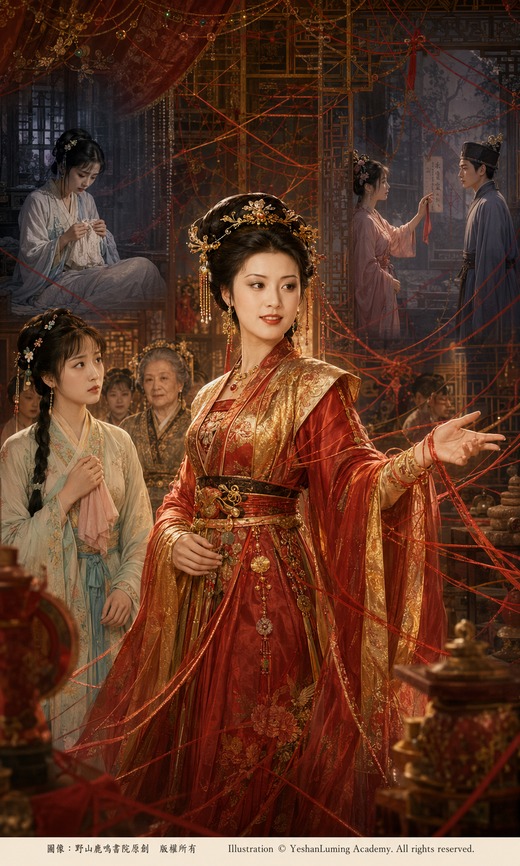
王熙鳳·機關算盡太聰明反算了卿卿性命Wang Xifeng · Her Schemes Were Too Clever—and in the End Cost Her Own LifeWang Xifeng · Her Schemes Were Too Clever—and in the End Cost Her Own Life王熙鳳·機關算盡太聰明反算了卿卿性命
Yet no matter how strong or ruthless Wang Xifeng became, she was still only a woman. In a society dominated by men, she could not indulge herself with the same confidence and impunity as a man. She could only struggle from within the position of a lawful wife to preserve her title, her dignity, and the little self-respect still left to her.
The more fiercely she defended them, the more ruthless she became; and the more ruthless she became, the more isolated she was.
Ping’er was the person closest to her. Yet even the gentle and uncontentious Ping’er often became the target of her anger and had to clean up the consequences of her actions time after time.
Xifeng had made too many enemies. Throughout the Jia household, people appeared to respect her but were actually afraid of her. They flattered her aloud while resenting her in their hearts. Almost no one truly understood or felt compassion for her.
Within all of Rongguo House, only Baoyu retained a distinctive affection for her.
Baoyu called Wang Xifeng “Sister Feng,” never “Second Sister-in-law Lian.” According to their positions within the Jia family, she was his second cousin’s wife; through the Wang family, however, they were also related as cousins. The name “Sister Feng” expressed both the affection of kinship and the intimacy born of growing up together.
Wang Xifeng genuinely cared for Baoyu. Of course, part of this affection arose from her desire to please Grandmother Jia and Lady Wang. Baoyu was the apple of Grandmother Jia’s eye, and anyone who treated him well earned favor in her sight. How could someone as intelligent as Xifeng fail to understand that?
But it would also be unfair to say that all her affection for Baoyu was false or merely performed.
In her treatment of Baoyu, Wang Xifeng showed some of the genuine tenderness of an elder sister toward a younger brother, as well as a measure of sincere affection. She knew Baoyu had no interest in managing household affairs. She therefore regarded him neither as a rival for power nor as an ally who might help her exercise it.
She liked Baoyu and was willing to humor, cherish, protect, and indulge him. When Baoyu rejected the path of official advancement, she did not pressure him relentlessly as Jia Zheng did. When he preferred playing among the young women, she turned a blind eye and left him alone.
If some measure of human affection remained in Wang Xifeng’s heart, not yet completely corrupted by power and money, then at least part of what she felt for Baoyu—the younger boy who always called her “Sister Feng”—was real.
And in this respect, Baoyu understood Sister Feng very well.
Although Baoyu detested worldly struggles for power and advantage, he did not look down upon Xifeng’s abilities. His recommendation that she manage Ningguo House shows that he knew how capable she was and believed that such talent should not be buried.
Yet Baoyu and Xifeng ultimately traveled along different roads.
Baoyu detested the falseness of the world, while Wang Xifeng excelled at surviving and pursuing advantage within that false world. Baoyu refused to learn calculation and intrigue, while Xifeng depended upon them to survive.
Thus, although they were close, they could never truly walk the same path.
Wang Xifeng also once performed a kindness that appeared insignificant at the time but later changed her daughter’s fate.
When Granny Liu first entered Rongguo House seeking help, Wang Xifeng received this impoverished country relation with the arrogance of the wealthy and did not truly regard her as important. Yet in accordance with Lady Wang’s wishes, she gave Granny Liu twenty taels of silver, along with another string of cash to hire a carriage, enabling Granny Liu’s family to survive its hardship.
This help may not have originated entirely from Xifeng herself, nor was it an act of extraordinary generosity or selflessness. Nevertheless, it remained one of the few gestures of kindness in her life.
She could never have imagined that this small assistance, casually given, would one day become the crucial bond that allowed her daughter Qiaojie to escape disaster and find salvation.
In the original Dream of the Red Chamber, Qiaojie’s prophetic verse reads:
“When power is lost, speak no more of noble rank;
When the family falls, do not depend upon your kin.
Because her mother once aided a village woman,
By happy chance, the child would meet her benefactor.”
These lines foreshadow precisely what was to come.
Throughout her life, Wang Xifeng devised countless schemes, most of which ultimately harmed both others and herself. Yet the one kindness she had casually shown Granny Liu was what eventually changed the fate of her daughter Qiaojie.
As for the death of Jia Rui, which is also frequently charged to Wang Xifeng’s account, it cannot be placed in the same category as the death of Second Sister You.
Although Jia Rui occupied no important position in the Jia household, he possessed the same lustful and frivolous tendencies seen in some of its other men. He truly lost all sense of judgment when he conceived an obscene desire for Wang Xifeng and attempted to seduce her with suggestive words.
How could a woman as proud and strong-willed as Wang Xifeng tolerate such an insult?
Yet instead of rebuking him openly, she secretly set a “trap of desire,” intending to deceive, punish, and humiliate Jia Rui so severely that she could vent her anger. She may not have intended to kill him, but her revenge was unquestionably vicious.
First, she made Jia Rui wait for her in the bitter winter cold. Later, she arranged for Jia Rong and Jia Qiang to humiliate and extort money from him. Frozen and disgraced, Jia Rui fell seriously ill.
Even then, Jia Rui did not repent. He remained enslaved by lust and ignored the lame Taoist’s instructions on how to use the Precious Mirror of Romantic Enchantment. In the end, he brought about his own death.
The principal causes of Jia Rui’s death, therefore, were his own lust, obsession, and refusal to repent. To a great extent, he suffered the consequences of his own conduct. Yet Wang Xifeng’s excessive vengeance undeniably hastened his illness and death.
Although Wang Xifeng may not have consciously intended to take Jia Rui’s life, she cannot be absolved of the moral responsibility arising from the cruelty of her revenge.
In the three fatal tragedies associated with Wang Xifeng, the degree and nature of her responsibility were not the same.
For the deaths of Jinge and the commandant’s son, she had no intention to kill and was not the only person responsible. Yet by abusing power to force the cancellation of their engagement, she became a crucial participant in the chain of events that produced the tragedy.
In the death of Second Sister You, she bore unmistakable hostility and carried out a planned and sustained campaign of persecution. She must therefore bear the principal responsibility.
In Jia Rui’s case, she was originally the person who had been insulted. Her scheme was primarily intended to punish and avenge herself, and she may not have explicitly sought his death. Yet because her methods were excessively cruel, she still bore a measure of moral responsibility.
These three cases cannot be confused with one another, nor can every death be simplistically described as someone Wang Xifeng deliberately killed.
This is precisely what makes judging Wang Xifeng so complicated and so difficult.
She was not innocent, but neither did her cruelty arise from nothing. Most of the time, she had a reason for striking back. Yet this does not mean that those she injured deserved what she did to them.
To understand why she harmed others is not to say that she was justified in doing so. To acknowledge the injuries she suffered is not to absolve her of responsibility for the injuries she inflicted.
Wang Xifeng calculated against other people. She calculated money, favors, her husband, and the thoughts of everyone in the Jia household. The one thing she failed to calculate was that she too was trapped inside the game—and that others were constantly calculating against her.
She always imagined herself to be the person playing the game, the master strategist who controlled the entire board. Only at the end did she discover that she too was merely one of the pieces.
She was the most capable woman in a great feudal household, yet she was still only a woman. The field in which she could exercise her abilities was extremely narrow. She could use her talents only to manage the inner household, preserve the order of an aristocratic family, compete for her husband’s affection, accumulate silver, suppress maids, and attack concubines.
Had she been born a man, she might have exercised her abilities in a much wider world and accomplished something of lasting value. But she was born a woman. All her intelligence and strength were therefore consumed within the narrow confines of the Jia household, until they were transformed into weapons that harmed others and ultimately destroyed herself.
She cannot be reduced to a woman who was simply born wicked. The sharpness and cruelty she later displayed were closely connected to the conditions in which she struggled to survive.
A truly fair judgment neither excuses her nor reduces her to an innately evil woman.
Then the Jia family fell.
After the collapse of the family, those most quickly crushed were precisely the people like Wang Xifeng, whose lives and identities had depended upon its power.
The influence upon which she had relied disintegrated almost overnight. Her health was already gravely impaired: she suffered from persistent bleeding and severe weakness. Then household turmoil, lawsuits, debts, confiscation of the family property, her husband’s estrangement, and the reproaches of her elders closed in upon her all at once. At last, she could endure no more.
The woman whose laughter had once been heard before she even entered the room gradually became gaunt and sallow, stripped of all her former radiance. She had once been so fond of managing everything, yet in the end she could not even manage to preserve her own life.
Wang Xifeng’s prophetic verse in Chapter Five of Dream of the Red Chamber reads:
“This splendid phoenix came in an age of decline;
All admired the brilliance of her life and mind.
First obedience, then command, and finally dismissal;
She would return to Jinling in tears, her grief still deeper.”
The song Too Much Cleverness also declares:
“Her schemes were too clever, every calculation made;
Yet all that cleverness cost her her own life.”
These lines are indeed an extraordinarily precise summation of Wang Xifeng’s life.
Yet exactly how Wang Xifeng died, and what happened to her after death, differs among the surviving versions and later adaptations of Dream of the Red Chamber.
Cao Xueqin’s surviving first eighty chapters do not narrate Wang Xifeng’s death. They contain only the prophetic verse, the song, and a number of scattered clues. From these fragments, some Redology scholars have conjectured that after the fall of the Jia family, her involvement in usurious lending, interference in lawsuits, and other offenses may have been exposed, leading Jia Lian to repudiate her and possibly even resulting in her imprisonment.
Some readers interpret the three Chinese characters in the line “first obedience, then command, and finally three-men-wood” as components forming the character 休, meaning “to repudiate a wife.” They therefore regard the line as a hint that Jia Lian would eventually cast her off.
The marginal annotations attributed to Zhiyanzhai also preserve fragmentary references to episodes beyond Chapter Eighty, including an incident at the Prison God Temple. Some scholars attempting to reconstruct the lost chapters have gone further, suggesting that Xifeng may have been imprisoned after her downfall, and even imagining that Granny Liu might have visited her in her time of ruin.
These ideas, however, all belong to the scholarly reconstruction of the novel’s lost ending. No surviving complete manuscript can confirm them.
We therefore cannot know with certainty how Cao Xueqin originally intended Wang Xifeng to die, whether Jia Lian would repudiate her, whether she would be imprisoned, or whether she would die in prison.
The final forty chapters of the Cheng-Gao editions present a different conclusion.
In the commonly read 120-chapter version, Wang Xifeng is neither repudiated by Jia Lian nor left to die in prison. Gravely ill, she dies of physical exhaustion in Rongguo House. Even in her final hours, she remains concerned about her daughter Qiaojie. After her death, Jia Lian, though impoverished and unable to provide her with an elaborate funeral, orders Lai Da to make the necessary arrangements. Remembering the good she had once done, he weeps bitterly.
Although this ending contains none of her former splendor, it also includes no scene in which her body is wrapped in a straw mat and abandoned in an unmarked grave.
The 1987 television adaptation of Dream of the Red Chamber did not follow the Cheng-Gao version in having Xifeng die of illness in Rongguo House. Drawing instead upon the prophetic verses, the Zhiyanzhai annotations, and scholarly reconstructions current at the time, the series created an ending in which Xifeng is convicted and imprisoned, dies in disgrace, and is wrapped in a straw mat before being dragged away through the falling snow.
This famous scene appears neither in Cao Xueqin’s surviving first eighty chapters nor in the final forty chapters of the Cheng-Gao editions. It was an artistic creation of the television adaptation, designed to heighten the contrast between Xifeng’s former magnificence and her final ruin.
How imposing Xifeng had been in life!
A single command from her could set all of Ningguo House in motion. With one gesture, she could make countless people lower their heads and obey. Yet at the end of the television adaptation, her body is wrapped in a ragged straw mat and dragged away through a great snowstorm.
On one side stands the woman whose “powdered face held the warmth of spring, though its authority remained concealed,” and whose “laughter was heard before her crimson lips had opened.” On the other lies a corpse wrapped in a tattered mat, with no one to mourn or accompany her. The extreme contrast possesses undeniable artistic power. It also satisfies the desire of some viewers to see her receive retribution for her wrongdoing.
But artistic power is not the same as fact in the original novel.
The image of Wang Xifeng’s body wrapped in a straw mat was created for the 1987 television adaptation. It was not the ending recorded in Cao Xueqin’s surviving text.
Viewed from another perspective, Wang Xifeng herself was also a victim.
As a woman, she was too capable, too independent in judgment, and too determined to control her own destiny. A woman of that kind could never be fully accepted by a society ruled by men.
Jia Lian could commit adultery, take concubines, and keep another woman in a secret residence behind his wife’s back, and others would at most describe him as incorrigibly amorous. But if Xifeng became jealous, angry, or resistant, she would be condemned as a jealous wife, a shrew, and a wicked woman.
This, of course, cannot justify her persecution of Second Sister You.
Wang Xifeng’s greatest tragedy was that she did not—and in truth could not—directly resist the unjust system or the husband who betrayed their marriage. Instead, she turned all her strength against another woman whose destiny was equally controlled by men.
She had the strength to resist, but chose the wrong object of resistance. She wanted to protect herself, but attempted to do so by destroying another woman. She wanted to control her destiny, yet in the end she was destroyed both by her own actions and by a society profoundly unjust to women.
To understand Wang Xifeng, therefore, is not to excuse her. To recognize that she too was a victim is not to erase her principal responsibility for the death of Second Sister You, or her responsibility for abusing power in the tragedy of Jinge and the commandant’s son.
In the entire world of Dream of the Red Chamber, no one truly wins.
The Jia family is like an enormous and magnificent net.
Some people weep at the bottom of the net. Some laugh at its center. Others stand above it and issue commands. Wang Xifeng once imagined that she was the person controlling the net. Only at the end did she understand that she too had always been trapped within it and had never truly been free.
When that enormous net finally collapsed, Qingwen, Lin Daiyu, and Second Sister You failed to escape. Wang Xifeng failed to escape as well.
She harmed others, but she too was harmed by other people and by the age in which she lived. She was an accomplice of that man-eating world, and in the end, she became one of its victims.
This does not absolve her. It is what makes her more complicated, more profound, and more tragic than an ordinary villain.
(To be continued)