《紅樓夢》裡,有些人的死亡,曹雪芹用了整整幾回去鋪陳;有些人的死亡,卻只用了短短一兩句話。
然而,越是短,往往越令人不寒而慄。瑞珠,便是這樣一個人物。
她在《紅樓夢》中戲份極少,甚至許多讀者第一次讀完全書,都未必會特別注意這個名字。可是,只要稍微細想,就會發現,她的死,其實更加可怕。
因為她死得太快了。快得不像正常殉主,倒像一個忽然知道自己已經沒有活路的人,在最短時間內,替自己選擇了結局。
秦可卿死後,關於她的丫鬟瑞珠之死, 曹雪芹在原著第十三回裡,只淡淡寫了一句:「秦氏之丫鬟名喚瑞珠者,見秦氏死了,他也觸柱而亡。此事可罕,」
曹雪芹不愧是中國歷史上第一文學巨匠,他筆下的每一個字, 都有極深刻的寓意, 簡單四個字 「此事可罕」, 最後一個「罕」字, 給人留下無限想像空間。
就這麼簡單幾句,沒有鋪墊,沒有描寫,沒有交代。可偏偏是這種輕描淡寫,卻最讓人感覺毛骨悚然,脊背發冷。《紅樓夢》裡,有些人的死亡,曹雪芹用了整整幾回去鋪陳;有些人的死亡,卻只用了短短一兩句話。
然而,越是短,往往越令人不寒而慄。瑞珠,便是這樣一個人物。
她在《紅樓夢》中戲份極少,甚至許多讀者第一次讀完全書,都未必會特別注意這個名字。可是,只要稍微細想,就會發現,她的死,其實更加可怕。
因為她死得太快了。快得不像正常殉主,倒像一個忽然知道自己已經沒有活路的人,在最短時間內,替自己選擇了結局。
秦可卿死後,關於她的丫鬟瑞珠之死, 曹雪芹在原著第十三回裡,只淡淡寫了一句:「秦氏之丫鬟名喚瑞珠者,見秦氏死了,他也觸柱而亡。此事可罕,」
曹雪芹不愧是中國歷史上第一文學巨匠,他筆下的每一個字, 都有極深刻的寓意, 簡單四個字 「此事可罕」, 最後一個「罕」字, 給人留下無限想像空間。
就這麼簡單幾句,沒有鋪墊,沒有描寫,沒有交代。可偏偏是這種輕描淡寫,卻最讓人感覺毛骨悚然,脊背發冷。
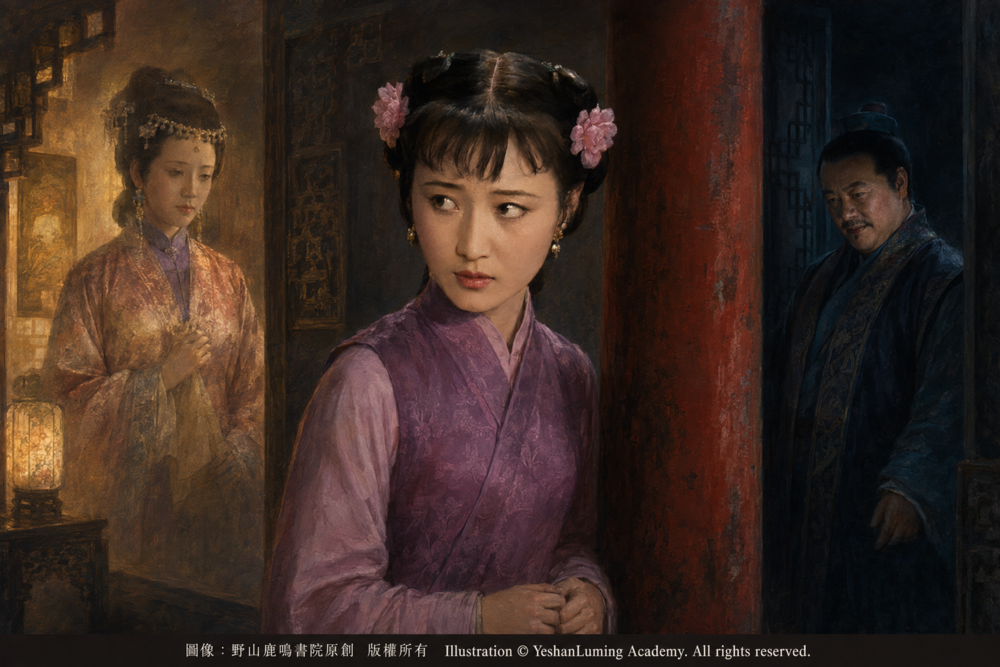
因為真正忠心殉主的人,往往還有悲痛、哀哭、守靈、安排後事的過程。可瑞珠不是。她幾乎是在秦可卿剛死之後,立刻便撞柱自盡。
這不像悲痛過度,更像是因恐懼而死, 甚至是「被死亡」。
瑞珠是秦可卿的貼身大丫鬟。她和小丫鬟寶珠一樣,都是秦可卿從秦家帶來的人。秦可卿平日的一切生活起居,她都知道;秦可卿見過什麼人,夜裡發生過什麼事,她也極可能知道。
而秦可卿,本身就是《紅樓夢》中最神秘、也最曖昧的一個女子。她表面上是賈蓉之妻,是寧國府少奶奶。可整個寧國府裡,卻始終瀰漫著一種說不出口的詭異氣息。尤其是她與公公賈珍之間那種說不清, 道不明的曖昧關係,更像一團藏在深處的黑氣, 籠罩著整個寧國府,發散著腐臭的味道。
脂硯齋後來批出「秦可卿淫喪天香樓」幾個字,更幾乎等於直接捅破了那層窗戶紙。也就是說,秦可卿的死,很可能並不乾淨。而瑞珠,作為她的貼身丫鬟,對於秦可卿死亡真相,就不可能不知情。
她也許曾深夜替秦可卿守門;也許曾看見賈珍出入天香樓;也許曾聽見那些不該聽見的聲音;見過那些不該看見的事情, 她可能是秦可卿死亡真相的直接見證人 。
她知道得太多了, 而這,才是真正可怕的地方。
因為在寧國府那樣的地方,下人知道得太多,本身就是一種危險。尤其是女子。她既沒有主子的身份,也沒有男人的權勢。她只是一個丫鬟,一個隨時可以被滅口的人。
所以,當秦可卿忽然死去時,瑞珠很可能立刻便明白了一件事:下一個,就輪到她了。因此,她選擇了最乾脆的方法。自己先死。或許她的死, 並非出於她的本意, 而是主人安排的「被死亡」。
很多人讀《紅樓夢》,總把寧國府看成荒淫腐敗的淫窩。其實這還不是最可怕的。 真正最可怕的,還不只是主子的荒淫無恥,而是裡面那種深不見底的黑暗。
在那裡,人命極輕,尤其是下人的生命。主子們犯下再大的醜行,甚至犯罪, 都沒有關係,可以託人花錢擺平。
但是為了掩蓋真相, 保全主子臉面, 最後要死的,就是那些最卑微、最無力保護自己, 但又知道真相的人。瑞珠,應該就是其中之一。
而另一個丫鬟寶珠,為了自保,走了另一條路。秦可卿死後,寶珠主動要求做她的義女,替她守靈。表面看,是盡忠;其實細想,何嘗不也是求生。因為她知道,只有躲進「忠僕為主」這把保護傘,才有可能活下去。
瑞珠沒有這樣做,她直接死了。一個求活,一個求死,卻都說明同一件事:
秦可卿之死,絕不只是病死那麼簡單,應該另有隱情。因為關係主子賈珍臉面, 凡是知情人, 都必須「被滅口」, 主子才能放心。
而這件事,對年少的賈寶玉,也是一次極大的震動。寶玉和秦可卿的關係,本就極特殊。他人生第一次真正接觸男女情事,就是在秦可卿臥房中。夢遊太虛幻境時,那個與他雲雨纏綿的「兼美」,乳名也叫可卿。
所以秦可卿在寶玉心中,從來不只是普通姪媳婦。她像一場夢。一場關於溫柔、情色、幻覺與死亡的夢。而當這場夢忽然破碎時,瑞珠又立刻「撞柱」而亡,這種接連而來的死亡陰影,對寶玉的刺激,震撼極大。
按照原著描寫:「卻說寶玉因近日林黛玉回去,剩得自己孤悽,也不和人頑耍,每到晚間便索然睡了。如今從夢中聽見說秦氏死了,連忙翻身爬起來,只覺心中似戳了一刀的不忍,哇的一聲,直奔出一口血來。」
一個尚是孩童年紀的少年, 聽到一個人的死訊, 竟然有如此的激烈反應? 可見這對他的刺激到底有多深。
寶玉也許當時還年少,未必真正看懂了寧國府裡那些骯髒祕密,但他已經本能地感覺到:這個世界,並不像表面看起來那樣乾淨。
有些事,是不能說的。有些秘密,一旦知道,人就活不長了。
後來,大觀園裡那些女孩,一個個走向悲劇結局。可真正最早讓寶玉聞到死亡氣味的人,也許正是秦可卿與瑞珠。一個淫喪天香樓,一個撞柱死於靈前。
而這兩個女子的死亡,也像一道陰影,從此慢慢籠罩了整個《紅樓夢》。
(未完待續)In Dream of the Red Chamber, some deaths are developed over several entire chapters, while others are dismissed in no more than a sentence or two.
Yet the shorter the account, the more chilling it often becomes. Ruizhu is one such figure.
She plays only a tiny role in the novel. Many readers finish the book without paying much attention to her name. Yet anyone who pauses to think about her story soon realizes that her death may be one of the most terrifying of them all.
Because she died far too quickly.
Her death does not resemble the devoted suicide of a loyal servant following a beloved mistress. Instead, it feels like the desperate act of someone who suddenly realizes there is no road left but death—and chooses her own ending before anyone else can choose it for her.
After Qin Keqing died, Cao Xueqin recorded the death of her maid Ruizhu in Chapter Thirteen with remarkable brevity:
"Among Qin's maids was one named Ruizhu. Seeing that Qin had died, she dashed herself against a pillar and died as well. Such a thing was exceedingly rare."
Cao Xueqin truly deserves his reputation as one of the greatest literary masters in Chinese history. Every word he chose carries layers of meaning. In this brief sentence, the four characters "此事可罕" ("Such a thing was exceedingly rare") are especially striking. The final character—"rare"—opens an endless space for the reader's imagination.In Dream of the Red Chamber, some deaths are developed over several entire chapters, while others are dismissed in no more than a sentence or two.
Yet the shorter the account, the more chilling it often becomes. Ruizhu is one such figure.
She plays only a tiny role in the novel. Many readers finish the book without paying much attention to her name. Yet anyone who pauses to think about her story soon realizes that her death may be one of the most terrifying of them all.
Because she died far too quickly.
Her death does not resemble the devoted suicide of a loyal servant following a beloved mistress. Instead, it feels like the desperate act of someone who suddenly realizes there is no road left but death—and chooses her own ending before anyone else can choose it for her.
After Qin Keqing died, Cao Xueqin recorded the death of her maid Ruizhu in Chapter Thirteen with remarkable brevity:
"Among Qin's maids was one named Ruizhu. Seeing that Qin had died, she dashed herself against a pillar and died as well. Such a thing was exceedingly rare."
Cao Xueqin truly deserves his reputation as one of the greatest literary masters in Chinese history. Every word he chose carries layers of meaning. In this brief sentence, the four characters "此事可罕" ("Such a thing was exceedingly rare") are especially striking. The final character—"rare"—opens an endless space for the reader's imagination.
That is all he gives us.
No preparation.
No emotional description.
No explanation.
Yet it is precisely this understated treatment that sends a chill down the reader's spine.
A servant who truly dies out of grief usually passes through stages of mourning,crying, keeping vigil beside the body, arranging the funeral, or lingering in unbearable sorrow.
Ruizhu does none of these.
Almost immediately after Qin Keqing dies, she throws herself against a pillar and kills herself.
This does not look like grief overwhelming the heart.
It looks far more like death born of terror. Or perhaps... a death that was forced upon her.
Ruizhu was Qin Keqing's personal senior maid. Like the younger maid Baozhu, she had accompanied Qin Keqing from the Qin family into the Jia household. She knew every detail of her mistress's daily life. She knew whom Qin Keqing met. She likely knew what happened behind closed doors at night.
And Qin Keqing herself is perhaps the most mysterious,and most ambiguous,young woman in Dream of the Red Chamber.
Outwardly, she was Jia Rong's wife and the young mistress of the Ningguo Mansion.
Yet throughout the entire Ningguo Mansion hangs an atmosphere that cannot quite be described,an invisible sense of corruption and unease.
Most disturbing of all is the relationship between Qin Keqing and her father-in-law, Jia Zhen: a relationship never openly stated, yet never entirely concealed.
It hovers like a mass of black smoke hidden deep within the mansion, casting its shadow over the entire household and giving off the stench of moral decay.
Later, the commentator Zhiyanzhai left behind the famous annotation:
"Qin Keqing met her disgraceful end in Tianxiang Tower."
The phrase has long been understood as implying that her death was entwined with a sexual scandal rather than resulting from natural causes.
Those few words almost tear away the final veil that Cao Xueqin deliberately left hanging.
In other words, Qin Keqing's death was very likely far from innocent.
And Ruizhu, as her personal maid, could hardly have remained ignorant of the truth behind her mistress's death.
She may have stood guard outside Qin Keqing's chamber late at night.
She may have seen Jia Zhen entering and leaving Tianxiang Tower.
She may have overheard conversations never meant for her ears.
She may have witnessed scenes that no one was ever supposed to see.
She may well have been a direct witness to the truth behind Qin Keqing's death.
She simply knew too much.
And that is precisely what made her situation so terrifying.
In a place like the Ningguo Mansion, knowing too much was itself a fatal danger.
Especially for a woman.
She possessed neither the protection of noble birth nor the power enjoyed by men.
She was merely a maidservant,someone whose life could be erased at any moment without consequence.
So when Qin Keqing suddenly died, Ruizhu may have understood one terrible truth immediately:
She would be next.
And so she chose the quickest solution. She died before anyone else could decide her fate.
Or perhaps her death was never entirely her own choice at all.Perhaps it was, in the truest sense, a death arranged for her.
Many readers describe the Ningguo Mansion as nothing more than a nest of lust and moral corruption.
But that is not what is most frightening.
Its deepest horror lies not merely in the masters' sexual depravity.It lies in the immeasurable darkness hidden beneath it all.
Within that household, human life meant almost nothing,least of all the lives of servants.
The masters could commit scandals, even crimes, and still find ways to smooth everything over with money and influence.
But when the time came to bury the truth and preserve the family's reputation, it was always the weakest, the most powerless, and those who knew too much who had to die.
Ruizhu was almost certainly one of them.
Baozhu, the other maid, chose a different path in order to survive.
After Qin Keqing's death, Baozhu voluntarily asked to become Qin Keqing's adopted daughter and remain beside her coffin as its guardian.
On the surface, it appeared to be the highest expression of loyalty.
But upon closer reflection, was it not also an act of self-preservation?
She understood that only by wrapping herself in the protective cloak of "the faithful servant devoted to her mistress" might she have any hope of surviving.
Ruizhu chose differently,She died immediately.
One sought life.
The other chose death.
Yet both point unmistakably toward the same conclusion.
Qin Keqing's death was almost certainly far more than a simple death from illness.
There was very likely another truth hidden beneath the surface.
Because the matter touched upon Jia Zhen's honor and reputation, anyone who knew what had really happened had to be silenced forever.
Only then could the master feel secure.
For the young Jia Baoyu, this was also a tremendous emotional shock.
The relationship between Baoyu and Qin Keqing had always been an unusual one.
His first true encounter with the mysteries of love and sexuality took place in Qin Keqing's own chamber.
When he wandered through the Land of Illusion in his dream, the woman who shared the dream of love with him,known as Jianmei, "She Who Combined All Beauties",also bore the childhood name Keqing.
For Baoyu, Qin Keqing was never merely his cousin's wife.
She was like a dream itself,a dream woven of tenderness, desire, illusion, and death.
When that dream suddenly shattered, Ruizhu immediately followed by dying after dashing herself against a pillar.
The shadow cast by these two deaths descended upon Baoyu one after another with overwhelming force.
Cao Xueqin records Baoyu's reaction in the original novel:
"Since Lin Daiyu had recently returned home, Baoyu had become lonely and withdrawn, finding little pleasure in the company of others. Each night he went to bed listlessly. Then, while still in his sleep, he heard someone announce Qin Keqing's death. He sprang up at once, feeling as though a knife had pierced his heart. With a cry, he suddenly spat out a mouthful of blood."
How could a boy still little more than a child react so violently merely upon hearing news of someone's death?
The answer reveals how profoundly Qin Keqing's death shook his heart.
Baoyu may still have been too young to understand the filthy secrets hidden within the Ningguo Mansion.
Yet instinctively, he sensed something was terribly wrong.
He realized that the world before him was not nearly as clean or as innocent as it appeared.
Some things can never be spoken aloud.
Some secrets become a death sentence the moment they are known.
Later, one after another, the young women of the Grand View Garden would all walk toward their own tragic destinies.
But perhaps the first people who allowed Baoyu to smell the scent of death were Qin Keqing and Ruizhu.
One met her disgraceful end in Tianxiang Tower.
The other died after smashing herself against a pillar before the mourning hall.
From that moment onward, the deaths of these two women became a dark shadow that slowly spread across the entire world of Dream of the Red Chamber.
(To be continued)