因此,「病死」便成了最體面的說法。可是曹雪芹終究還是不甘,所以他在脂本的評註中留下:
「秦可卿淫喪天香樓。」
這個評註,像一滴黑血,滲進整部《紅樓夢》最華麗的地方, 讓讀者自己思考。
而少年寶玉,也在秦可卿死後,真正感受到死亡的可怕。以前他雖然也聽說過有人死去,可那些人離他很遠。但秦可卿不同,她是真正疼過他的人。是真正讓他感受到溫柔的人。她是寶玉少年時代,第一個朦朦朧朧感受到「情」的人。
可就是這樣好的一個人,忽然死了。而且死得那麼神秘,那麼壓抑,那麼不可言說。
寶玉雖然年少,卻並不傻。他已經隱隱約約感覺到,大人們嘴裡說的那些話,不是真相。而在那些豪華院落、錦衣玉食、歡聲笑語背後,其實還藏著某種極黑暗、極骯髒的東西。
只是那時的寶玉,還太小。他還不真正明白,大觀園裡那些年輕美麗的少女們,其實很多人,命運早已註定。
秦可卿,只是第一個。
(未完待續)In Dream of the Red Chamber, the very first young girl to be swallowed by the black hole that was the Jia clan was Qin Keqing, the most beautiful, most radiant, and most gentle among all the women of the Rongguo and Ningguo Houses.
Within the Ning Mansion, Qin Keqing occupied a very special place. She was the wife of Jia Rong, and by family seniority she was technically Baoyu’s grandniece-in-law, yet in reality she was only a few years older than he was. She was young, beautiful, tender in manner, soft-spoken, and gracious toward everyone. There was upon her a mature charm unlike that of any other woman in the Jia household.
Baoyu had grown up surrounded by girls, and by nature he loved the company of women. Because of this, he developed a special attachment to Qin Keqing.
More importantly, Qin Keqing herself showed Baoyu a kind of affection that was difficult to describe. She did not restrain him like Lady Wang, nor lecture him constantly like Xiren, nor beat and scold him like Jia Zheng. When she looked at Baoyu, it was as though she were gazing upon a flawless jade untouched by the dust of the mortal world. In her eyes there was always a faint tenderness, almost pity. It could be said that in the entire Jia household, aside from Daiyu, Qin Keqing was the person who truly understood Baoyu’s nature best.
For Baoyu, there was something even more special about Qin Keqing: his awakening to desire, his very first contact with the mysteries between men and women, took place in Qin Keqing’s chamber.In Dream of the Red Chamber, the very first young girl to be swallowed by the black hole that was the Jia clan was Qin Keqing, the most beautiful, most radiant, and most gentle among all the women of the Rongguo and Ningguo Houses.
Within the Ning Mansion, Qin Keqing occupied a very special place. She was the wife of Jia Rong, and by family seniority she was technically Baoyu’s grandniece-in-law, yet in reality she was only a few years older than he was. She was young, beautiful, tender in manner, soft-spoken, and gracious toward everyone. There was upon her a mature charm unlike that of any other woman in the Jia household.
Baoyu had grown up surrounded by girls, and by nature he loved the company of women. Because of this, he developed a special attachment to Qin Keqing.
More importantly, Qin Keqing herself showed Baoyu a kind of affection that was difficult to describe. She did not restrain him like Lady Wang, nor lecture him constantly like Xiren, nor beat and scold him like Jia Zheng. When she looked at Baoyu, it was as though she were gazing upon a flawless jade untouched by the dust of the mortal world. In her eyes there was always a faint tenderness, almost pity. It could be said that in the entire Jia household, aside from Daiyu, Qin Keqing was the person who truly understood Baoyu’s nature best.
For Baoyu, there was something even more special about Qin Keqing: his awakening to desire, his very first contact with the mysteries between men and women, took place in Qin Keqing’s chamber.
That day, Baoyu accompanied Grandmother Jia to the Ning Mansion to admire the flowers. At noon he grew sleepy and took a nap in Qin Keqing’s room. In his dream he wandered into the Land of Illusion and first experienced the pleasures of love with the Fairy of Combined Beauty. And that fairy’s childhood name just happened to be “Keqing.” This was no coincidence. Cao Xueqin was hinting that Qin Keqing herself was the initiator of Baoyu’s youthful world of desire. Because of this, Qin Keqing held an extraordinarily special place in Baoyu’s heart.
To Baoyu, Qin Keqing was different because she did not constantly make his heart ache the way Daiyu did, nor was she so dignified and proper as Baochai, causing him to keep his distance. She was more like a lovely older sister, more like a soft pink dream wrapped in mist, a dream Baoyu wished to remain inside forever. Yet that dream shattered very quickly.
The death of Qin Keqing is like a cloud of fog. From beginning to end, it carries a strange and sinister air that cannot be explained away.
On the surface, Cao Xueqin wrote that she died of illness. That is the version described in the one-hundred-and-twenty-chapter Chengjia edition of Dream of the Red Chamber that people read today. Yet the more carefully one reads, the more deeply one thinks, the more one feels that things were not so simple. Especially because of the famous annotation left behind by Zhiyanzhai:
“Qin Keqing died from sexual scandal at the Tower of Heavenly Fragrance.”
Here it is necessary to explain briefly who Zhiyanzhai was, and what this famous annotation actually means.
Zhiyanzhai was the name of a person, the reader and commentator of the original first eighty chapters of Dream of the Red Chamber. This person was extremely close to Cao Xueqin. Some say Zhiyanzhai was actually Cao Xueqin’s wife. Others say it was a close relative or friend. Some even believe it was Cao Xueqin himself.
Whatever the truth may be, whether Zhiyanzhai was a wife, a friend, or even Cao Xueqin himself, this reader of the original manuscript, who was able to write commentary directly onto Cao Xueqin’s handwritten drafts, must have been among the people who understood Cao Xueqin best. Therefore, the manuscript annotated by Zhiyanzhai should also be closer to Cao Xueqin’s original creative intentions.
The annotated version of The Story of the Stone, which was the original title of Dream of the Red Chamber, later came to be known as the “Zhi edition.” The Zhi edition was essentially a handwritten copy of Cao Xueqin’s original manuscript.
Therefore, the annotation found in the Zhi edition — “Qin Keqing died from sexual scandal at the Tower of Heavenly Fragrance” — indicates that in Cao Xueqin’s original conception, Qin Keqing did not die of illness at all. She died through “sexual scandal at the Tower of Heavenly Fragrance.” In other words, she died because of illicit sexual relations.
Then the question naturally arises: with whom was Qin Keqing involved at the Tower of Heavenly Fragrance? And why did it cost her life?
Naturally, such a question drew the attention of Redology scholars. Many researchers of Dream of the Red Chamber concluded that in Cao Xueqin’s original story, Qin Keqing did not die of illness. Rather, she engaged in an incestuous relationship with her father-in-law Jia Zhen — what was known as “climbing the ashes” — and after the affair was exposed, she was forced to hang herself in the Tower of Heavenly Fragrance.
Imagine this clearly. Qin Keqing was a girl with no family background at all, an orphan adopted from an orphanage by the minor official Qin Ye. She was young and beautiful, and because of her beauty, Jia Zhen selected her and married her to his son Jia Rong.
Because she was beautiful, and because she was weak and vulnerable, from the very beginning she was desired by the wolf-like and lustful Jia Zhen. Under the pretext of arranging a marriage for his son, he locked Qin Keqing inside the cage of the Ning Mansion, until at last the incestuous relationship occurred exactly as he wished. Jia Zhen suffered no consequences whatsoever afterward, yet Qin Keqing was supposedly the one who had to hang herself. The hidden truth behind this, anyone living today should be able to understand with even the slightest bit of thought.
There are Redology scholars who have written long articles arguing that Qin Keqing herself was promiscuous by nature, that she deliberately seduced Jia Zhen, and that after the affair was exposed she was forced to hang herself.
I am not a Redology scholar. I truly do not understand why these scholars insist on pouring all the blame onto Qin Keqing. Does this matter really still require investigation?
On one side stood Jia Zhen, the patriarch who held absolute power of life and death within the family. On the other side stood Qin Keqing, a young daughter-in-law with no background whatsoever, beautiful yet helpless and defenseless. Under such circumstances, who was truly responsible for initiating this relationship? Is there really any need to “research” that question?
Chinese men, especially those in positions of great power, have long possessed a terrible habit. When they commit wrongdoing, they refuse to accept responsibility themselves, and instead push the blame onto women, sanctimoniously calling them “disasters brought by beauty.”
From Mo Xi of the Xia dynasty, to Daji of the Shang dynasty; from Bao Si of the Western Zhou, to Yang Guifei of the Tang dynasty — the fall of which dynasty was truly caused by these powerless women hidden away in palace chambers, rather than by foolish emperors themselves?
I do not believe Cao Xueqin thought this way. He would never have accepted this theory of “fatal women” used to shift men’s responsibilities onto women. He would never have blamed the fall of the Jia family upon pitiable women such as Qin Keqing.
Through Baoyu’s own words, Cao Xueqin clearly expressed his understanding of women: they were as pure as water itself. He would never have attributed Jia Zhen’s lust and depravity to the unfortunate Qin Keqing. If he could see today’s Redology scholars enthusiastically discussing theories about Qin Keqing being lustful and shamelessly seducing Jia Zhen, he would probably leap angrily from his grave to argue with them in person.
After Qin Keqing died, the entire Jia household shook with cries of grief, especially Jia Zhen himself. His reaction far exceeded the sorrow a normal father-in-law would show toward a daughter-in-law. He wept as though mourning his own parents, almost out of his mind with grief. For Qin Keqing’s funeral he spared no expense, even using precious timber originally reserved for Prince Yizhong to construct her coffin.
Qin Keqing’s funeral was conducted with earthshaking extravagance. Because of its excessive grandeur, its illegal coffin, and the attendance of guests whose rank violated court ritual — including the illegal appearance of the Prince of Beijing — the Rong and Ning Houses displayed arrogance and overreach before the imperial center of power. In the end, the emperor came to regard the Ning Mansion as the chief offender, setting the entire Jia clan upon an irreversible path toward ruin. But that comes later in the story.
Does this not seem strange? Why would the death of a daughter-in-law warrant such an enormous spectacle?
When the old stableman Jiao Da became drunk, he once shouted:
“Those who crawl into ashes crawl into ashes, and those who sleep with younger brothers sleep with younger brothers!”
The phrase “climbing the ashes” was a vulgar folk expression referring to a father-in-law violating his son’s wife. Cao Xueqin never stated it openly, yet through Jiao Da’s drunken words, he had already made it perfectly clear.
From top to bottom, the entire Ning Mansion was filled with a rotten and licentious atmosphere. And trapped within it all, Qin Keqing, though outwardly glamorous, was very likely already collapsing inside, suffering beyond endurance.
She was an orphan, a fragile young woman with no powerful family background and no authority of her own. Though she appeared to live among silks and luxuries inside a noble mansion, in truth she was terribly weak and defenseless. Before the violations of the patriarch Jia Zhen, she had no power to resist.
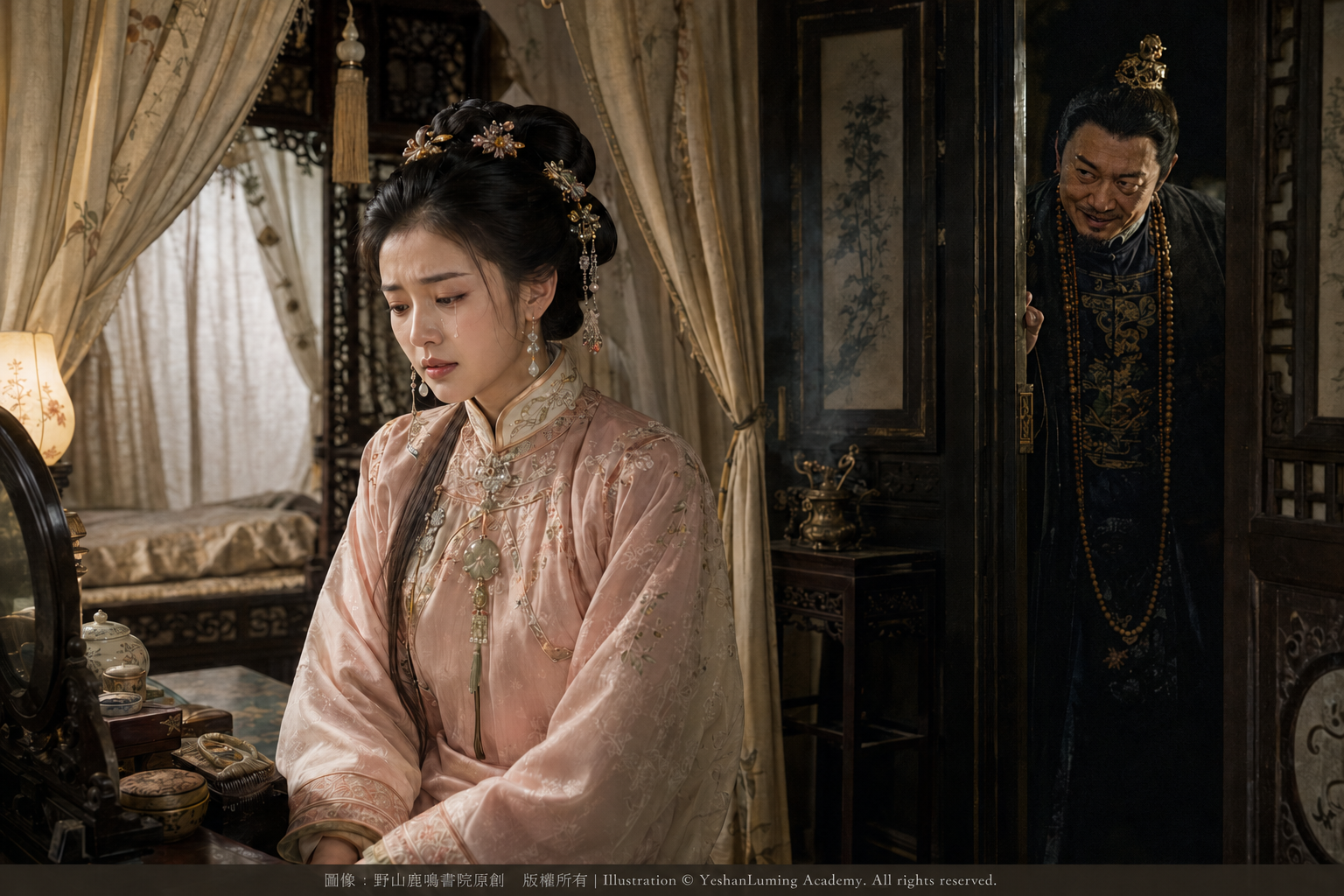
If her father-in-law wanted to violate her, what could she possibly do? If she resisted, she would not survive. If she submitted, she still would not survive. In the end, Jia Zhen obtained what he wanted, while she alone was forced to die and bear the reputation of being sexually immoral. And to preserve the dignity of the patriarch Jia Zhen, the true cause of her death could never be revealed publicly.
點擊查看大圖 Click to enlarge
Thus, “death by illness” became the most respectable explanation. Yet Cao Xueqin was ultimately unwilling to accept that completely, so he left behind this annotation in the Zhi edition:
“Qin Keqing died from sexual scandal at the Tower of Heavenly Fragrance.”
That annotation is like a drop of black blood seeping into the most magnificent parts of Dream of the Red Chamber, forcing readers to think for themselves.
And the young Baoyu, after Qin Keqing’s death, truly felt the terror of death for the first time. Before this, he had heard of people dying, but those deaths were far removed from him. Qin Keqing was different. She was someone who had genuinely cared for him. Someone who had truly shown him tenderness. She was the first person in Baoyu’s youth who made him vaguely understand the meaning of “love.”
Yet such a wonderful person suddenly died. And died in such a mysterious, oppressive, unspeakable way.
Though Baoyu was young, he was not foolish. He had already begun to sense vaguely that the words spoken by the adults were not the truth. Behind those luxurious courtyards, splendid clothes, fine food, laughter, and celebration, there lurked something profoundly dark and filthy.
But at that time Baoyu was still too young. He did not yet truly understand that many of the young and beautiful girls inside the Grand View Garden already had their fates decided from the very beginning.
Qin Keqing was only the first.
(To be continued)