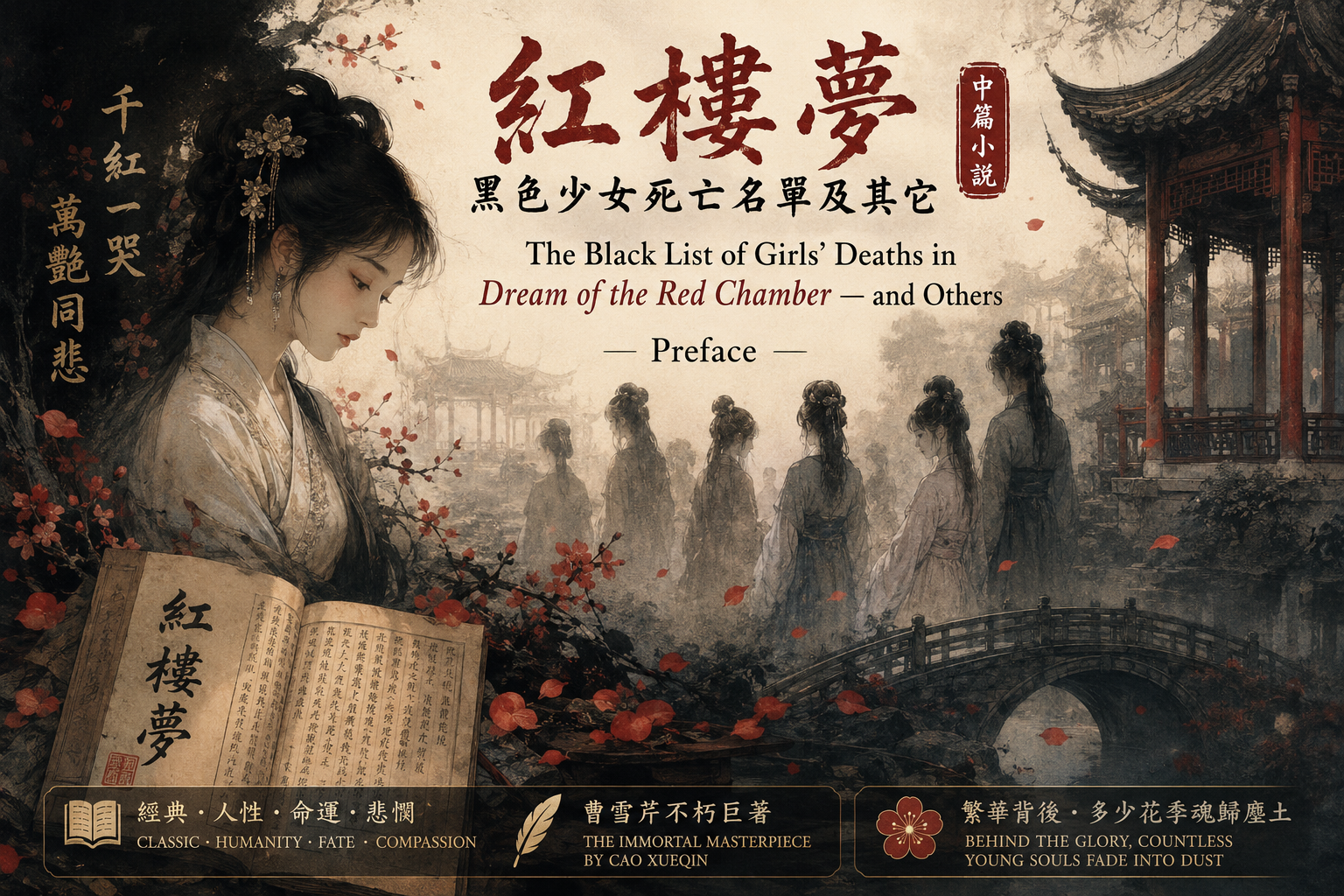
紅樓夢黑色少女死亡名單及其它 序The Black List of Girls’ Deaths in Dream of the Red Chamber — and Others: PrefaceThe Black List of Girls’ Deaths in Dream of the Red Chamber — and Others: Preface紅樓夢黑色少女死亡名單及其它 序
一部紅樓夢文學巨著, 從乾隆二十五年,即公元一七六零年,曹雪芹生前最後一個重大改定本, 庚辰本起算,至今已有 266年。
曹雪芹由於種種原因, 只寫了前八十回,未能完成巨著 。 後四十回現在大多數人承認, 是高鶚在曹雪芹遺稿基礎上續寫的。
高鶚與程偉元合作,在一七九一年,出版了用木版活字印刷,一百二十回的「程甲本」紅樓夢, 使之流傳至今 , 也就是我們現在看到的 一百二十回《紅樓夢》版本。 這 距今天,也有二百三十五年了。
兩百多年來, 這部文學巨著,擾動了整個中國文學界, 不同流派紅學研究者, 從不同角度考證作者曹雪芹的成書動機, 對書中的方方面面進行研究,考證, 甚至形成了不同的紅學學派,至今仍然爭論不休, 在很多問題上還都達不成共識。
那麼這一部《紅樓夢》, 到底寫的是什麼 ? 從不同的著眼點,不同的角度, 大家看到的好像都不一樣,就像是瞎子摸象。一部紅樓夢文學巨著, 從乾隆二十五年,即公元一七六零年,曹雪芹生前最後一個重大改定本, 庚辰本起算,至今已有 266年。
曹雪芹由於種種原因, 只寫了前八十回,未能完成巨著 。 後四十回現在大多數人承認, 是高鶚在曹雪芹遺稿基礎上續寫的。
高鶚與程偉元合作,在一七九一年,出版了用木版活字印刷,一百二十回的「程甲本」紅樓夢, 使之流傳至今 , 也就是我們現在看到的 一百二十回《紅樓夢》版本。 這距今天,也有二百三十五年了。
兩百多年來, 這部文學巨著,擾動了整個中國文學界, 不同流派紅學研究者, 從不同角度考證作者曹雪芹的成書動機, 對書中的方方面面進行研究,考證, 甚至形成了不同的紅學學派,至今仍然爭論不休, 在很多問題上還都達不成共識。
那麼這一部《紅樓夢》, 到底寫的是什麼 ? 從不同的著眼點,不同的角度, 大家看到的好像都不一樣,就像是瞎子摸象。
有的看見了賈府的榮華富貴, 以為這是了解當時社會的絕佳窗口; 有的看到寶黛愛情的悲劇,認為遠比《羅密歐和茱麗葉》, 有更深悲劇色彩; 有人看到《好了歌》, 裡面對世人警示的哲理;還有人, 甚至研究榮國府的烹調精美菜餚, 創作出紅樓菜系,生意好的不得了。
真是五花八門, 各有所好, 各取所需, 各有所得。 足見這部巨著, 內容真是廣,大, 博,深, 兩百多年了, 研究仍然繼續。
可是我卻不一樣, 這本書, 讀過幾次, 每次讀, 都讓我感到渾身發冷, 我看到的不是賈府的繁華世界, 不是寶玉黛玉的淒美愛情, 我看到的是一大串, 黑色少女死亡名單。 繼續讀下去, 發現還遠不止這些, 所以我又加了三個字, 及其它。
被賈府這個黑洞吞噬的, 不止那些可憐的少女, 還有許多, 許多,甚至包括賈府那個至高無上的實際掌權者, 王熙鳳。 她最有權, 最有心機, 從來都是強者, 勝者, 她不是受害人, 而是加害於人者。
但是就是她, 也免不了被這個黑洞吞噬, 最後下場最慘, 被丈夫賈璉休妻,貧病交加,死後連一口棺材都沒有, 一領破席卷身, 棄置於亂喪崗。 其實, 她又何嘗不也是,被這個黑洞吞噬的一個 , 。。。。。。
在賈府, 榮府花團錦簇的繁華背後,卻站著一排排,走向死亡的少女。大觀園裡,花團錦簇,鶯聲燕語,人人看上去,都活得鮮亮,美麗,讓人羨慕。可是曹雪芹卻早早就預言, 告訴讀者:
千紅一哭, 萬艷同悲。
那些繁華熱鬧, 花團錦簇背後, 是被賈府這個黑洞吞噬的一個個花季少女。
一個又一個女孩,被吞沒的人生。有的死於愛情,有的死於名節,有的死於權力,有的死於封建禮教,有的死於人心黑暗,有的死於這個根本不容真情存在的世界,。。。。。。
而最可怕的是:這些死亡,往往並不轟轟烈烈。
有時只是簡單的:一句話, 一口井,一堵牆, 一場病,一樁婚事,一句羞辱,一場毒打,一次逐出,甚至只是,一點點絕望,然後,人就沒了。
少年賈寶玉,從小生長在脂粉堆裡,被一群天真少女包圍。他愛所有那些女孩,親近她們,憐惜她們,甚至想保護她們。 他認為:女孩都是水做的, 如同山間清泉水那麼清澈純潔。
可是, 現實世界中, 他卻無力為她們做什麼, 更不用說保護。他只能眼睜睜地看著她們,一個接一個步入死亡, 他能做的不過是事後偷偷祭奠一下她們的亡魂, 滴幾滴辛酸淚, 然後等待下一個同樣的悲劇,再次發生。
眼睜睜看著,那些最美好、最鮮活、最純潔, 最有靈性的女孩,一個一個死去。他阻止不了,救不了。這種感覺, 非常人可以忍受, 這些死亡,像一把又一把黑色尖刀,一次次插進寶玉心裡。最後,他終於對這個世界徹底失望, 絕望 ,他無力改變什麼, 最終選擇離開,。。。。。。
因此,《紅樓夢》,曹雪芹真正寫的,也許並不只是愛情。而是一場:對美好,如何被毀滅的巨大哀悼。
(未完待續)This great literary masterpiece, Dream of the Red Chamber, has now existed for 266 years if counted from the Gengchen Manuscript, the final major revised edition produced during Cao Xueqin’s lifetime in the twenty-fifth year of the Qianlong Emperor, corresponding to the year 1760.
For various reasons, Cao Xueqin completed only the first eighty chapters and was unable to finish the monumental work. Today, most scholars acknowledge that the final forty chapters were continued by Gao E on the basis of Cao Xueqin’s surviving drafts.
In 1791, Gao E cooperated with Cheng Weiyuan to publish the 120-chapter “Cheng Jia Edition” of Dream of the Red Chamber, printed with movable wooden type, allowing the novel to circulate down to the present day. This is the 120-chapter version of Dream of the Red Chamber that we now read. From that publication until today, another 235 years have passed.
For more than two centuries, this literary giant has stirred the entire Chinese literary world. Scholars of different schools of Redology have examined Cao Xueqin’s motives for writing the novel from every possible angle, studying and debating every aspect of the book. Entire schools of Redology have formed around it. Even today, arguments continue endlessly, and on many questions no consensus has ever been reached.
So then, what exactly is Dream of the Red Chamber about? Seen from different perspectives and different points of view, everyone seems to see something different, like blind men feeling different parts of an elephant.This great literary masterpiece, Dream of the Red Chamber, has now existed for 266 years if counted from the Gengchen Manuscript, the final major revised edition produced during Cao Xueqin’s lifetime in the twenty-fifth year of the Qianlong Emperor, corresponding to the year 1760.
For various reasons, Cao Xueqin completed only the first eighty chapters and was unable to finish the monumental work. Today, most scholars acknowledge that the final forty chapters were continued by Gao E on the basis of Cao Xueqin’s surviving drafts.
In 1791, Gao E cooperated with Cheng Weiyuan to publish the 120-chapter “Cheng Jia Edition” of Dream of the Red Chamber, printed with movable wooden type, allowing the novel to circulate down to the present day. This is the 120-chapter version of Dream of the Red Chamber that we now read. From that publication until today, another 235 years have passed.
For more than two centuries, this literary giant has stirred the entire Chinese literary world. Scholars of different schools of Redology have examined Cao Xueqin’s motives for writing the novel from every possible angle, studying and debating every aspect of the book. Entire schools of Redology have formed around it. Even today, arguments continue endlessly, and on many questions no consensus has ever been reached.
So then, what exactly is Dream of the Red Chamber about? Seen from different perspectives and different points of view, everyone seems to see something different, like blind men feeling different parts of an elephant.
Some see the wealth and splendor of the Jia family and regard the novel as a perfect window into the society of that era; some see the tragic love between Baoyu and Daiyu, believing it possesses an even deeper tragic power than Romeo and Juliet; some focus on The Song of All Good Things and the philosophical warnings it offers to the world; still others even study the exquisite cuisine of the Rongguo Mansion and create entire “Red Chamber culinary traditions” from it, with astonishing commercial success.
It truly is a dazzling variety of interpretations. Each person takes from the novel what they desire, each finds what they seek. This alone shows how vast, broad, profound, and inexhaustible this masterpiece truly is. More than two hundred years have passed, and the study of it still continues.
But I am different. I have read this book several times, and each time I read it, I feel a chill spread through my entire body. What I see is not the prosperous world of the Jia household, nor the tragic romance of Baoyu and Daiyu. What I see is a long black list of dead girls. And as I kept reading, I realized it was far more than that alone. That is why I added three extra words to the title: “and Others.”
The black hole that was the Jia household devoured not only those pitiful girls, but many, many others as well , including Wang Xifeng herself, the true power behind the Jia family. She possessed the greatest authority, the sharpest schemes, and was always the strong one, the victor. She was not merely a victim, but often a perpetrator of harm against others.
And yet even she could not escape being swallowed by that black hole. In the end she met the most miserable fate of all: cast aside by her husband Jia Lian, crushed by poverty and illness, and after death denied even a proper coffin. Her body was wrapped only in a tattered mat and abandoned in a paupers’ graveyard. And in truth, was she not also one more soul consumed by that same black hole…?
Behind the dazzling splendor and blooming prosperity of the Rongguo Mansion stood row after row of girls walking steadily toward death. Within the Grand View Garden, amid flowers, laughter, songs, and beauty, everyone appeared so radiant and enviable. Yet Cao Xueqin had already foretold the truth long ago, warning his readers:
“One thousand crimson flowers weep as one,
Ten thousand beauties share the same sorrow.”
Behind all that brilliance and luxury stood one flower-like young girl after another, swallowed whole by the black hole of the Jia household.
One after another, girls whose lives were devoured. Some died for love, some for chastity and reputation, some for power, some for feudal morality, some for the darkness of the human heart, and some because they lived in a world that could not tolerate genuine feeling at all…
And most terrifying of all: these deaths were rarely grand or dramatic.
Sometimes all it took was a single sentence, a well, a wall, an illness, a marriage arrangement, an insult, a beating, an expulsion, or merely a little despair. And then the person was gone.
The young Jia Baoyu grew up surrounded by powder and perfume, encircled by innocent girls. He loved all of them, stayed close to them, cherished them, and even wished to protect them. He believed that girls were made of water , pure and clear like mountain spring water itself.
Yet in the real world, he was powerless to do anything for them, much less protect them. All he could do was watch helplessly as they walked one by one toward death. The only thing left to him afterward was to secretly mourn their spirits, shed a few bitter tears, and wait for the next identical tragedy to happen again.
He watched helplessly as those girls, the most beautiful, most vivid, most innocent, most spiritual souls , died one after another. He could not stop it. He could not save them. Such suffering is almost beyond human endurance. Each death became another black dagger stabbing into Baoyu’s heart. In the end, he became utterly disappointed in this world, utterly hopeless. Unable to change anything, he finally chose to leave…
Therefore, what Cao Xueqin truly wrote in Dream of the Red Chamber may not merely be a love story. Rather, it is a vast lament for how beauty itself is destroyed.
(To be continued)