
金伯利岩的故事·鑽石從地幔到人間的搬運夫The Story of Kimberlite · The Carrier That Brings Diamonds from the Mantle into the Human World
The World of Gemstones · Diamond SeriesThe Story of Kimberlite · The Carrier That Brings Diamonds from the Mantle into the Human World
The World of Gemstones · Diamond Series金伯利岩的故事·鑽石從地幔到人間的搬運夫
寶石世界·鑽石篇
寶石世界·鑽石篇(109)The World of Gemstones · Diamond Series (109)
我們已經知道,大多數寶石級鑽石形成於地下約一百五十至兩百公里的地幔深處,另有少量超深源鑽石,可能形成於更加深入的地幔區域。許多鑽石早在數億乃至數十億年前便已形成,並在上千攝氏度的高溫與地表數萬倍的高壓環境中,保存了漫長歲月。
那麼,在如此深的地下形成的鑽石,究竟如何來到地球表面,最後被人類發現?
這就要依靠一種極其特殊的深源火山活動。
這種火山活動可以將地幔深處的物質,包括早已形成的鑽石,以驚人的速度帶向地表。岩漿冷卻後,形成一種特殊的火山岩,這就是金伯利岩(Kimberlite)。
金伯利岩並不是創造鑽石的地方。大多數鑽石在金伯利岩漿出現以前,早已在地幔中形成並保存了億萬年。金伯利岩所扮演的角色,是把這些鑽石從地球深處運送到接近地表的地方。
因此,如果把鑽石比作一位長眠於地幔中的旅客,那麼金伯利岩,就是把它帶到人間的搬運夫。
如果深源岩漿上升得太慢,鑽石便可能在溫度、壓力及周圍化學環境改變的過程中受到溶蝕或破壞,甚至發生部分石墨化。因此,快速上升,是鑽石能否保存下來的重要條件。
金伯利岩的神奇之處,正在於它富含二氧化碳、水及其他揮發性物質。這有些像一瓶被劇烈搖晃後突然打開的碳酸飲料:當深處的壓力迅速釋放時,岩漿便會猛烈膨脹,裹挾著地幔岩石與鑽石,向上快速衝刺。
我們已經知道,大多數寶石級鑽石形成於地下約一百五十至兩百公里的地幔深處,另有少量超深源鑽石,可能形成於更加深入的地幔區域。許多鑽石早在數億乃至數十億年前便已形成,並在上千攝氏度的高溫與地表數萬倍的高壓環境中,保存了漫長歲月。
那麼,在如此深的地下形成的鑽石,究竟如何來到地球表面,最後被人類發現?
這就要依靠一種極其特殊的深源火山活動。
這種火山活動可以將地幔深處的物質,包括早已形成的鑽石,以驚人的速度帶向地表。岩漿冷卻後,形成一種特殊的火山岩,這就是金伯利岩(Kimberlite)。
金伯利岩並不是創造鑽石的地方。大多數鑽石在金伯利岩漿出現以前,早已在地幔中形成並保存了億萬年。金伯利岩所扮演的角色,是把這些鑽石從地球深處運送到接近地表的地方。
因此,如果把鑽石比作一位長眠於地幔中的旅客,那麼金伯利岩,就是把它帶到人間的搬運夫。
如果深源岩漿上升得太慢,鑽石便可能在溫度、壓力及周圍化學環境改變的過程中受到溶蝕或破壞,甚至發生部分石墨化。因此,快速上升,是鑽石能否保存下來的重要條件。
金伯利岩的神奇之處,正在於它富含二氧化碳、水及其他揮發性物質。這有些像一瓶被劇烈搖晃後突然打開的碳酸飲料:當深處的壓力迅速釋放時,岩漿便會猛烈膨脹,裹挾著地幔岩石與鑽石,向上快速衝刺。
根據不同地質模型推測,金伯利岩漿可能在數小時至一兩天內,穿越一百多公里的地幔與地殼,把鑽石帶到接近地表的位置。
正因為速度足夠快,鑽石原有的晶體結構才更有可能完整保存,不至於在漫長而緩慢的上升過程中被破壞。
這類深源岩漿活動可能極為迅速而猛烈,並在近地表形成岩管、火山碎屑岩及其他複雜的火山構造。
其中最典型的結構,就是金伯利岩管(Kimberlite Pipe)。
金伯利岩管通常呈現上寬下窄的形狀,類似倒置的漏斗或煙囪。它是古代金伯利岩漿穿越地殼、接近地表時留下的管狀岩體,其深部岩漿來源可以追溯到地幔。
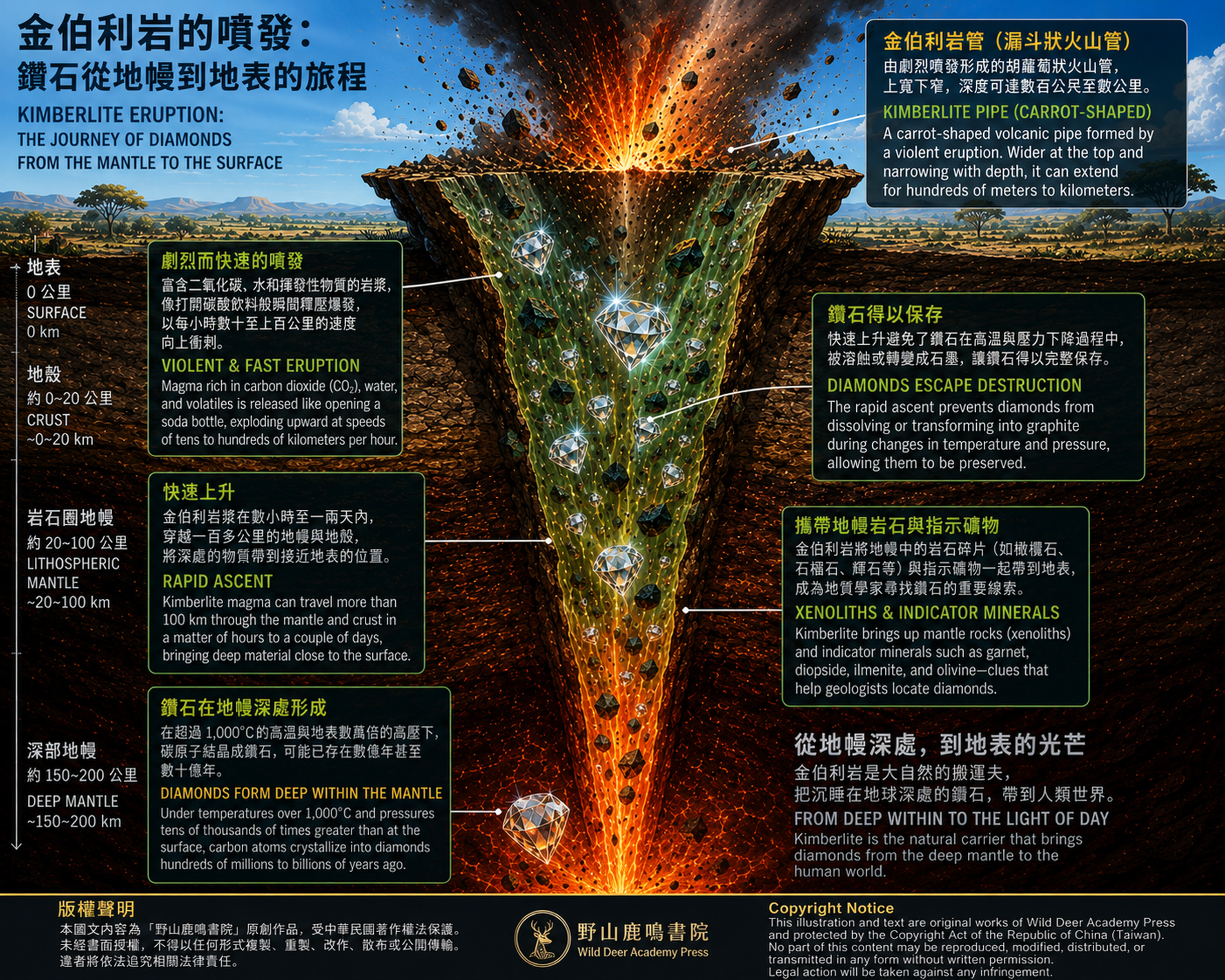
Click to enlarge
不過,幸運或者說遺憾的是,人類歷史上並沒有留下直接目睹典型鑽石金伯利岩噴發的可靠紀錄。
絕大多數已知金伯利岩都非常古老,但坦桑尼亞的伊格維西山(Igwisi Hills)火山,被認為可能是目前已知最年輕的金伯利岩火山之一,其形成時間可能只有大約一萬年。即便如此,對於人類歷史來說,它仍然發生得太早,沒有人真正記錄下那一刻。
科學家研究過去數億年間金伯利岩噴發與板塊運動的關係,發現當超大陸開始裂解、地殼受到拉伸時,金伯利岩活動往往更加頻繁。
甚至有研究人員把不同年代金伯利岩噴發的時間資料轉化成音符,製作成一段象徵「地球深處活動節奏」的音樂。
金伯利岩(Kimberlite)的名稱,來自南非城市金伯利(Kimberley)。十九世紀後期,正是在這一地區,人類第一次真正找到含有大量鑽石的原生岩體,從此揭開了現代鑽石礦業的序幕。
人們有時把金伯利岩稱為鑽石的「時空特快列車」。這個比喻很形象,因為它從地幔深處出發,把在那裡沉睡了億萬年的鑽石,迅速帶到接近地表的位置。
在十九世紀以前,人類發現的鑽石,主要是沖積鑽石,也就是從河流、溪谷或河床砂礫中找到的鑽石。古代印度以及後來的巴西,都曾是重要的沖積鑽石產地。
當時的人們雖然能在河流中找到鑽石,卻不知道這些鑽石真正的源頭在哪裡。
直到十九世紀六十年代,南非鑽石史開始發生轉折。
一八六七年,一名十五歲的南非男孩埃拉斯默斯·雅各布斯(Erasmus Jacobs),在奧蘭治河附近撿到一顆閃閃發光的石頭,最初只是把它當作玩具。
後來,這顆石頭被確認為一顆重達二十一點二五克拉的鑽石,並被命名為「尤里卡鑽石」(Eureka Diamond)。
尤里卡鑽石的確認,引起了人們對南非鑽石資源的巨大興趣。此後,更多鑽石相繼被發現,其中包括一八六九年發現的著名「南非之星」。
隨著發現不斷增加,成千上萬的探礦者, 冒險家湧入南非,最終引發了席捲當地的鑽石熱。
起初,人們仍然主要在河流、砂礫及黃色地表土層中尋找鑽石。後來,隨著挖掘不斷深入,地下開始出現一種堅硬的藍灰色岩石,當時被稱為「藍地」(Blue Ground)。
更令人震驚的是,這種藍灰色岩石中竟然直接含有天然鑽石原石。
人類終於第一次發現,鑽石不只是散落在河流中的石頭,它們還存在於一種特殊的原生火山岩體之中。
這種岩石後來便以南非金伯利地區命名,被稱為金伯利岩。
為了開採金伯利岩中的鑽石,大量礦工使用鐵鎬、鏟子與簡單工具,在金伯利鎮附近進行露天挖掘。
經過多年開採,最終形成了一個地表寬約四百六十多公尺、露天採掘深度約二百四十公尺的巨大坑洞,後來被稱為「金伯利大坑」(Big Hole)。
它成為世界上最著名的人工露天採礦坑之一,也是南非鑽石熱最具代表性的歷史遺跡。
地質學研究證明,金伯利岩是一類來源於地幔深處、富含揮發性成分的火成岩。它具有在短時間內迅速向上運動的能力,並能把地幔中的岩石碎片、礦物及鑽石一起帶到近地表。
這種快速搬運能力,是鑽石得以保存並最終被人類發現的關鍵。
但是,並不是所有金伯利岩都含有鑽石。
即使某一岩體確實含有鑽石,也不一定具有經濟開採價值。真正能夠形成大型鑽石礦山的金伯利岩管,在自然界中只是極少數。
因此,發現金伯利岩,只能說明附近可能存在鑽石,並不能保證一定能夠找到具有商業價值的礦床。
這種不確定性,使鑽石勘探, 開採始終充滿風險,也充滿誘惑。
為了尋找埋藏在地下的金伯利岩管,地質學家除了直接尋找鑽石之外,還會尋找一些特殊的指示礦物。
常見的金伯利岩指示礦物,包括某些鉻質鎂鋁榴石、鉻透輝石、鎂鈦鐵礦與鎂橄欖石等。
這些礦物能夠承受長距離風化與搬運,並保存在河流沉積物中。對地質學家來說,它們就像散落在大地上的線索,可以幫助判斷上游或地下是否可能存在金伯利岩管及鑽石。
南非金伯利岩的發現,正式開啟了現代原生鑽石礦業時代。
人類不再只是沿著河流碰運氣,而是開始運用地質學、礦物學和工程技術,主動尋找鑽石的原生礦床。
此後,世界各地陸續發現了更多金伯利岩管。南非、博茨瓦納、俄羅斯、加拿大以及其他地區,都建立起大型現代鑽石礦山。
這些礦山不僅生產了數量驚人的鑽石,也孕育出許多世界著名的傳奇名鑽。
例如我們前面曾經提到的庫里南鑽石,就是在南非一座金伯利岩管礦山中發現的。
它並不是出自金伯利大坑,而是出自當時被稱為普雷米爾礦(Premier Mine)的礦山,也就是後來的庫里南礦(Cullinan Mine)。
一九〇五年,這顆重達三千一百零六點七五克拉的巨大寶石級鑽石原石被發現,震驚了整個世界。
關於庫里南鑽石如何被切割、如何進入英國王室,以及它在歷史中的地位,我們將在後面的「名鑽篇」中詳細介紹。
金伯利岩的意義,並不只在於它可能含有鑽石。
它還像一封來自地球深處的信件。
金伯利岩漿在快速上升過程中,會把地幔中的岩石碎片與礦物一起帶到地表。科學家通過研究這些物質,可以了解人類無法直接到達的地幔環境,推測地球深處的溫度、壓力、物質組成及演化歷史。
因此,金伯利岩不僅具有重要的經濟價值,也具有極高的科學研究價值。
對普通讀者來說,金伯利岩也許只是一個陌生而拗口的岩石名稱。
但實際上,它是鑽石與人類世界之間最重要的橋樑之一。
如果沒有這種快速而猛烈的深源岩漿活動,大量形成於地幔深處的鑽石,可能會永遠埋藏在地下,人類根本沒有機會看見它們。
也許可以這樣理解:鑽石之所以能夠被人類發現,並不只是因為它存在,還因為地球為它準備了一條通往地表的道路,也安排了一位忠實而有力量的搬運夫。
這條道路,是古代深源岩漿留下的金伯利岩管。
而這位把鑽石從地幔深處帶到人間的搬運夫,就是金伯利岩。
(未完待續)
We already know that most gem-quality diamonds form deep within the mantle, approximately 150 to 200 kilometers beneath the Earth’s surface, while a small number of superdeep diamonds may originate in even deeper regions of the mantle. Many diamonds formed hundreds of millions or even billions of years ago and remained preserved for immense spans of time under temperatures exceeding one thousand degrees Celsius and pressures tens of thousands of times greater than those at the Earth’s surface.
How, then, could diamonds formed at such extraordinary depths ever reach the surface of the Earth and ultimately be discovered by humanity?
For this, they depend upon an exceptionally unusual form of deep-source volcanic activity.
This volcanic activity can carry material from the depths of the mantle, including diamonds that had formed long before, toward the surface at astonishing speed. After the magma cools, it forms a distinctive volcanic rock known as kimberlite.
Kimberlite is not the place where diamonds are created. Most diamonds had already formed and remained within the mantle for hundreds of millions or billions of years before the kimberlite magma appeared. Kimberlite’s role is to transport these diamonds from deep within the Earth to locations close to the surface.
Therefore, if we imagine a diamond as a traveler who has slept for ages within the mantle, kimberlite is the carrier that brings it into the human world.
If deep-source magma rises too slowly, diamonds may undergo corrosion or damage as temperature, pressure, and the surrounding chemical environment change, and some may even become partially graphitized. Rapid ascent is therefore one of the most important conditions determining whether diamonds can survive.
The remarkable nature of kimberlite lies in its abundance of carbon dioxide, water, and other volatile substances. It is somewhat like a giant bottle of carbonated drink that has been violently shaken and then suddenly opened: when pressure deep underground is rapidly released, the magma expands explosively, sweeping mantle rocks and diamonds upward in a powerful rush.
We already know that most gem-quality diamonds form deep within the mantle, approximately 150 to 200 kilometers beneath the Earth’s surface, while a small number of superdeep diamonds may originate in even deeper regions of the mantle. Many diamonds formed hundreds of millions or even billions of years ago and remained preserved for immense spans of time under temperatures exceeding one thousand degrees Celsius and pressures tens of thousands of times greater than those at the Earth’s surface.
How, then, could diamonds formed at such extraordinary depths ever reach the surface of the Earth and ultimately be discovered by humanity?
For this, they depend upon an exceptionally unusual form of deep-source volcanic activity.
This volcanic activity can carry material from the depths of the mantle, including diamonds that had formed long before, toward the surface at astonishing speed. After the magma cools, it forms a distinctive volcanic rock known as kimberlite.
Kimberlite is not the place where diamonds are created. Most diamonds had already formed and remained within the mantle for hundreds of millions or billions of years before the kimberlite magma appeared. Kimberlite’s role is to transport these diamonds from deep within the Earth to locations close to the surface.
Therefore, if we imagine a diamond as a traveler who has slept for ages within the mantle, kimberlite is the carrier that brings it into the human world.
If deep-source magma rises too slowly, diamonds may undergo corrosion or damage as temperature, pressure, and the surrounding chemical environment change, and some may even become partially graphitized. Rapid ascent is therefore one of the most important conditions determining whether diamonds can survive.
The remarkable nature of kimberlite lies in its abundance of carbon dioxide, water, and other volatile substances. It is somewhat like a giant bottle of carbonated drink that has been violently shaken and then suddenly opened: when pressure deep underground is rapidly released, the magma expands explosively, sweeping mantle rocks and diamonds upward in a powerful rush.
According to different geological models, kimberlite magma may travel through more than one hundred kilometers of mantle and crust within a matter of hours or perhaps one or two days, carrying diamonds to positions close to the Earth’s surface.
Because the ascent is sufficiently rapid, the diamonds’ original crystal structures are more likely to remain intact rather than being destroyed during a prolonged and gradual journey upward.
This type of deep-source magmatic activity may be extraordinarily rapid and violent, producing pipes, volcanic fragmental rocks, and other complex volcanic structures near the surface.
The most characteristic of these structures is the kimberlite pipe.
Kimberlite pipes usually widen toward the top and narrow downward, resembling an inverted funnel or chimney. They are pipe-shaped bodies left behind as ancient kimberlite magma forced its way through the crust and approached the surface, while the magma itself originated deep within the mantle.
Click to enlarge
Fortunately—or perhaps regrettably—human history contains no reliable record of anyone directly witnessing a typical diamond-bearing kimberlite eruption.
Most known kimberlites are extremely ancient, but the Igwisi Hills volcanoes in Tanzania are thought to be among the youngest known kimberlite volcanoes, possibly having formed only about ten thousand years ago. Even so, that was still too early in human history for anyone to leave a true record of the event.
Scientists have studied the relationship between kimberlite eruptions and plate movements over hundreds of millions of years and have found that kimberlite activity often becomes more frequent when supercontinents begin to break apart and the crust is placed under tension.
Some researchers have even converted the timing of kimberlite eruptions from different geological periods into musical notes, creating a piece intended to represent the “rhythm of activity deep within the Earth.”
The name kimberlite comes from the South African city of Kimberley. It was in this region during the late nineteenth century that humanity first discovered primary rock bodies containing large quantities of diamonds, opening the era of modern diamond mining.
Kimberlite is sometimes described as the diamond’s “express train through time and space.” The comparison is vivid because kimberlite begins its journey deep within the mantle and rapidly carries diamonds that have lain there for hundreds of millions or billions of years toward the surface.
Before the nineteenth century, most diamonds known to humanity were alluvial diamonds—stones discovered in rivers, valleys, streambeds, or gravel deposits. Ancient India, and later Brazil, were both important sources of such alluvial diamonds.
People could find diamonds in rivers, yet they had no idea where those diamonds had originally come from.
It was not until the 1860s that the history of diamonds in South Africa began to change dramatically.
In 1867, a fifteen-year-old South African boy named Erasmus Jacobs found a sparkling stone near the Orange River and initially treated it simply as a toy.
The stone was later confirmed to be a diamond weighing 21.25 carats and was named the Eureka Diamond.
The identification of the Eureka Diamond generated enormous interest in South Africa’s diamond resources. More diamonds were subsequently discovered, including the celebrated Star of South Africa in 1869.
As the discoveries continued, thousands of prospectors and adventurers poured into South Africa, eventually igniting a diamond rush that swept across the region.
At first, people continued searching mainly in rivers, gravel deposits, and the yellow soil near the surface. As digging proceeded deeper, however, they began to encounter a hard blue-gray rock that became known at the time as “Blue Ground.”
Even more astonishingly, this blue-gray rock directly contained natural rough diamonds.
For the first time, humanity realized that diamonds were not merely loose stones scattered through rivers; they also occurred within a special type of primary volcanic rock body.
This rock was later named after the Kimberley region of South Africa and became known as kimberlite.
To extract diamonds from the kimberlite, large numbers of miners used picks, shovels, and simple tools to conduct open-pit excavation near the town of Kimberley.
After years of mining, their efforts produced a gigantic excavation measuring more than 460 meters across at the surface and approximately 240 meters deep during the period of open-pit operation. It later became known as the Big Hole.
It became one of the world’s most famous open mining excavations and one of the most representative historical remains of the South African diamond rush.
Geological research has shown that kimberlite is a type of igneous rock originating deep within the mantle and rich in volatile components. It is capable of rising rapidly over a short period of time, carrying mantle rock fragments, minerals, and diamonds toward the near-surface environment.
This ability to transport material so rapidly is the key to preserving diamonds and ultimately making their discovery by humanity possible.
However, not all kimberlite contains diamonds.
Even when a particular kimberlite body does contain diamonds, it may not possess enough of them, or diamonds of sufficient quality, to justify commercial mining. Kimberlite pipes capable of supporting large diamond mines represent only a tiny fraction of those found in nature.
Consequently, the discovery of kimberlite merely indicates that diamonds may be present nearby; it does not guarantee the existence of a commercially valuable deposit.
This uncertainty ensures that diamond exploration and mining remain filled with both danger and temptation.
To locate kimberlite pipes concealed underground, geologists search not only for diamonds themselves but also for certain distinctive indicator minerals.
Common kimberlite indicator minerals include particular varieties of chromium-rich pyrope garnet, chrome diopside, magnesium-rich ilmenite, and forsteritic olivine.
These minerals can survive prolonged weathering and transportation and may remain preserved in river sediments. To geologists, they are like clues scattered across the land, helping them determine whether kimberlite pipes and diamonds may exist upstream or beneath the ground.
The discovery of South African kimberlite formally opened the age of modern primary diamond mining.
Humanity no longer depended solely upon chance discoveries along riverbanks, but began to use geology, mineralogy, and engineering technology to search deliberately for primary diamond deposits.
Afterward, more kimberlite pipes were discovered throughout the world. Large modern diamond mines were established in South Africa, Botswana, Russia, Canada, and other regions.
These mines not only produced astonishing quantities of diamonds but also yielded many of the most legendary diamonds known to the world.
The Cullinan Diamond, which we mentioned earlier, was discovered in a South African mine developed in a kimberlite pipe.
It did not come from the Kimberley Big Hole, but from the mine then known as the Premier Mine, later renamed the Cullinan Mine.
In 1905, this enormous gem-quality rough diamond, weighing 3,106.75 carats, was discovered and astonished the entire world.
How the Cullinan Diamond was cut, how it entered the British royal collection, and the place it came to occupy in history will be discussed in detail later in our series on famous diamonds.
The significance of kimberlite does not lie solely in the possibility that it may contain diamonds.
It is also like a letter sent from the depths of the Earth.
During its rapid ascent, kimberlite magma carries fragments of mantle rock and minerals toward the surface. By studying these materials, scientists can gain knowledge about mantle environments that humans cannot reach directly and infer the temperatures, pressures, composition, and evolutionary history of the deep Earth.
Kimberlite therefore possesses not only major economic value but also exceptional scientific value.
To an ordinary reader, kimberlite may seem no more than an unfamiliar and difficult name for a rock.
In reality, however, it is one of the most important bridges between diamonds and the human world.
Without this rapid and violent form of deep-source magmatic activity, vast numbers of diamonds formed in the mantle might have remained buried underground forever, entirely beyond human sight.
Perhaps we can understand it this way: diamonds were discovered by humanity not simply because they existed, but because the Earth prepared a road leading them toward the surface and provided them with a faithful and powerful carrier.
That road is the kimberlite pipe left behind by ancient deep-source magma.
And the carrier that brings diamonds from the depths of the mantle into the human world is kimberlite.
(To be continued)