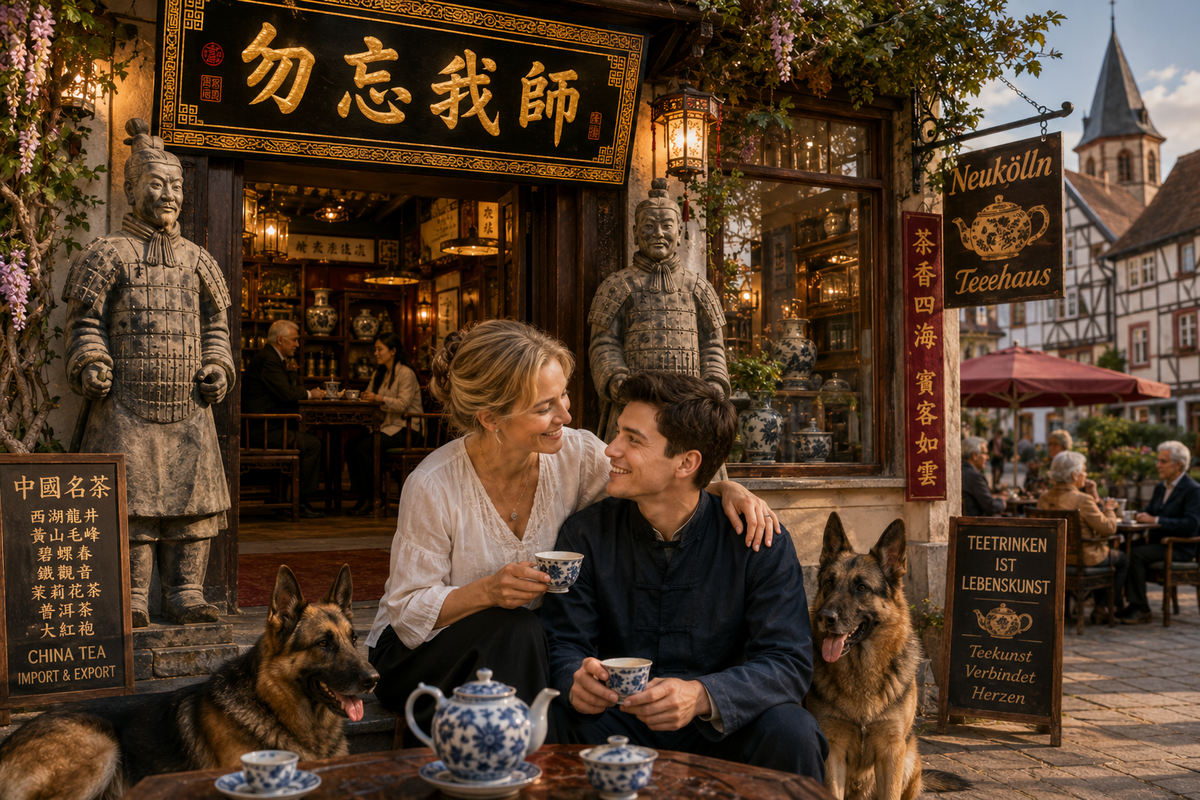
話說德國,杜塞爾多夫附近, 有個小鎮, 以養德國牧羊犬出名,【德語:Deutscher Schäferhund;英語:German Shepherd】 住著一個可愛的小男孩, 紐克隆,天性活潑,脣紅齒白, 人見人愛。
可是小紐克隆命不好, 早早父母車禍身亡。成了孤兒。
小鎮學校老師簡尼佛, 二十歲,一個漂亮德國姑娘, 憐之, 愛之, 將其收養, 親如母子, 食同桌, 寢同床。成了鎮上, 第一個沒結婚, 就有兒子的單親媽媽。
二人關係特好, 不是母子, 勝似母子。 小紐克隆, 有了 “母愛” , 從此走出悲痛, 茁壯成長。
二十年後, 紐克隆大學畢業,還到中國住了兩年,進修學藝,再回老家創業, 開了一家【勿忘我師】茶館。 紅木鑲金大字匾額, 上面十八開金箔大字,【勿忘我師】, 高高掛在茶館大門之上。話說德國,杜塞爾多夫附近, 有個小鎮, 以養德國牧羊犬出名,【德語:Deutscher Schäferhund;英語:German Shepherd】 住著一個可愛的小男孩, 紐克隆,天性活潑,脣紅齒白, 人見人愛。
可是小紐克隆命不好, 早早父母車禍身亡。成了孤兒。
小鎮學校老師簡尼佛, 二十歲,一個漂亮德國姑娘, 憐之, 愛之, 將其收養, 親如母子, 食同桌, 寢同床。成了鎮上, 第一個沒結婚, 就有兒子的單親媽媽。
二人關係特好, 不是母子, 勝似母子。 小紐克隆, 有了 “母愛” , 從此走出悲痛, 茁壯成長。
二十年後, 紐克隆大學畢業,還到中國住了兩年,進修學藝,再回老家創業, 開了一家【勿忘我師】茶館。 紅木鑲金大字匾額, 上面十八開金箔大字,【勿忘我師】, 高高掛在茶館大門之上。
紐克隆,大學主修的就是東方藝術, 在中國兩年留學, 對中國有了更多的了解,對中國文化佩服的五體投地, 特別是中國茶。
他的茶館:
茶具,清一色進口的中國景德鎮青花瓷,典型傳統的中國風;
傢俱,清一色定製的明朝式樣紅木, 透著明朝特有的簡約,高雅,皇家氣派;
茶葉,全部中國進口,西湖龙井、黄山毛峰、蒙顶甘露、洞庭碧螺春、都匀毛尖、庐山云雾、安溪铁观音、银毫茉莉花,中國各地茗茶,應有盡有。
茶館佈置古色古香, 一對比人高的複製版,秦朝兵馬俑, 有如哼哈二將,在門口站崗,不知情的人以為這裡是博物館。
茶館, 也做國際貿易, 除了進口自用, 也為別人代購, 雖不能發大財, 紐克隆卻可以每天悠哉度日, 不慌不忙。
當年的恩師, 養母詹尼佛, 丈夫癌症剛剛去世, 正在休息療傷, 成了茶館常客, 有時間敘 “母子情” , 回憶當年幸福時光,
詹尼佛每天都來 , 大把的時間, 也不能光是回憶, 就為紐克隆幫忙。 紐克隆創業不久, 還沒雇幫手, 有了詹尼佛, 也就不再提雇幫手的事。
兩個人把個茶館打理的窗明几淨, 把顧客招待的滿意的不了不了的,一句又一句的 【 Vielen Dank 】 ( Thank you very much ), 回頭客不說, 後來有人乾脆把茶館整天包下來, 生日, 聚會, 婚娶, Party 不斷, 生意越來越紅火, 兩個人忙的不亦樂乎。
茶館是個兩層小樓, 二樓有幾個房間, 紐克隆就住在上面。他建議, 老師不妨也搬過來住, 省房租不說, 兩個人一起, 就可以快樂打發晚上孤獨,寂寞時光。
詹尼佛從善如流,每天生意結束, 兩人單獨共享晚上時光,品茶, 飲酒, 何其快哉。
有一天, 小酌之後, 看著當年老師發紅可愛的臉, 紐克隆實在忍不住, 把老師抱住,親了一口, 老師開始還有些抗拒, 後來就。。。。。。
從此, 兩個臥室, 變成一個, 成了小鎮上, “ 母子戀 ” 變眷屬首例, 引來人們的奇異眼光, 好的, 壞的, 好奇,羨慕, 嫉妒, 恨 ? ! ?。。。。。。
他們倒也不在乎, 自己高興就得, 哪有時間關心別人眼光。
“母子” 變夫妻, 看上去, 不可思議, 其實呢, 合情合理,順理成章。
結婚後, 老師鼓勵紐克隆從政, 第一次競選, 全票當選小鎮鎮長, 老師鼓勵, 再進一步, 你看人家馬克龍, 現在幹的多風光,以後你選總理都有希望。“
紐克隆 : “ 打住, 到此為止, 我這人沒野心, 守著我這個茶館,與妳共度此生, 閒雲野鶴, 自由自在, 不比幹那玩意兒強。 有妳在, 有茶館, 人生還有何求,此生足矣。 “
” 你以為馬克龍風光呀 ? 今日俄國,烏克蘭, 明天哈瑪斯,以色列, 國內恐怖襲擊不斷, 經濟通貨膨脹,持高不下, 讓人頭痛不已的事, 我可不想管, 你,我,他, 都不明白, 他心裡有多煩, 沒人能理解, 高處不勝寒。”
您說這人世間, 情為何物, 還真沒一個人說的清,,親情, 愛情, 友情,交情, 有時真分不清,弄不白, 友情變愛情有之, 愛情變親情有之,到底是愛情, 友情, 交情,親情, 還真是分不開, 理不清,
別人,看詹尼佛眼角上已經有了魚尾紋, 紐克隆, 看老師臉上永遠不消失的迷人笑容,
別人,看詹尼佛逐漸老去, 紐克隆,看老師如一瓶老酒, 越老越醇,越老越香,
其實看人,和看花也差不多, 你愛梅花高冷聖潔, 他愛牡丹雍容華貴, 這世人,跟人的指紋一樣, 沒有一個重樣的,要不然怎麼就用指紋鑑定身分 ?
想讓整個世界都一個樣,想讓大夥兒都想的一個樣, 門兒都沒有。
這還真就合了老北平人最愛說的一句話,【 蘿蔔白菜, 各有所愛】, 其實呢,管他別人怎麼看呢? 自己喜歡就得, 。。。。。。
( 全文完 )Neukölln of Düsseldorf
Near Düsseldorf, in a small German town known for breeding German Shepherds, there lived a lovely little boy named Neukölln. He was lively by nature, with bright lips, white teeth, and a face that drew affection from everyone who met him.
But fate had not been kind. His parents died in a car accident when he was very young, leaving him an orphan.
A schoolteacher in the town, Jennifer, a beautiful German woman in her twenties, took pity on him and brought him into her home. She raised him as her own. They ate at the same table and even shared the same bed. and became, in every way that mattered, mother and son. She became the town’s first single mother without ever having been married.
Their bond was extraordinary. Though not truly related by blood, they were closer than many who were. With the warmth of a mother’s care, Neukölln gradually emerged from his grief and grew strong.
Twenty years passed.
Neukölln graduated from university. He spent two years in China studying further, then returned to his hometown to start a business—a tea house called Forget Not the Teacher.
Above its entrance hung a large wooden plaque, inlaid with gold, bearing bold Chinese characters:
勿忘我師Neukölln of Düsseldorf
Near Düsseldorf, in a small German town known for breeding German Shepherds, there lived a lovely little boy named Neukölln. He was lively by nature, with bright lips, white teeth, and a face that drew affection from everyone who met him.
But fate had not been kind. His parents died in a car accident when he was very young, leaving him an orphan.
A schoolteacher in the town, Jennifer, a beautiful German woman in her twenties, took pity on him and brought him into her home. She raised him as her own. They ate at the same table, slept under the same roof, and became, in every way that mattered, mother and son. She became the town’s first single mother without ever having been married.
Their bond was extraordinary. Though not truly related by blood, they were closer than many who were. With the warmth of a mother’s care, Neukölln gradually emerged from his grief and grew strong.
Twenty years passed.
Neukölln graduated from university. He spent two years in China studying further, then returned to his hometown to start a business—a tea house called Forget Not the Teacher.
Above its entrance hung a large wooden plaque, inlaid with gold, bearing bold Chinese characters:
勿忘我師
He had majored in Eastern art, and his years in China deepened his understanding and admiration of Chinese culture—especially tea.
Everything in the tea house reflected that devotion.
The tea sets were all imported blue-and-white porcelain from Jingdezhen.
The furniture was custom-made in the style of the Ming dynasty—simple, elegant, with a quiet sense of imperial grace.
The teas were all imported from China: Longjing from West Lake, Huangshan Maofeng, Mengding Ganlu, Biluochun from Dongting, Duyun Maojian, Lushan Yunwu, Tieguanyin from Anxi, jasmine silver needle—fine teas from across the land.
The space itself was richly atmospheric, almost antique in feeling. At the entrance stood two life-sized replicas of Qin dynasty terracotta warriors, like silent guardians. To those unfamiliar, the place could easily be mistaken for a museum.
The tea house also engaged in small-scale international trade—importing for its own use and procuring goods for others. It did not make Neukölln wealthy, but it allowed him a peaceful life, unhurried and content.
Jennifer, his former teacher and adoptive mother, had recently lost her husband to cancer. She came often to the tea house, spending long hours there. They would sit together, reminiscing about earlier days, about the quiet happiness they once shared.
She began to help him with the business. Neukölln had not yet hired staff, and with Jennifer there, he felt no need to.
Together, they kept the tea house spotless, and welcomed their guests with warmth and care. One heard again and again:
“Vielen Dank.”
Customers returned, and soon some began reserving the entire place for birthdays, gatherings, weddings, and parties. Business grew lively, and the two of them found themselves busier than ever—yet happier for it.
The tea house was a two-story building. Neukölln lived upstairs.
One day, he suggested that Jennifer move in as well. It would save her rent, and the two of them could keep each other company, easing the loneliness of the evenings.
Jennifer agreed without hesitation.
After the day’s business ended, they would share the quiet of the night—drinking tea, sometimes wine, talking without hurry.
One evening, after a few drinks, Neukölln looked at Jennifer—her face flushed, still as warm and gentle as he remembered from years past.
He could not hold back.
He embraced her and kissed her.
At first, she resisted.
Then… she did not.
From that night on, two bedrooms became one.
What had once been called “mother and son” became something else—a union that had never before been seen in the town.
People talked about them .
Some with curiosity, some with admiration, some with envy, others with judgment.
They did not care.
Their happiness left little time for the opinions of others.
What seemed unthinkable to outsiders, to them felt natural, even inevitable.
After they married, Jennifer encouraged Neukölln to enter politics.
In his first election, he was unanimously chosen as mayor of the town.
She urged him to go further.
“Look at Macron,” she said. “See how far he has gone. One day, you might even become prime minister.”
Neukölln laughed.
“Stop right there. I have no ambition for that kind of life. This tea house, and a lifetime with you—that is enough. A quiet life, like drifting clouds and wandering cranes—that is far better than power. With you, with this place… what more could I want?”
He paused, then added:
“You think Macron’s life is glorious? Today it is Russia and Ukraine. Tomorrow it is Hamas and Israel. At home, there are constant attacks, endless problems, inflation rising. You, I, none of us truly understand how heavy it is. At the top, the cold is real.”
And so it is in this world.
What is love?
No one can say for certain.
Affection, passion, friendship, attachment—sometimes they blur into one another.
Friendship may become love.
Love may become something like family.
In the end, it is impossible to separate them cleanly.
Others saw the faint lines forming at the corners of Jennifer’s eyes.
Neukölln saw only her smile—unchanged, enduring, beautiful.
Others saw her aging.
Neukölln saw her as a fine old wine—growing richer, deeper, more fragrant with time.
To see a person is not unlike seeing a flower. One loves the plum blossom for its quiet purity. Another loves the peony for its fullness and grace.
People, like fingerprints, are never the same.
How else could identity be confirmed, if all were identical?
To want the whole world to be the same, and to expect everyone to think alike, is impossible.
As the old people of Beijing would say:
“Radishes and cabbages, each to his own liking.”
In truth, what others think matters little.
What matters is simply this: To love what one loves.
( The end )