微型小說(5)
清朝的光緒皇帝,是醇賢親王奕譞的第二個兒子,道光皇帝的孫子,咸豐皇帝的姪子,同治皇帝的堂弟,慈禧太后的外甥。
同治皇帝駕崩後,因為沒有兒子,由當時的東宮慈安太后, 和西宮慈禧太后, 共同決定, 讓光緒繼承皇位。
他當時就是一個三歲小孩, 因為要繼承皇位, 就正式過繼給咸豐皇帝 。實際的朝政, 仍然由兩宮太后主持。
光緒皇帝的故事很多, 最有名的就是他失敗的百日維新,戊戌變法, 失敗後, 被慈禧太后關在中南海瀛台軟禁,失去親政權力。
慈禧太后在上朝聽政時, 為掩人耳目,仍然給他安排一把椅子, 坐在她旁邊, 卻不許他講話, 但是很多朝廷旨意, 仍然以他的名義發出, 淪為現在人們常說的橡皮圖章。滿清的光緒皇帝,是醇賢親王奕譞的第二個兒子,道光皇帝的孫子,咸豐皇帝的姪子,同治皇帝的堂弟,也是慈禧太后的外甥。
同治皇帝駕崩後沒有留下子嗣,由東宮慈安太后與西宮慈禧太后共同決定,讓年僅三歲的光緒,繼承皇位,並正式過繼給咸豐皇帝為後。從那一刻起,他的命運,便不再屬於他自己。
光緒年幼時,朝政大權一直掌握在兩宮太后手中,光緒長大親政後,曾經試圖有所作為,推行強國變法,史稱「戊戌變法」。結果因為識人不當,被袁世凱告密, 導致變法失敗。
以康有為為首的改革派, 被稱為亂黨, 逃的逃, 抓的抓, 殺的殺。 就是光緒皇帝自己, 也被慈禧太后囚禁於中南海瀛台,從此不但失去親政權力, 連人身自由也沒有了, 成了一個高級囚徒。
為了掩人耳目, 特別是避免洋人指責, 慈禧仍然安排他上朝聽政,坐在慈禧身旁,但是只許聽, 卻不許說話。慈禧下旨意,仍以光緒的名義,他就是一個空有名號的囚徒皇帝。
瀛台不大,門禁森嚴,四面環水 。光緒皇帝住在裡面,日子單調難過。他每天除了看書、寫字,其它的什麼也不能做,沒有慈禧的容許, 也不能見任何人。 時間就這樣一天天過去,難熬, 也只能熬,他的心,也慢慢麻木, 在失望中逐漸死去 。
慈禧軟禁了光緒, 還把皇后葉赫那拉氏,名靜芬,慈禧太后的親侄女,作為眼線,監視光緒皇帝的一舉一動, 還是不放心。 為了徹底掌握光緒皇帝的思想動向, 她還特意找了一個小太監,專門做她的眼線, 安置在光緒皇帝身邊。
這個小太監年紀很輕,個子矮小,臉上還帶著孩子般的稚氣,宮裡人都習慣叫他「小不點兒」, 他的真名倒是沒有人記住。
他去贏台伺候光緒皇帝前,曾被慈禧單獨召見。慈禧坐在高處,語氣平和地對他說:“皇帝年輕, 受康有為一幫亂黨蠱惑,以改革為名, 妄圖動搖祖宗基業, 動搖大清根基。你去他身邊,一是要好好服侍他, 更要仔細留心他的言行。 他說過什麼? 做過什麼? 有什麼想法, 有什麼異動,都要定期向我匯報。你雖然年紀小, 但是, 你要做的, 卻是為國為民的大事。”
小不點兒聽得心頭一震。他出身低微,從未想過自己會被太后親自召見, 還託付如此重任。他相信慈禧說的每一句話,認為這確實是一件關乎大清國家前途的大事。
於是他跪地叩頭謝恩時, 帶著發自內心的忠誠, 鄭重答應慈禧的要求, 決心盡忠職守, 注意光緒皇帝的一言一行, 及時向太后匯報。
到了瀛台,光緒皇帝見他年輕,模樣還帶幾分幼稚的憨氣,倒是對他沒有任何戒心。
小不點兒做事勤快,說話小心, 從不多嘴。寂寞的光緒皇帝, 漸漸把他當作一個可以說話, 更是可以傾聽他說話的人。
有時候夜深人靜,四下無人,光緒會一邊寫字,一邊隨口與他說些心裡話,倒不是希望他能反饋什麼, 就是因為他太寂寞了, 沒有一個可以說心裡話的人。
起初,小不點兒只是聽, 不打斷, 也不表態, 就是及時給光緒更換冷了的茶水, 為他研磨, 換宣紙。
對於光緒說過的每一句話,他都盡力牢牢記住。到了規定的時間, 他會被宮中來人叫出去, 說是有事情交辦, 實際上,是帶他去慈禧處, 匯報光緒這一段的言行,
由於小不點兒平時留心, 年輕,記憶力又好, 他幾乎可以把光緒說過的話, 幾乎是一字不漏地記下來,向慈禧匯報, 深得慈禧歡心。他心裡對於這樣做, 從來沒有過一絲懷疑,動搖,因為他相信,自己是在為大清朝國家,做大事。
可是時間久了,小不點兒開始對自己這種密探式的工作, 感到有些不安。
他每天親眼看到光緒,聽光緒講話, 使他對光緒皇帝有了真正的了解。 他眼中親見,逐漸了解的真實光緒皇帝。 和慈禧口中描述的, 那個被「亂黨蠱惑」, 要動搖大清國祖宗基業的皇帝,好像根本就不是一個人。
光緒想的, 講的, 都是為了大清朝的國家前途。他說中國現在積弱不堪,被列強任意欺負。 洋人的洋槍洋炮, 一次次地打敗了大清的軍隊, 被迫和洋人簽訂了一系列,喪權辱國的不平等條約。
光緒多次表示, 國家如果再不改革,終將被洋人瓜分, 餐食;他說這都是因為大清傳統的制度腐敗所致, 如果不改革,國家滅在洋人手裡,就是分分鐘都有危險的可能。
有一天夜裡,光緒沈痛, 低聲地對小不點兒說:「國家若再這樣下去,就會亡, 你明白嗎?」
光緒的言行, 讓小不點兒內心產生了極大震動, 那一夜,他第一次對自己幹的事, 真是對大清國好的大事, 還是他被慈禧利用了, 產生了懷疑, 他內心開始動搖 。
有一天, 一個新穎的外國八音盒, 被人送到瀛台。說是老佛爺慈禧怕光緒皇帝悶得慌, 特別下旨意,送他一個奇巧洋玩意兒, 用來解解悶
那是外國使臣進貢的禮品, 慈禧為了消磨光緒的鬥志, 倒是經常把這些西洋的精巧物件, 送給他, 希望他玩物喪志, 磨滅他東山再起的野心。
光緒在瀛台,本來就是度日如年, 百無聊賴, 因此就拿起那個八音盒,隨意把玩。 他擰緊發條,打開盒蓋,一段悅耳, 卻不陌生的音樂流淌而出。
他一下子就被這個洋玩意兒吸引住, 小音樂盒發出的音樂, 是他熟悉的, 著名的華爾滋圓舞曲, 那是奧地利著名作曲家小約翰·史特勞斯,Johann Strauss II, 創作的名曲,《藍色多瑙河》。An der schönen blauen Donau, 是德文藍色多瑙河, 他太熟悉了 。
其實, 光緒皇帝自己可能都不曾意識到, 他其實有, 異於常人的音樂天賦。
為了消磨他的鬥志, 慈禧不阻止,甚至鼓勵光緒,和海外回來的晚清著名外交官裕庚的兩個女兒,公主德玲,容齡姐妹來往。
當然她們不是真正意義上的公主, 就是因為從國外回來, 受慈禧重用, 從一九零三年到一九零五年, 擔任慈禧的御前女官, 英文翻譯 。她們向慈禧介紹西洋習俗,並教慈禧拍照、攝影,甚至讓慈禧,接受了西方的香水和化妝品。
她們有顯赫家世, 是漢軍正白旗人,父親裕庚,是晚清傑出外交官。她們年輕時隨父親外派, 先後在日本和法國生活多年,受過良好的西方教育,思想新派,精通法語,英語,並熟悉西洋禮儀,舞蹈和文化。
因此 ,她們被慈禧賦予公主頭銜, 留在慈禧身邊工作, 卻非出生於皇家的真正公主。
德玲教光緒皇帝學習英文, 還教光緒彈鋼琴, 光緒學習過彈奏這首藍色多瑙河曲子, 而且非常喜歡。 經過他刻苦的練習, 很快就上手了, 可以完全自主的演奏這首著名的圓舞曲。
據德齡後來以德齡公主名義寫的回憶錄, 【清宮二年記】中記載, 光緒皇帝是一個音樂天才, 他喜歡鋼琴, 讓她去教, 結果一學就會。 還有未經證實的傳聞, 說光緒皇帝對這個年輕貌美, 完全西化的德齡公主,一見鐘情, 喜歡的不得了。 如果不是被軟禁, 就很可能把她納為妃子。
德玲教光緒皇帝鋼琴, 彈藍色多瑙河華爾滋圓舞曲。 沒過多久, 光緒就彈的有模有樣, 不但音准,而且節拍都和原曲完全一樣。
八音盒裏的音樂雖然只是一小段, 但是聲音清脆悅耳,和中國傳統的京劇、崑曲完全不同。光緒一遍一遍地聽,似乎有些著迷。
聽了許多遍之後, 他好像突然悟出什麼。就把八音盒拆開,仔細研究裡面的構造。原來八音盒發音的原理, 是由鋼絲發條,帶動觸碰不同長短的鋼片,就能發出不同的音階,構成美妙的音樂。
光緒用手撥動一個個鋼片 , 聽它們的不同音階, 他一邊聽,一邊記,把每一個鋼片發的音階準確紀錄下來。
忽然,光緒皇帝突發奇想,能不能讓這個八音盒,發出中國音樂的聲音 ?
他反覆聆聽, 畫圖,計算,反覆推敲。最後甚至親手拆裝,試圖按自己的構想重組八音盒。結果, 毫無疑問, 他失敗了。
光緒皇帝為此事苦惱了好幾天,最後讓小不點兒,去宮外找找,是否有什麼人, 能修理八音盒。
小不點兒出宮四處打聽,找到東華門外萬珍齋的老闆張雪岩, 他的店裡, 就有不少西洋來的新奇玩意兒。 別人介紹,這個人, 見多識廣, 經常與外國人打交道, 沒準有門。
張雪岩被召入宮,他原來以為, 就是把光緒拆開的八音盒,恢復原狀,就開始動手組裝,卻被光緒制止。光緒拿出自己畫的圖紙,讓他照圖重裝。
張雪岩雖然不解,但不敢違抗, 就按照光緒畫的圖紙, 把音樂盒拆開, 再重新裝好。
光緒接過張雪岩裝好的音樂盒, 親自擰緊發條,打開盒蓋。這一次,流淌出的音樂就不再是西方的圓舞曲,而是著名京劇《四郎探母》的旋律 。
張雪岩當場愣住,心中大為震驚,他對光緒皇帝的音樂才華, 佩服的五體投地 。
小不點兒站在一旁,看著光緒,心中第一次生出一種,對他的深深敬意,這個人,不光是皇帝,還是個音樂天才。
光緒皇帝雖然身處變相監禁, 但是仍然胸無城府, 想說什麼就說什麼。 有一次,光緒曾在無意間對身邊人說過:”等那個老太婆死了,我要先殺袁世凱,再殺李蓮英。“
這句話,被小不點兒如實向慈禧匯報了。當時的他,還以為自己是在為國盡忠。等他明白過來, 這就等於是他,把光緒皇帝送上死路。 不過,為時已晚,無法挽回。
小不點兒內心悔恨不已, 卻又不知如何挽救自己因為無知, 給光緒皇帝帶來的致命危險。
光緒去世前兩天,瀛台的氣氛忽然變的詭異,宮中傳出消息,慈禧太后,已經病入膏肓,拖不過三日, 必亡。 光緒心中暗自高興,他隱約感到,自己或許還有機會,東山再起。 但同時,他也感到緊張,內心警惕, 怕慈禧死前會對自己下殺手, 他太了解慈禧了。
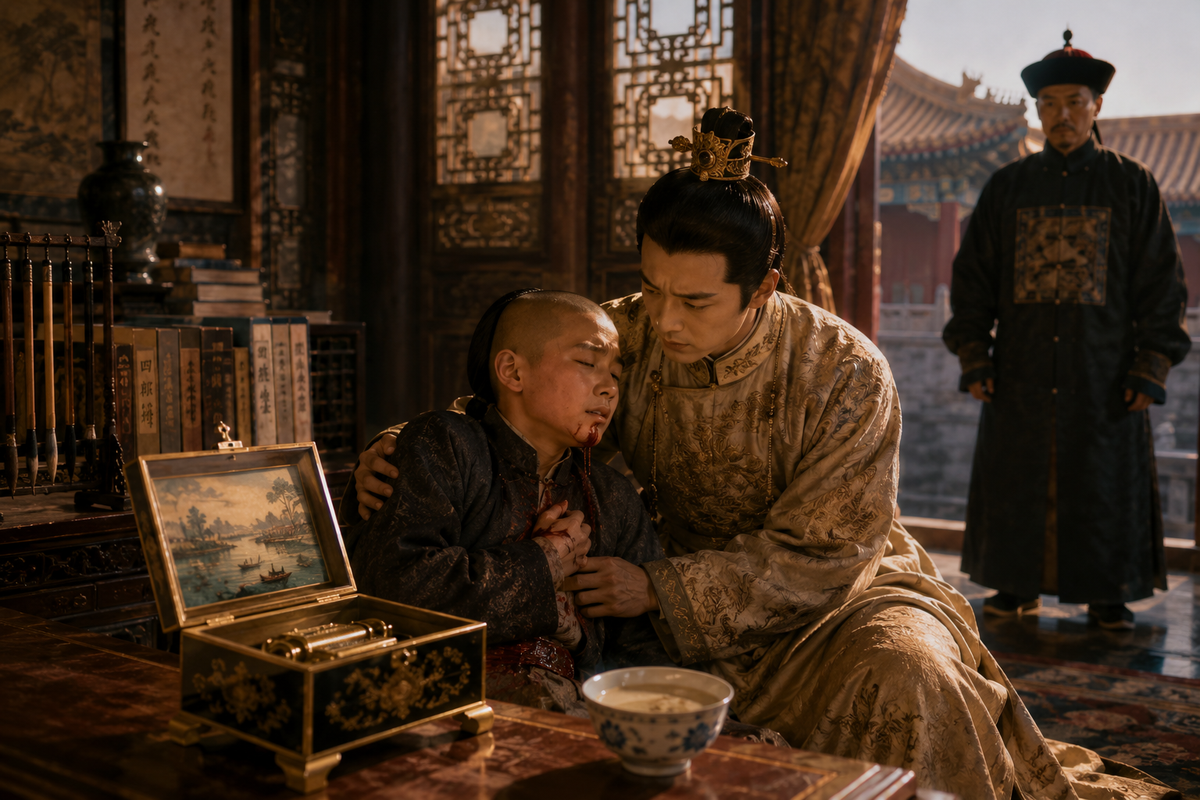
果不其然, 那天大太監李蓮英親自來到瀛台,身後跟著幾個橫眉冷對, 手持大刀的宮中侍衛。
李蓮英手裡端著一碗酸奶,笑容恭敬陰冷,語氣卻帶著不容拒絕的威嚴:“太后有旨,請萬歲爺當著奴才的面,把這碗酸奶吃完。”
光緒看著那碗酸奶,沒有動, 他鎮定地說:“ 謝太后關心,拿回去吧, 告訴太后, 朕不想吃。“
李蓮英臉色一沉,用他那太監特有的尖利嗓音說道:” 萬歲爺若不肯吃,奴才無法回去交差。“
光緒這時忽然站起身來,眼中閃過一絲久違的怒意。他盯著李蓮英的眼睛,聲音不高,卻冷得像刀:”你這個狗奴才,不要忘了,朕現在還是皇上。今天這碗酸奶,朕就是不吃。你能如何?你回去告訴那個老太婆,讓她親自來懲罰朕!“
屋裡的空氣,一下子僵住, 這是光緒被多年囚禁以來, 第一次對大太監李蓮英表示強硬,可也是最後一次強硬。
李蓮英深感意外, 愣在原地,這個平時脾氣好的皇帝,今天這是怎麼了?一時也不知如何應對為好。
就在這時,小不點兒走了過來。
他看著那碗酸奶,心裡已經明白大半。他知道,如果這件事繼續僵下去,會對光緒皇帝十分不利。
他覺得自己應該做些什麼, 這杯酸奶肯定有毒, 自己喝了, 就可以救下, 保住光緒皇帝的命。 可以償還自己欠光緒皇帝的命債, 雖然是出於無知, 但是卻把光緒皇帝送上死路。 如果自己能替光緒皇帝去死, 他的內心就會安寧。
小不點兒, 沒有說話,突然上前, 端起那碗酸奶,低頭喝了一大口。 他的動作很快。所有人都愣住了, 沒有人來得及阻止他的這種大不敬行為。
他放下碗,抬頭看向光緒,眼神裡沒有恐懼,只有一種釋然。
沒過兩分鐘, 小不點就開始站立不穩, 滿臉痛苦倒在地上。 他口中喃喃地說:” 萬歲爺……您千萬不能喝,那碗酸奶,有毒, 奴才替您喝了,您保重, 大清國還需要您,……“,話未說完,就已經意識全無 。
看到這一切, 光緒什麼都明白了。他看著躺在地上的小不點兒,眼中閃過極端複雜的情緒,震驚、痛惜、還有一絲難以言說的理解。
看著倒在地上, 渾身抽搐的小不點兒, 光緒沒有再說話, 也看看僵在那裡不知所措的李蓮英, 看看他身後那幾個滿臉殺氣的宮中侍衛, 手中緊握著的大刀, 他明白了, 是福不是禍, 是禍躲不過, 慈禧就是要自己死在她前面。
要反抗嗎 ? 看看李蓮英身後, 那幾個凶神惡煞般的宮中侍衛,他搖搖頭, 端起小不點兒剩下的那碗酸奶,一口氣喝了下去。
兩條年輕的生命, 就這樣沒了,李蓮英高興的回去稟報, 他的任務完成了, 為慈禧除掉了最後的心頭大患, 自己的命也保住了。
第二天,慈禧太后雖然極不願意, 還是嚥下了最後一口氣,光緒如她所願,死在她前一天。
瀛台四周的水,依然平靜如鏡, 可是人沒了。只有那個會唱京戲的八音盒,靜靜地躺在那裡, 好像在等待什麼 。
後人化驗過光緒皇帝的頭髮,發現裡面砒霜含量,遠超常人百倍。至於那個叫小不點兒的太監,史書上連個名字都沒有留下。
(全文完)The Guangxu Emperor of the Great Qing was the second son of Prince Chun, Yixuan, the grandson of the Daoguang Emperor, the nephew of the Xianfeng Emperor, the cousin of the Tongzhi Emperor, and also the nephew of Empress Dowager Cixi.
After the Tongzhi Emperor died without leaving an heir, Empress Dowager Ci’an of the Eastern Palace and Empress Dowager Cixi of the Western Palace jointly decided that the three-year-old Guangxu would inherit the throne and be formally adopted as the son of the Xianfeng Emperor. From that moment on, his fate no longer belonged to himself.
When Guangxu was still a child, all political power remained in the hands of the two empress dowagers. After he grew older and began ruling personally, he once tried to strengthen the nation through reform, an event later known as the Hundred Days’ Reform. But because he trusted the wrong people, Yuan Shikai betrayed him, and the reform movement failed.
The reformers led by Kang Youwei were branded as rebels. Some fled, some were arrested, and some were executed. Even Emperor Guangxu himself was imprisoned by Empress Dowager Cixi on Yingtai Island in Zhongnanhai. From that moment on, he not only lost the power to rule, but even his personal freedom. He became a high-ranking prisoner.The Guangxu Emperor of the Great Qing was the second son of Prince Chun, Yixuan, the grandson of the Daoguang Emperor, the nephew of the Xianfeng Emperor, the cousin of the Tongzhi Emperor, and also the nephew of Empress Dowager Cixi.
After the Tongzhi Emperor died without leaving an heir, Empress Dowager Ci’an of the Eastern Palace and Empress Dowager Cixi of the Western Palace jointly decided that the three-year-old Guangxu would inherit the throne and be formally adopted as the son of the Xianfeng Emperor. From that moment on, his fate no longer belonged to himself.
When Guangxu was still a child, all political power remained in the hands of the two empress dowagers. After he grew older and began ruling personally, he once tried to strengthen the nation through reform, an event later known as the Hundred Days’ Reform. But because he trusted the wrong people, Yuan Shikai betrayed him, and the reform movement failed.
The reformers led by Kang Youwei were branded as rebels. Some fled, some were arrested, and some were executed. Even Emperor Guangxu himself was imprisoned by Empress Dowager Cixi on Yingtai Island in Zhongnanhai. From that moment on, he not only lost the power to rule, but even his personal freedom. He became a high-ranking prisoner.
To maintain appearances, especially to avoid criticism from foreigners, Cixi still arranged for him to attend court sessions and sit beside her, but he was only allowed to listen and forbidden to speak. Imperial edicts issued by Cixi continued to be proclaimed in Guangxu’s name. He was nothing more than an emperor in title, a prisoner wearing a crown.
Yingtai was not large. Security was strict, and water surrounded it on all sides. Guangxu lived there in unbearable monotony. Every day, besides reading and writing, he could do nothing else. Without Cixi’s permission, he could not even meet another person. Time passed one difficult day after another. He endured because he had no choice but to endure. Slowly, his heart grew numb, dying little by little inside disappointment.
Even after imprisoning Guangxu, Cixi still did not feel secure. She used Empress Yehenara Jingfen, her own niece, as a pair of eyes to watch every movement of the emperor. But even that was not enough. In order to completely control Guangxu’s thoughts and intentions, she deliberately arranged for a young eunuch to stay at his side as her secret informant.
The little eunuch was very young, small in stature, with a childlike innocence still visible on his face. Everyone in the palace called him “Little Dot.” As for his real name, no one remembered it anymore.
Before Little Dot was sent to serve Emperor Guangxu on Yingtai, he was summoned privately by Cixi. Sitting high above him, she spoke in a calm voice: “The emperor is young and has been misled by Kang Youwei and his band of rebels. Under the excuse of reform, they seek to shake the foundations left by our ancestors and undermine the Qing Empire itself. You are to stay by his side. First, serve him well. But more importantly, observe him carefully. Whatever he says, whatever he does, whatever thoughts or unusual behavior he shows, you must report everything to me regularly. You may be young, but what you are doing is a matter of great importance for the country and the people.”
Little Dot felt his heart tremble. He came from a humble background and had never imagined that the Empress Dowager herself would summon him personally and entrust him with such responsibility. He believed every word she said and truly thought he was carrying out a great mission for the future of the Qing Empire.
So he knelt and kowtowed in gratitude, filled with sincere loyalty, solemnly agreeing to fulfill Cixi’s orders. He resolved to carry out his duty faithfully, pay close attention to everything Emperor Guangxu said and did, and report promptly to the Empress Dowager.
When he arrived at Yingtai, Emperor Guangxu saw only a young boy with a somewhat innocent and simple appearance, and felt no suspicion toward him at all.
Little Dot worked diligently, spoke carefully, and never talked too much. Gradually, Guangxu began treating him as someone he could speak to, and more importantly, someone who would quietly listen.
Sometimes late at night, when all was silent and no one else was around, Guangxu would write while casually speaking his thoughts aloud to Little Dot. It was not because he expected advice or answers. He was simply too lonely. He no longer had a single person with whom he could speak honestly.
At first, Little Dot only listened. He never interrupted and never expressed opinions. He simply replaced cold tea with warm tea, ground ink for the emperor, and changed the sheets of paper on the writing desk.
Every word Emperor Guangxu spoke, he tried his best to memorize firmly. At appointed times, palace attendants would come to summon him away, claiming there were tasks to handle. In reality, he was being taken to report Guangxu’s recent words and actions directly to Cixi.
Because Little Dot paid close attention and possessed an excellent memory, he could repeat almost every sentence Guangxu had spoken, nearly word for word, when reporting to Cixi. This greatly pleased her.
In his own mind, he never once doubted what he was doing, nor did he waver, because he sincerely believed he was serving the Qing Empire and doing something important for the nation.
But as time passed, Little Dot gradually began to feel uneasy about this life as a secret informant.
Every day he watched Guangxu with his own eyes and listened to him speak. Slowly, he came to know the emperor as a real person. The Guangxu Emperor he personally saw and gradually understood seemed nothing like the man Cixi had described, the emperor supposedly bewitched by rebels and trying to destroy the foundations of the Qing dynasty.
Everything Guangxu thought about and spoke about concerned the future of the nation. He said China had become weak and vulnerable, bullied at will by foreign powers. Western guns and cannons had defeated Qing armies again and again, forcing China into signing one humiliating unequal treaty after another.
Guangxu repeatedly said that if the country did not reform, it would eventually be carved apart and devoured by foreign powers. He believed the true cause lay in the corruption of the Qing system itself. Without reform, the destruction of the country at foreign hands could happen at any moment.
One night, Guangxu spoke softly to Little Dot with deep sorrow in his voice: “If the country continues like this, it will perish. Do you understand?”
Those words shook Little Dot deeply. That night, for the first time, he began questioning whether what he was doing was truly for the good of the Qing Empire, or whether he himself had merely become a tool used by Cixi. His heart began to waver.
One day, a newly imported foreign music box was delivered to Yingtai. It was said that the Old Buddha, Cixi herself, feared Emperor Guangxu was suffering from boredom and had specially ordered this clever Western toy sent to amuse him.
The music box had originally been presented as tribute by foreign diplomats. To weaken Guangxu’s spirit, Cixi often sent him these refined Western curiosities, hoping he would lose himself in trivial pleasures and gradually abandon any desire to rise again politically.
Life on Yingtai already felt like endless suffering to Guangxu, so he casually picked up the music box and examined it. He wound the spring and opened the lid. Immediately, a beautiful yet strangely familiar melody flowed out.
At once, he was captivated. The melody produced by the tiny music box was a famous waltz he already knew well, The Blue Danube, composed by the great Austrian composer Johann Strauss II. An der schönen blauen Donau was simply the German title for The Blue Danube. Guangxu knew it extremely well.
In truth, Emperor Guangxu himself may never have fully realized that he possessed extraordinary musical talent.
In order to weaken his political ambition, Cixi not only permitted but even encouraged Guangxu to associate with the daughters of the late Qing diplomat Yu Geng, Princess Der Ling and her sister Rong Ling, both of whom had returned from overseas.
Of course, they were not true princesses by birth. Because they had returned from abroad and were favored by Cixi, they served from 1903 to 1905 as ladies-in-waiting and English interpreters for the Empress Dowager. They introduced Western customs to Cixi, taught her photography, and even encouraged her to use Western perfumes and cosmetics.
They came from a distinguished background. Their father, Yu Geng, was an outstanding diplomat of the late Qing dynasty. During their youth, the sisters had accompanied him overseas, living for years in Japan and France. They received a fine Western education, held progressive ideas, spoke French and English fluently, and were familiar with Western etiquette, dance, and culture.
For this reason, Cixi granted them the title of princess and kept them by her side, though they were not born members of the imperial family.
Der Ling taught Emperor Guangxu English and also taught him piano. Guangxu learned to play The Blue Danube and became deeply fond of the piece. Through hard practice, he quickly mastered it and could eventually perform the famous waltz entirely on his own.
According to Two Years in the Forbidden City, the memoir later written by Der Ling under the name Princess Der Ling, Emperor Guangxu was a musical genius. He loved the piano and learned astonishingly quickly. There were also unverified rumors claiming that Guangxu fell deeply in love at first sight with the young and beautiful, completely Westernized Princess Der Ling. Some even said that had he not been imprisoned, he might have made her one of his imperial consorts.
Der Ling taught Guangxu to play the piano and perform The Blue Danube waltz. Before long, he played it remarkably well, with not only accurate notes but also rhythm perfectly matching the original composition.
The melody from the music box lasted only a short while, but its sound was crisp and beautiful, entirely different from traditional Chinese opera or Kunqu music. Guangxu listened again and again, almost mesmerized.
After hearing it many times, he suddenly seemed to realize something. He dismantled the music box and carefully studied its internal structure. He discovered that the sound came from a steel spring mechanism striking metal strips of different lengths, each producing a different note that together formed beautiful music.
Guangxu used his fingers to pluck each metal strip one by one, listening carefully to their different pitches. As he listened, he recorded every note with precision.
Then suddenly, a thought came to him. Could this music box be made to play Chinese music instead?
He listened repeatedly, sketched diagrams, calculated measurements, and pondered endlessly. Eventually, he even attempted to dismantle and rebuild the music box according to his own ideas. Unsurprisingly, he failed.
The matter troubled Guangxu for several days. Finally, he instructed Little Dot to go outside the palace and search for someone capable of repairing music boxes.
Little Dot made inquiries everywhere and eventually found Zhang Xueyan, the owner of Wanzhenzhai outside Donghua Gate. Zhang’s shop sold many unusual imported Western items. People said he was knowledgeable, widely experienced, and frequently dealt with foreigners. Perhaps he could help.
Zhang Xueyan was summoned into the palace. At first, he assumed his task was simply to restore the dismantled music box to its original condition and immediately began reassembling it, but Guangxu stopped him. The emperor produced his own drawings and ordered Zhang to rebuild the box according to those designs.
Although confused, Zhang dared not disobey. Following Guangxu’s diagrams, he dismantled the music box again and carefully rebuilt it.
When the work was finished, Guangxu personally wound the spring and opened the lid. This time, the melody flowing out was no longer a Western waltz, but the tune of the famous Peking Opera piece Silang Visits His Mother.
Zhang Xueyan stood frozen in shock. He admired Emperor Guangxu’s musical talent with complete amazement.
Little Dot stood nearby watching Guangxu, and for the first time, a deep sense of admiration rose within him. This man was not only an emperor. He was also a musical genius.
Although Emperor Guangxu lived under disguised imprisonment, he remained open-hearted and spoke freely. Once, without much thought, he said to someone nearby: “When that old woman dies, I will kill Yuan Shikai first, and then Li Lianying.”
Little Dot faithfully reported those words to Cixi, still believing at the time that he was serving the country loyally. Only later did he realize that by doing so, he had pushed Emperor Guangxu toward death. But by then, it was too late to undo anything.
Little Dot was consumed with regret, yet had no idea how to save Guangxu from the mortal danger his own ignorance had helped create.
Two days before Guangxu’s death, the atmosphere on Yingtai suddenly became strange and unsettling. Rumors spread through the palace that Empress Dowager Cixi was already dying and would not survive more than three days. Guangxu secretly felt hope rising within him. He sensed that perhaps he might still have another chance. Yet at the same time, he became deeply wary, fearing that before dying, Cixi would move to eliminate him. He understood her too well.
Sure enough, on that day the chief eunuch Li Lianying personally arrived at Yingtai, accompanied by several palace guards carrying large sabers and wearing grim expressions.
In Li Lianying’s hands was a bowl of yogurt. His smile appeared respectful, but his voice carried unmistakable authority. “By order of the Empress Dowager, Your Majesty is to finish this bowl of yogurt in front of this servant.”
Guangxu looked at the bowl without touching it. Calmly, he replied, “Thank the Empress Dowager for her concern. Take it back. Tell her I have no desire to eat it.”
Li Lianying’s face darkened. In the sharp voice peculiar to eunuchs, he said, “If Your Majesty refuses to eat it, this servant will have no way to report back.”
At that moment, Guangxu suddenly stood up. For the first time in years, anger flashed in his eyes. Staring directly at Li Lianying, he spoke in a low voice cold as steel: “You dog of a servant, do not forget that I am still the emperor. Today, I refuse to drink this yogurt. What can you do about it? Go back and tell that old woman to come punish me herself!”
The room instantly froze in silence. Since the beginning of his imprisonment, this was the first time Guangxu had openly defied Li Lianying. It would also be the last.
Li Lianying stood stunned. He had never expected this usually mild-tempered emperor to suddenly become so forceful, and for a moment, he did not know how to respond.
At that moment, Little Dot stepped forward.
Looking at the bowl of yogurt, he already understood most of the truth. He knew that if the confrontation continued, Emperor Guangxu would be in grave danger.
He felt he had to do something. The yogurt was certainly poisoned. If he drank it himself, he might save Guangxu’s life. It would repay the debt he owed the emperor. Though born from ignorance, his reports had pushed Guangxu toward death. If he could die in Guangxu’s place, perhaps his own heart would finally find peace.
Without saying a word, Little Dot suddenly stepped forward, picked up the bowl, and drank a large mouthful of the yogurt. His movement was so fast that no one had time to stop him from committing such an outrageous act.
He lowered the bowl and looked up at Guangxu. There was no fear in his eyes, only relief.
Less than two minutes later, Little Dot could no longer stand steadily. His face twisted in agony as he collapsed to the ground. In a weak voice, he murmured, “Your Majesty… you must never drink that yogurt. It is poisoned. This servant has drunk it for you. Please take care of yourself. The Great Qing still needs you…”
Before he could finish speaking, consciousness left him.
Seeing all this, Guangxu instantly understood everything. Looking at Little Dot lying on the floor, a flood of emotions flashed through his eyes: shock, grief, and a strange kind of understanding beyond words.
Looking at Little Dot writhing on the ground in convulsions, Guangxu said nothing more. He glanced at the frozen Li Lianying, then at the murderous palace guards behind him gripping their sabers tightly. At that moment, he understood completely. Some disasters could not be escaped. Cixi was determined to make sure he died before she did.
Should he resist?
Looking at the fierce guards behind Li Lianying, Guangxu slowly shook his head. Then he picked up the bowl of yogurt Little Dot had left behind and drank the rest in one breath.
Thus ended two young lives.
Li Lianying happily returned to report that his task had been completed. He had removed the final threat from Cixi’s heart, and his own life was safe as well.
The next day, although utterly unwilling, Empress Dowager Cixi herself finally breathed her last. Just as she had wished, Guangxu had died one day before her.
The waters surrounding Yingtai remained calm and mirror-like, but the people were gone. Only the music box that could play Peking Opera melodies remained lying silently there, as though still waiting for something.
Later generations tested Emperor Guangxu’s hair and discovered arsenic levels more than a hundred times higher than normal. As for the little eunuch called Little Dot, history did not even leave behind his real name.
(The End)
The Guangxu Emperor and His Music Box
光緒皇帝和他的八音盒
Microfiction (5)
The Guangxu Emperor of the Great Qing was the second son of Prince Chun, Yixuan, the grandson of the Daoguang Emperor, the nephew of the Xianfeng Emperor, the cousin of the Tongzhi Emperor, and also the nephew of Empress Dowager Cixi.
After the Tongzhi Emperor died without leaving an heir, Empress Dowager Ci’an of the Eastern Palace and Empress Dowager Cixi of the Western Palace jointly decided that the three-year-old Guangxu would inherit the throne and be formally adopted as the son of the Xianfeng Emperor. From that moment on, his fate no longer belonged to himself.
When Guangxu was still a child, all political power remained in the hands of the two empress dowagers. After he grew older and began ruling personally, he once tried to strengthen the nation through reform, an event later known as the Hundred Days’ Reform. But because he trusted the wrong people, Yuan Shikai betrayed him, and the reform movement failed.
The reformers led by Kang Youwei were branded as rebels. Some fled, some were arrested, and some were executed. Even Emperor Guangxu himself was imprisoned by Empress Dowager Cixi on Yingtai Island in Zhongnanhai. From that moment on, he not only lost the power to rule, but even his personal freedom. He became a high-ranking prisoner.
小說(5)【光緒皇帝和他的八音盒】 四個模塊