我問小布朗 : “ 你老爸就你這一個兒子, 怎麼忍心,讓你幹這種苦活?”
小布朗笑了, 從屁股兜裏掏出一個小本, 打開後一字一句地念: “ 勞其體膚, ”
我奇怪這小子, 怎麽還能拽幾句中文, 難道又是繼承了他老爸的語言基因 ?
我把他的小本子拿過來一看, 只見上面有中英文對照的幾行字。
苦其心志,使他們的意志經歷嚴峻的考驗和困難。
Torment their determination:
Subject their will to severe tests and difficulties.
一年沒有女孩。
No girls, One year,
劳其筋骨,使他們的身體到達極度勞累和疲憊的狀態。
Exhaust their muscles and bones
Bring their body to a state of extreme tiredness and exhaustion.
在倉庫工作三年, 第一年 全部時間, 第二年, 一半時間, 第三年, 四分之一時間.
work at warehouse for three years,
First year, 100%
Second year 50%
Third year 25%
饿其体肤,令他們的身體承受飢餓,影響到皮膚和整體健康。
Starve their body and skin ,cause their body to endure hunger, affecting their skin and overall health.
一週不許吃飯.
No food for a week .
空乏其身, 使他們的整個身體資源耗盡,陷入虛弱無力的狀態。
Deplete their body, exhaust all the resources of their body, leaving them weak and powerless.
每週一天, 不許吃飯。
Once a week,no food for a day,
下面還有一些文字, 抄錄如下 :
鋼鐵是怎樣鍊成的 ?
鋼鐵是經過真火淬鍊, 千錘百鍊, 才鍊成的。
How Is steel forged ?
Steel is forged only after being tempered in true fire and subjected to a thousand hammer blows.
我看了, 不禁大吃一驚 , 這個老布朗, 是要把他兒子,培養成世界領袖的架勢呀!
我問小布朗 : “ 你爸爸就是這樣教育你 ? 這種辦法你同意嗎 ?”
小布朗也嚴肅了, 說: ”開始不理解, 現在逐漸懂了。“
我說 : “ 你爸爸讓你一個星期不吃飯, 那不是到了快被餓死的邊緣, 已經是人能忍耐的極限嗎?”
小布朗笑了: “ 沒那麼慘, 老爸不讓我吃飯, 就是讓我一個人到山裡求生, 我可以自選三樣東西帶去, 就是不能帶吃的。”
”那你帶什麼去了?“
”獵槍, 獵刀, 火柴,
其實那一週,是我渡過最愉快的一週, 在荒無人煙的大森林里, 有過去獵人居住的小屋,可以避風, 擋雨。 我一個人在山裡閒逛, 打了三隻兔子, 四隻松雞, 每天燒烤, 都吃不完,日子過的挺悠閒。“
”那一年沒有女朋友, 你受的了嗎?“ 我問,
” 還有幾天就解放了, 其實挺好, 這一年, 心靜下來了, 可以思考很多問題, “
晚上, 老布朗請我到家裏吃飯, 中間談起,小布朗口袋中小本子上的文字, 我說: “ 你是不是對孩子太嚴厲了。 ”
老布朗表情嚴肅起來, 他說:“ 你看看現在的年輕人, 還有救嗎 ?吸大麻的, 打嗎啡的, 把可卡因當可樂提神, 性解放, 濫交, 群交,街上一群群的癮君子, 蓬頭垢面, 人不人, 鬼不鬼,還自詡為是解放, 前衛,精英。 如果年輕人都這樣, 這世界還有救嗎 ?”
老布朗說起,他在1964年,陪同比利時共產黨主席雅克。格里巴, Jacques Grippa ,訪問中國,與毛澤東會談。 當談到農村包圍城市, 武裝奪取政權的問題時, 毛澤東同意格里巴的意見, 國情不同, 道路不同, 不能照搬他人經驗, 要考慮各國國情。
老布朗談話不經意間, 流露出對毛澤東的極端崇拜,佩服之情。
談到對小布朗的教育問題, 老布朗拿出來一個文件夾, 還有一本書。
老布朗從文件夾裡,拿出一張紙, 遞給我, 我一看, 樂了。 這哥們從哪兒找來的呀。
紙上寫著:
孟子曰:“天将降大任于斯人也,必先苦其心志,劳其筋骨,饿其体肤,空乏其身,行拂乱其所为,所以动心忍性,曾益其所不能。”
下面,就是分門別類英文, 佛拉芒語的注釋,和小布朗小本上記的一樣。
老布朗解釋, 他是請來比利時留學的上海姑娘劉小姐,幫助翻譯的。 那位劉小姐我倒是也認識, 年輕, 漂亮, 對人熱情, 是外交部派出留學的, 主修佛拉芒語, 就住在中國大使館。
老布朗說 : ” 你們中國歷史悠久, 思想深刻, 我對孟子的話深信不疑, 所以用它來教育我兒子, 想要他以後, 起碼做個對社會有用的人。 人, 要想成熟, 成功, 第一要能吃苦, 要懂得飢餓,是什麼滋味, 這是人成熟的先決條件。 “
” 你們的毛澤東主席, 把剛從蘇聯回來的兒子, 送到鄉下和農民學習勞動, 送到朝鮮去打仗。 可惜他被美國人飛機炸死了, 否則, 應該是個很有出息的年輕人。
毛澤東兒子都如此, 我的兒子就更要如此。 “
老布朗說完, 又把那本書遞給我, 是英文版的蘇聯小說, 鋼鐵是怎樣煉成的 。
老布朗說: “ 這是我喜歡的一部小說, 書中主人公, 保爾·柯察金, 是年輕人的榜樣。 我讓兒子讀這本書, 就是要他理解, 人, 就如鋼鐵, 不經過艱苦奮鬥, 不經過千錘百鍊, 是無法成長起來的。 ”
布魯塞爾世界博覽會結束後, 老布朗兒子開車送我到機場, 又是西裝革履。 這次有一個漂亮的高個子金髮女孩,和他在一起, 離別時, 我對他說 :” 年輕人, 你很幸運, 有一個好爸爸。“
他點點頭,。。。。。。
出於禮貌, 和小布朗握別後,我和那個漂亮女孩也握手道別,
我問小布朗 :” 這是 ?。。。。。。“
他說 :” 這是 「 一年以後 」。。。。。”
我們倆都哈哈大笑,。。。。。。
圖像:野山鹿鳴書院原創Original Illustration by YeshanLuming Academy
點擊查看大圖 Click to enlarge
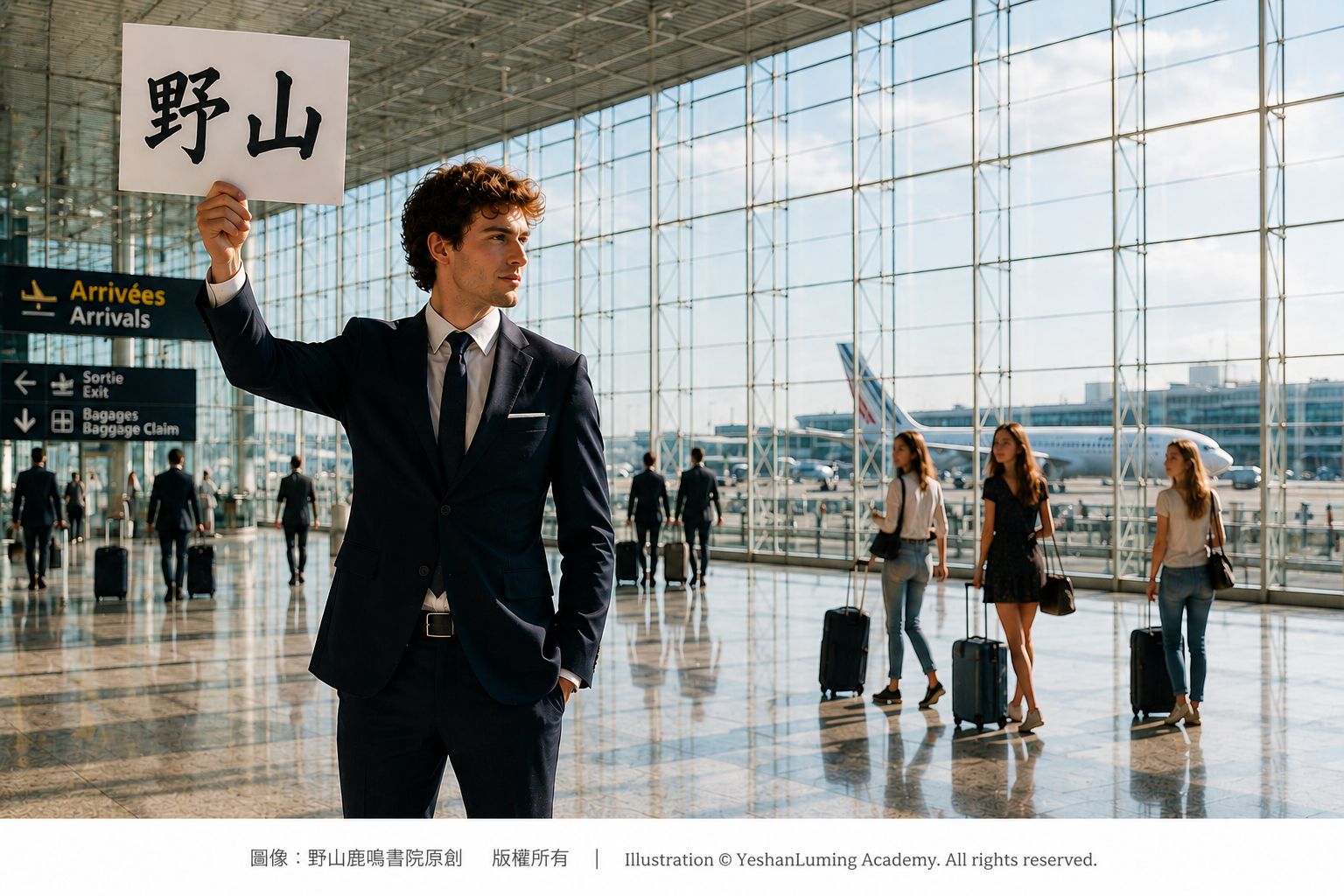
(全文完)After landing at Charles de Gaulle Airport in Paris and picking up my luggage, I noticed someone holding up a large sign with two bold Chinese characters: “野山”.
I found it strange, I hadn’t informed any of my French friends about this trip. Curious, I walked over for a closer look. The face looked oddly familiar, only much younger.
He was tall, strikingly handsome, impeccably dressed in a fine suit, with a pair of polished leather shoes so bright they almost hurt the eyes. His complexion was fair, his features sharp, his eyes lively and full of spirit. A head of curly blond hair framed his face, and the faint fuzz above his lip suggested he hadn’t started shaving regularly yet. A hundred percent heartthrob. Several young women nearby had already locked their eyes on him, unable to look away.
Then it clicked. This had to be old Brown’s son. The resemblance was uncanny, as if the old man had been replicated in a younger mold.
He was even taller than his father, which made me, at 185 centimeters, feel almost short. I knew Brown and his wife were both tall, and I had heard they had an only son, though we had never met.After landing at Charles de Gaulle Airport in Paris and picking up my luggage, I noticed someone holding up a large sign with two bold Chinese characters: “野山”.
I found it strange, I hadn’t informed any of my French friends about this trip. Curious, I walked over for a closer look. The face looked oddly familiar, only much younger.
He was tall, strikingly handsome, impeccably dressed in a fine suit, with a pair of polished leather shoes so bright they almost hurt the eyes. His complexion was fair, his features sharp, his eyes lively and full of spirit. A head of curly blond hair framed his face, and the faint fuzz above his lip suggested he hadn’t started shaving regularly yet. A hundred percent heartthrob. Several young women nearby had already locked their eyes on him, unable to look away.
Then it clicked. This had to be old Brown’s son. The resemblance was uncanny, as if the old man had been replicated in a younger mold.
He was even taller than his father, which made me, at 185 centimeters, feel almost short. I knew Brown and his wife were both tall, and I had heard they had an only son, though we had never met.
“You are Brown Junior?” I asked.
He smiled. “Yes, Uncle Ye. My father asked me to meet you here today and drive you to Brussels.”
So that was it. Before leaving, I had sent my itinerary to old Brown. He was the only one who knew my schedule. Still, I hadn’t expected him to send his son driving over two hundred miles just to pick me up in France. That was thoughtful, even by his standards.
I had first met Brown at a jewelry trade show in the Hilton Hotel in New York. Our booths had been side by side. He was a Belgian jeweler, and his company had a rather poetic name, September Gems, “九月寶石”. One of those names you remember instantly. His business dealt in the import and export of various gemstones and semi-precious materials.
Brown was a natural linguist. His native language was German, but he also spoke French, Flemish, and English fluently. Even in Chinese, he could stumble out quite a few words, always at just the right moment.
Aside from being the owner of September Gems, Brown had another identity. He was a member of the Central Executive Committee of the Belgian Communist Party. Belgium, being a multi-party country, allowed open political participation, and the Communist Party competed like any other, seeking seats through elections.
After we became acquainted, Brown asked whether I knew any companies or individuals in China who might be interested in importing gemstone materials. I told him to give me his company information and said I would see what I could do.
Not long after, he called me internationally to thank me. Several import-export companies in Beijing, Tianjin, and Guangzhou had written to him, expressing interest in visiting Belgium to discuss business.
About a month later, I was woken in the middle of the night by another international call. It was Brown again. This time he invited me to Belgium to attend his father-in-law’s hundredth birthday celebration. The old man was Chinese, married to a Belgian woman, and apparently I was his only Chinese friend.
The timing happened to suit me. I had a week free and no fixed plans. I declined his offer to send me a plane ticket, saying I would be in Europe anyway.
Later I realized how cunning he was. The birthday celebration was real, but at the same time, two Chinese import-export delegations were scheduled to visit him in Belgium. Since I was there, and he was hosting everything at a five-star hotel, I naturally became his interpreter.
That deal made Brown a fortune. His raw stones, bought by the ton from Africa and South America, were sold to Chinese buyers by the kilogram. The profit margin was anything but modest.
Still, Brown had a certain code. Besides generous hospitality, he handed each visitor a five-hundred-dollar red envelope before departure, a habit he had picked up from his wife. Chinese people, he said, both loved to give and receive them.
Before I left, he handed me an envelope. I paused, wondering what he was up to this time.
Inside was a check for ten thousand dollars.
I burst out laughing. He laughed too. “Rules are rules. Ten percent commission.”
I pushed it back to him. “Keep it. Next time, you pay my travel expenses.”
Brown’s wife was a third-generation Chinese-Belgian. She spoke little Chinese, a typical BBC, Belgium Born Chinese.
Brown Junior drove the two-hundred-plus miles in under three hours. When we arrived, instead of going home, he took me straight to see the famous Manneken Pis statue, as if checking it off some essential list of national pride.
I had been to Belgium many times before. I had seen the statue every time. But I didn’t want to dampen the young man’s enthusiasm or his subtle attempt to show off a uniquely Belgian pride.
Belgium is far better known for Antwerp’s diamond industry and the Waterloo battlefield, not far from Brussels and NATO headquarters. Still, I played along, showing just the right amount of interest and appreciation. Brown Junior even assured me I could get the photos developed the next day, knowing how much Chinese visitors liked souvenirs.
There are many legends about the origin of the statue. My favorite is this:
A boy named Julien got up one night to relieve himself and noticed a burning fuse in a nearby building. The French army had planned to blow up the city with gunpowder. With no water in sight, the boy had an idea and urinated on the fuse, extinguishing it and saving the entire city. In gratitude, people later erected the statue in his honor.
By Chinese standards, the statue is nothing extraordinary. It can hardly compare to the countless street sculptures in Beijing—barbers, monkey trainers, sugar-blowers—that depict the city’s old traditions.
The next day, Brown took me to his warehouse, hoping I could help him promote a new batch of goods.
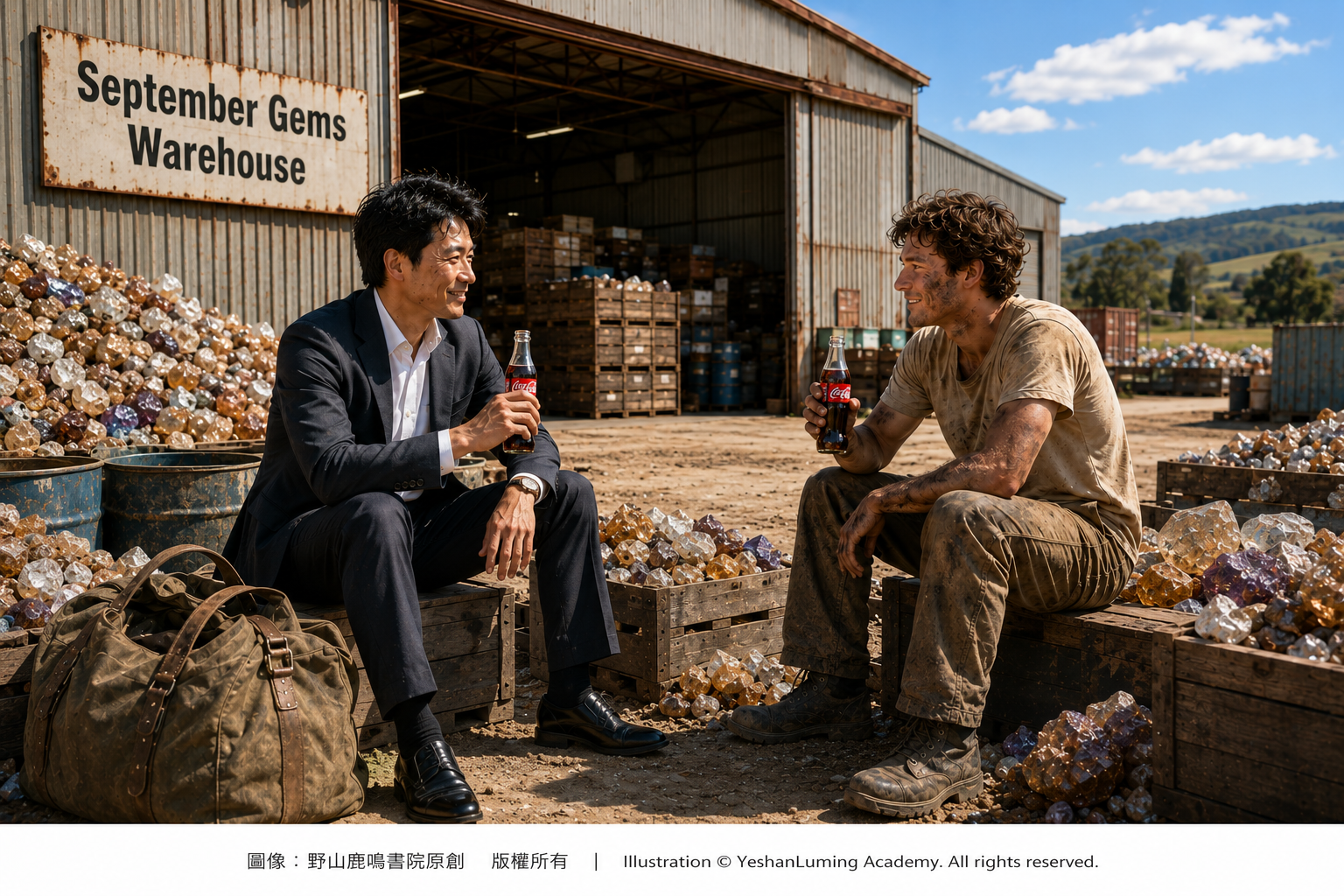
You would never imagine that a man in the gemstone business would have a warehouse that looked more like a construction yard. Piles of rough stones were stacked everywhere.
There I saw Brown Junior again. The contrast from the previous day was almost shocking. Gone was the polished young gentleman in a suit. He was shirtless under the blazing sun, working alongside laborers, sorting and grading piles of agate stones. Covered in dust and sweat, he looked even more worn out than the workers.
After inspecting the goods, I declined Brown’s invitation for coffee and told him I needed to pick out a few agate pieces for a friend. I said I would work with his son.
I was in Belgium mainly for the Brussels World Expo, but a friend in China had asked me to find agates containing water inclusions. Two such pieces from a previous shipment had been carved and sold at high prices.
Brown Junior helped me sift through a mountain of stones and picked out about a dozen. When I asked him how confident he was, he said, “Half, half.”
Seeing him drenched in sweat, still just a boy really, I felt a bit sorry for him. I handed him a cold can of Coke and told him to take a break.
圖像:野山鹿鳴書院原創Original Illustration by YeshanLuming Academy
點擊查看大圖 Click to enlarge
“Your father has only one son,” I asked. “How can he let you do such hard labor?”
Brown Junior smiled, reached into his back pocket, pulled out a small notebook, opened it, and began to read slowly, word by word:
“劳其体肤,”
I was surprised. How could this kid manage to throw out bits of Chinese like that? Had he inherited his father’s language genes?
I took the notebook and saw several lines written in both Chinese and English:
苦其心志,使他们的意志经历严峻的考验和困难。
Torment their determination:
Subject their will to severe tests and difficulties.
一年没有女孩。
No girls, one year.
劳其筋骨,使他们的身体到达极度劳累和疲惫的状态。
Exhaust their muscles and bones,
bring their body to a state of extreme tiredness and exhaustion.
在仓库工作三年,第一年全部时间,第二年一半时间,第三年四分之一时间。
Work at the warehouse for three years,
first year, 100 percent,
second year, 50 percent,
third year, 25 percent.
饿其体肤,令他们的身体承受饥饿,影响到皮肤和整体健康。
Starve their body and skin,
cause their body to endure hunger, affecting their skin and overall health.
一周不许吃饭。
No food for a week.
空乏其身,使他们的整个身体资源耗尽,陷入虚弱无力的状态。
Deplete their body, exhaust all the resources of their body, leaving them weak and powerless.
每周一天,不许吃饭。
Once a week, no food for a day.
There were more words. I copied and show them below:
钢铁是怎样炼成的?
钢铁是经过真火淬炼,千锤百炼,才炼成的。
How Is Steel Tempered?
Steel is forged only after being tempered in true fire and subjected to a thousand hammer blows.
I was stunned. This old Brown, he was clearly training his son as if he were preparing a future world leader.
“Is this really how your father raises you?” I asked. “Do you agree with it?”
Brown Junior grew serious. “At first, I didn’t understand. Now… I’m beginning to.”
“Not eating for a week? That’s pushing a person to the edge. That’s the limit of human endurance.”
He laughed. “It’s not that bad. When he says no food, he means sending me into the mountains to survive. I can choose three things to bring, just no food.”
“What did you take?”
“A hunting rifle, a knife, and matches.”
“That week was actually the happiest I’ve ever had. There’s an old hunter’s cabin in the forest where I could shelter. I wandered alone, hunted three rabbits and four grouse. I roasted them every day, couldn’t even finish the food. It was quite peaceful.”
“And one year without a girlfriend? You can handle that?”
“Only a few days left before liberation,” he said with a grin. “Actually, it’s been good. I’ve had time to think.”
That evening, Brown invited me to dinner. I brought up the notebook.
“Aren’t you being too harsh on your son?” I asked.
His expression turned serious.
“Look at young people today. Are they still worth saving? Marijuana, morphine, cocaine like soft drinks. Sexual liberation, promiscuity, group sex. Streets full of addicts, filthy, neither human nor ghost, yet calling themselves advanced, liberated, elite. If this continues, does the world have a future?”
He told me about his visit to China in 1964 with Jacques Grippa, chairman of the Belgian Communist Party, and his meeting with Mao Zedong.
Mao had agreed that different countries required different paths, that no one model could simply be copied.
Brown spoke of Mao with unmistakable admiration.
Then he took out a folder and a book. From the folder, he handed me a sheet of paper. I looked at it and couldn’t help but laugh.
孟子曰:“天将降大任于斯人也,必先苦其心志,劳其筋骨,饿其体肤,空乏其身,行拂乱其所为,所以动心忍性,曾益其所不能。”
Below it were explanations in English and Flemish, identical to what I had seen in his son’s notebook.
He told me a Chinese student in Belgium had helped him translate it.
“You Chinese think deeply,” he said. “I believe in Mencius completely. If a man is to succeed, he must first endure hardship. He must know hunger. That is the beginning of maturity.”
He paused, then added, “Your Chairman Mao sent his own son to the countryside to work with peasants, even to war in Korea. Unfortunately, he was killed by American bombing. Otherwise, he would have become an extraordinary man.”
“If Mao’s son was raised like that, then my son must be too.”
He handed me the book. It was the English edition of How the Steel Was Tempered.
“This is one of my favorite novels,” he said. “Pavel Korchagin is a role model. A man is like steel. Without hardship, without countless trials, he cannot be forged.”
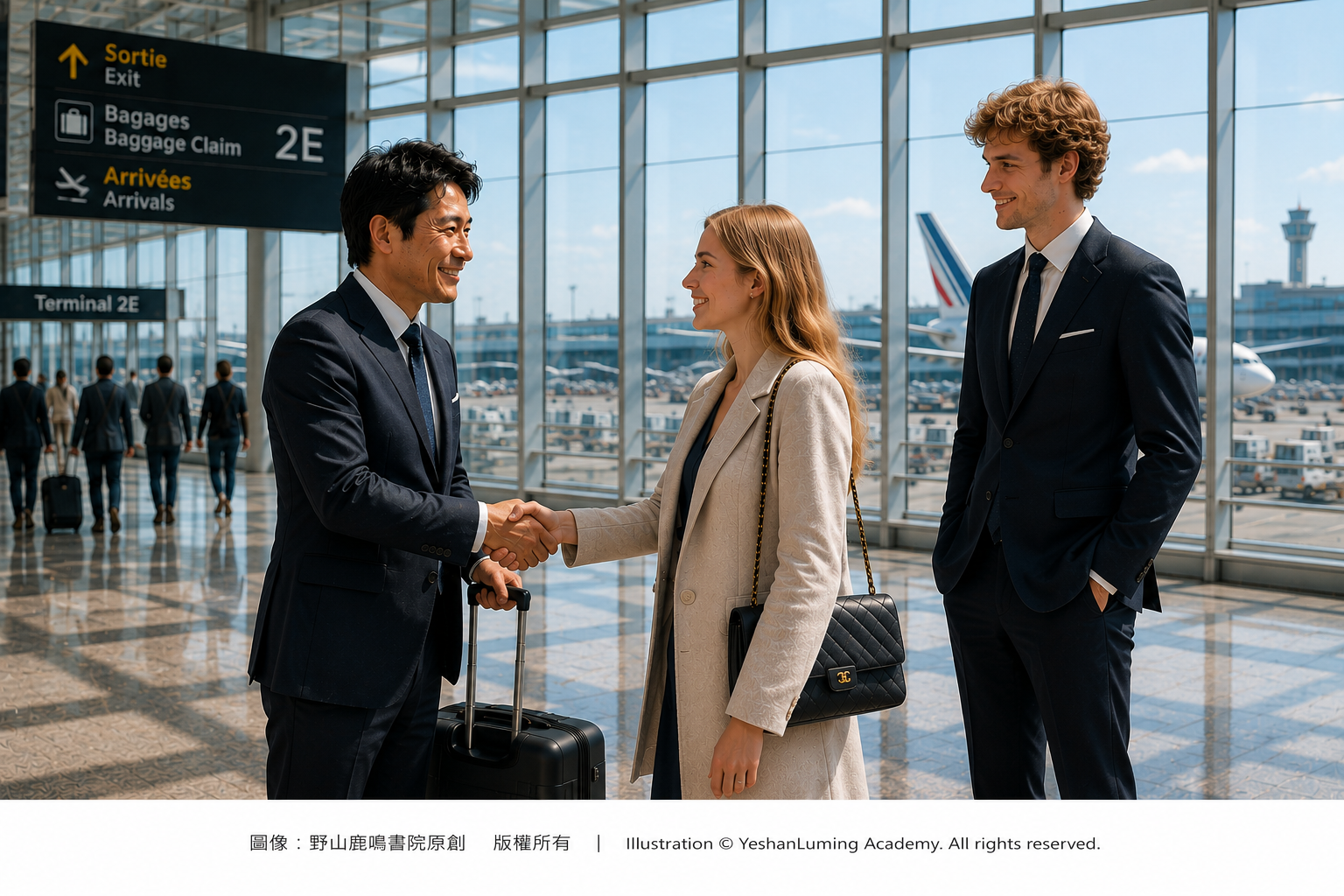
After the World Expo in Brussels ended, Brown Junior drove me to the airport. Once again, he was dressed in a suit.
This time, a tall, beautiful blonde girl stood beside him.
As we said goodbye, I told him, “Young man, you are lucky. You have a good father.”
He nodded.
Out of courtesy, I shook hands with the girl as well.
I asked, “And this is…?”
He smiled.
“This is… one year later.”
We both burst into laughter.
圖像:野山鹿鳴書院原創Original Illustration by YeshanLuming Academy